George Orwell’s 1984 divides the world into three parts: Oceania, Eurasia, Eastasia. Donald Trump, Xi Jinping and Vladimir Putin might be doing their best to realize Orwell’s vision, but we’re not there yet.
Skip to content

Commentary
Carmichael: Canada doesn’t need more trade deals—it needs more traders
The best way to fight Trump’s trade policy is to focus on the home front
President Donald Trump, Prime Minister Justin Trudeau and Mexico's then-president Enrique Peña Nieto sign the USMCA trade deal to replace NAFTA in Buenos Aires, Argentina, on Nov. 30, 2018. Photo: AP Photo/Martin Mejia
George Orwell’s 1984 divides the world into three parts: Oceania, Eurasia, Eastasia. Donald Trump, Xi Jinping and Vladimir Putin might be doing their best to realize Orwell’s vision, but we’re not there yet.
The “one world” ethos of the World Trade Organization now looks like a blip, but economic gravity will ensure that adventurous people will continue to exchange goods and services with one another—it’s just that national politics will make this exchange suboptimal. “There will be shocks,” said Marc Gilbert, a managing director at Boston Consulting Group. “You need to have, we call it a ‘geopolitical muscle.’”
Canada could be among those that struggle the most.
Before the U.S. election, Boston Consulting finished a new map of global commerce. Gilbert and his colleagues have divided the world into six centres of economic gravity: “Stronghold North America;” a China that pivots to trade with fast-growing emerging markets; the European Union; India; the Association of Southeast Asian Nations bloc of countries; and the emerging markets that are sometimes loosely described as the “global south.”
Related Articles
It’s a more interesting world than the one Orwell envisioned. Alas, history isn’t over and the world could continue to shrink. In an interview late last week, Gilbert conceded that “Stronghold North America” wasn’t looking so safe for Canada and Mexico. Boston Consulting anticipated the U.S. and China would continue to part ways. They didn’t foresee the U.S. president going after his neighbours. “India, China pivot, global south, they’re all pretty much going to continue,” said Gilbert. “The one that is possibly going to change in direction is Stronghold North America.”
Mexico, a low-cost producer of goods, could pivot to other markets: Claudia Sheinbaum’s government signed an updated trade agreement with the European Union on Friday. Nothing beats the world’s biggest economy, but Mexico probably would be competitive enough to take advantage of everything that’s happening in other emerging markets.
There is reason to worry that Canada is entirely at Trump’s mercy. Gilbert reckons the energy, automobile parts, metals and chemicals industries have few options, if any. The U.S. buys almost all of Canada’s oil because the transportation infrastructure is north-south. Autoparts makers primarily are set up to supply the Detroit-based car-and-track companies. There might not be anywhere else for many Canadian companies to go.
Geography determines destiny, but so does ambition. Executives haven’t made working on their geopolitical muscles a priority. With the world’s most dynamic economy next door, why bother? “Trade and proximity go hand-in-hand,” said Duncan Munn, chief executive of Elevate Export Finance. “People will pursue the easiest strategy.”
Trade with the U.S. is no longer easy. Trump proved that during his first presidency, and now he’s back with a vengeance. After giving every indication throughout his inauguration that he had decided to put his tariff threats on pause, the president created more uncertainty late that evening, saying that he might impose import taxes on Canada and Mexico as early as Feb. 1.
“Here we are,” Goldy Hyder, head of the Business Council of Canada, told The Logic. “It’s not even been 12 hours.’
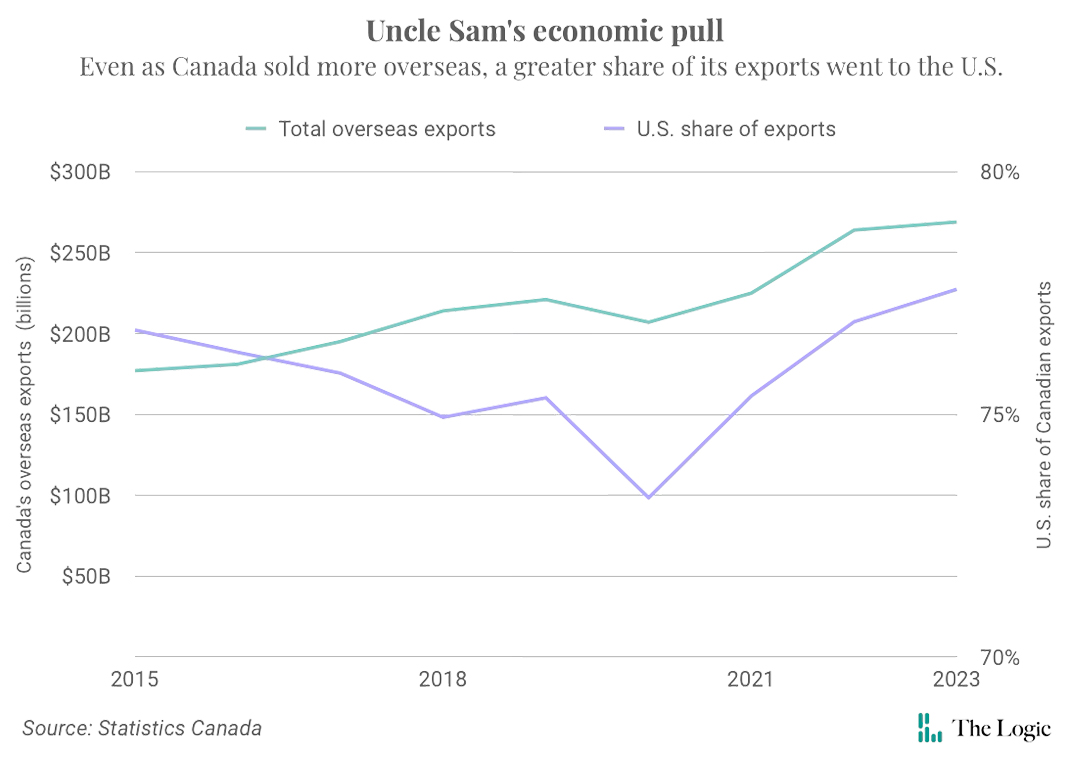
Canadian governments have tried for decades to coax companies to diversify, with little success. Some wonder if the Trump shock might finally force business leaders to take notice of the rest of the world. “Canadian businesses have a unique opportunity to reduce our near-suffocating reliance on the United States, and the coming years may be the very moment,” Randy Hoback, a Conservative member of Parliament from Saskatchewan and adviser to Conservative Leader Pierre Poilievre on Canada-U.S. relations, wrote on Substack last week.
The Economist recently documented how Sweden, Denmark, Norway and Finland have a knack for producing world-beating companies that’s disproportionate to their size. The article attributes the success in part to a Nordic desire to trade with places beyond the immediate geography.
You wonder if companies such as Lego, Ikea and Novo Nordisk would have tried so hard if they had a massive market like the U.S. next door. Nevertheless, the Nordic example shows that it can be done. Business leaders need to “double down” on trade diversification, said Munn, adding that he sees all sorts of opportunities in Brazil, Colombia and Chile, economies with significant energy, minerals and agriculture industries.
Hoback, who was first elected in 2008, said companies could make better use of all the help that the federal government provides, including the federal government’s multitude of trade commissioners. Firms could also build more “export capacity,” given the business case to build export terminals on the Pacific, Atlantic and Hudson Bay is much better now than it was a few months ago.
Maybe Hoback’s strongest point was his call for Canada to “get our house in order.” He suggested, correctly, that unproductive companies hampered by a thicket of regulation and inefficient tax policy will struggle to compete globally no matter how many trade agreements the government signs.
Hoback didn’t say what he’d do about the productivity crisis, although his boss, Poilievre, has been clear that he would cut taxes and regulation. That could help, but only if it’s done with some intention. Munn, former president of the C.D. Howe Institute, an economic policy think tank, said Canada has struggled to diversify its trade because it has too many smaller companies that lack the scale to do all that’s required to be competitive abroad.
In other words, Canada doesn’t need more trade deals, it needs more traders. Munn would overhaul tax policies that create incentives to stay small and implement a set of open-banking regulations, which would encourage competition in financial services. Breaking into new markets is risky and Canada’s big banks have little incentive to take such bets. But some hungry upstarts would.
There’s another reason that the best way to fight Trump’s trade policy might be focusing on the home front. The threat of tariffs is almost as scary as the actual thing. Most companies of any size have operations in the U.S. and they will be tempted to shift production south of the border so they can operate in peace.
“In my 80-some-odd conversations with CEOs and C-suites on this topic, unequivocally, the conclusion is, ‘My investment in the U.S. has always yielded a higher return,’” Gilbert said. “It’s poised to continue. If I’m investing in two places, it makes a lot of sense to deploy capital in the U.S.”
Most of the talk about the coming trade war is about retaliatory measures. Those might be tactically necessary, but to win, Canada will have to find a way to make returns on Canadian investments match American ones.
Kevin Carmichael is The Logic’s economics columnist and editor-at-large. He has spent more than two decades covering economics, business and finance for outlets including Bloomberg News, The Globe and Mail and the Financial Post, where he also served as editor-in-chief.



Loading...
Thanks for sharing!
You have shared 5 articles this month and reached the maximum amount of shares available.
CloseThis account has reached its share limit.
If you would like to purchase a sharing license please contact The Logic support at [email protected].
CloseGift the full article!
You have gifted 0 article(s) this month and have 5 remaining.
Recipients will be able to read the full text of the article after submitting their email address. They will not have access to other articles or subscriber benefits.
Photo: AP Photo/Martin Mejia
Most Popular This Week




In-depth, agenda-setting reporting
Great journalism delivered straight to your inbox.
Commentary
Carmichael: Being boxed in will help Canada focus on what matters
Briefing
Rio Tinto gets nearly $165M in additional federal funds for Quebec aluminum
U.S. to lift tariffs on some Canadian products crucial to Maine: Collins
Carney warns of tech dependence after Starlink disruptions in Ukraine
Best business newsletter in Canada
Get up to speed in minutes with insights and analysis on the most important stories of the day, every weekday.
Exclusive events
See the bigger picture with reporters and industry experts in subscriber-exclusive events.
Membership in The Logic Council
Membership provides access to our popular Slack channel, participation in subscriber surveys and invitations to exclusive events with our journalists and special guests.






