As prime minister, Conservative Leader Pierre Poilievre says he would fix the budget. But first, he would break it some more.
Skip to content


Commentary
Carmichael: Carney and Poilievre’s tax-cut promises are a major election distraction
The cost of living is an issue, but it’s no longer a crisis. Canadians must remain focused on the real emergency
Pierre Poilievre’s Conservatives and Mark Carney’s Liberals both kicked off this election campaign with promises of tax cuts. Photo: The Canadian Press/Adrian Wyld; Carney: The Canadian Press/Darryl Dyck
As prime minister, Conservative Leader Pierre Poilievre says he would fix the budget. But first, he would break it some more.
Poilievre began the election campaign with a pledge to drop the lowest marginal tax rate to 12.75 per cent from the current 15 per cent—a cut so large that it escaped the imagination of whoever designed the Parliamentary Budget Officer’s online tool for assessing the cost of tax changes. The slider only allows for changes of two percentage points in either direction. By swiping left to simulate a cut, you learn that Poilievre’s play for our affection would come at a cost of more than $12 billion a year. Unless a Conservative government cut spending by at least that much, it would add to a deficit that Poilievre has insisted is already too large.
Maybe promising to fix the budget is simply something you say to put distance between yourself and former prime minister Justin Trudeau’s notorious profligacy. Trudeau’s successor, Mark Carney, began his own campaign with a tax cut for the middle class, albeit one that would cost only $5.9 billion. He did so despite saying during the Liberal leadership campaign that he would balance the government’s operating budget within three years of taking power.
Makes you wonder how these guys rank their priorities. It also makes you wonder how we rank ours, and whether we’re ready for what’s coming.
Related Articles


Donald Trump is the campaign issue that everyone talks about, but the U.S. president’s belligerence isn’t necessarily the thing that every voter cares most about.
Leger’s most recent survey suggests the number of voters that rank dealing with the U.S. president as the top issue, and those who say their vote will be guided by who they think will change the country’s direction and “improve life for Canadians,” is roughly the same. Abacus Data’s polling for The Logic has found that about a third of the electorate thinks lower personal income taxes would help the economy. In an election where every vote counts, a bunch of tax-cut promises were inevitable.
Both Carney and Poilievre have said they would drop the consumer carbon tax, remove the federal sales tax from newly built homes and scrap the previous government’s plan to raise capital gains taxes—an increase that former finance minister Chrystia Freeland had described as necessary to keep the budget from busting through her fiscal guardrails.
Fussing about “relief” for middle-class taxpayers in the immediate aftermath of Trump’s latest bombing run will strike some of you as precious, given the stakes. But a relatively sturdy financial foundation is perhaps the one clear advantage Canada has over the U.S. in the short term. Washington has let its budget deficit balloon to about 7.5 per cent of potential gross domestic product, while Canada’s federal deficit is about one per cent, according to the International Monetary Fund.
That’s one of the reasons it costs the U.S. about 4.25 per cent to borrow over 10 years, more than a full percentage point higher than what Ottawa pays. Canada will almost certainly test the limits of its financial advantage in the months and years ahead, making governments’ fiscal room extremely precious. We don’t have the luxury to waste that space on feel-good measures. And yet that’s what those tax cuts represent: palliatives meant to soothe a public that has convinced itself it’s the victim of a terrible cost-of-living crisis.
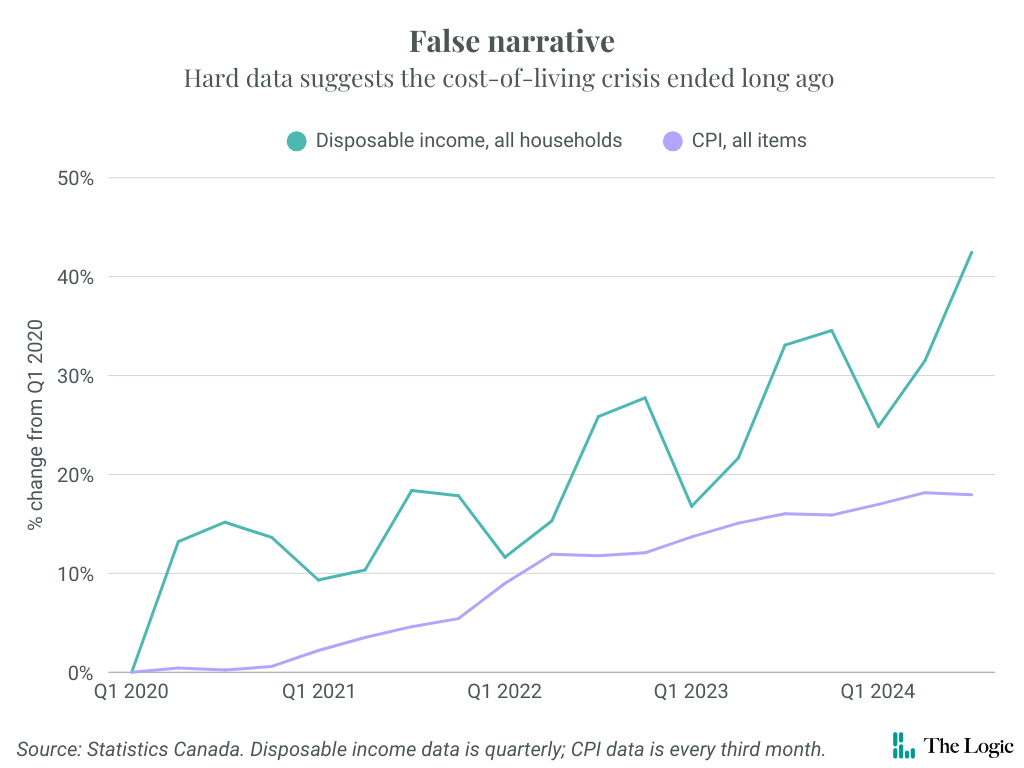
The inflation surge that followed the COVID-19 pandemic was a brutal shock. Plenty of people suffered, but fewer are suffering now. The disposable income of all households increased 42.5 per cent between the start of 2020 and the third quarter of 2024, according to the most recent Statistics Canada data available. The all-items consumer price index rose about 18 per cent over that period, and is 19 per cent higher now.
Aggregates often distort what most of us experience, so let’s go below the surface. The disposable income of people in the lowest quintile of household earnings increased 40.5 per cent of that period, while those in the second, third and fourth quintiles—that is, the middle class—rose 35.3 per cent, 39.3 per cent and 41.2 per cent, respectively.
The free-market economy worked: employers had to match a higher cost of living with higher wages, which have been rising faster than inflation since the later part of 2023. The next time you lament the cost of groceries (up 26 per cent since 2020) or rent (up 27 per cent), go back and check some old tax returns. You might find that you’re better off than you think.
Narratives matter. John Maynard Keynes identified the importance of “animal spirits,” and Nobel laureate Robert Shiller showed in his 2019 book Narrative Economics that stories can influence economic growth, like any other variable. Joel Flynn and Karthik Sastry, assistant professors of economics at Yale and Princeton, respectively, developed Shiller’s work last year using artificial intelligence to analyze the language of corporate conference calls and public filings to isolate the companies that were spinning optimistic tales, and those that were pessimistic about the future.
Flynn and Sastry found the happy storytellers increased hiring at a faster pace than would be expected based on their financial results. They also found that those firms didn’t ultimately achieve outsized stock gains or profits, suggesting their optimism was based on the stories they were telling themselves, rather than harder indicators about their prospects. The point is that stories drive behaviour, suggesting the “narratives introduced by policymakers have the potential for significant impact,” Flynn and Satry wrote in an article for the International Monetary Fund.
The cost of living is an issue, but it’s no longer a crisis. By continuing to treat it as such, we’re diverting attention from the country’s true challenge—and setting ourselves up for a very bad ending.
Kevin Carmichael is The Logic’s economics columnist and editor-at-large. He has spent more than two decades covering economics, business and finance for outlets including Bloomberg News, The Globe and Mail and the Financial Post, where he also served as editor-in-chief.



Loading...
Thanks for sharing!
You have shared 5 articles this month and reached the maximum amount of shares available.
CloseThis account has reached its share limit.
If you would like to purchase a sharing license please contact The Logic support at [email protected].
CloseGift the full article!
You have gifted 0 article(s) this month and have 5 remaining.
Recipients will be able to read the full text of the article after submitting their email address. They will not have access to other articles or subscriber benefits.
Photo: The Canadian Press/Adrian Wyld; Carney: The Canadian Press/Darryl Dyck
Most Popular This Week


In-depth, agenda-setting reporting
Great journalism delivered straight to your inbox.
The Big Read
The professor trying to make Canada a supercomputer superpower
Briefing
BMO, CIBC join cross-border blockchain experiment Project Agorá
Trade remains greatest ‘downside risk’ to Canada’s economic growth: Deloitte
AMD to acquire Radical Ventures-backed World Labs in US$8.2B deal
Best business newsletter in Canada
Get up to speed in minutes with insights and analysis on the most important stories of the day, every weekday.
Exclusive events
See the bigger picture with reporters and industry experts in subscriber-exclusive events.
Membership in The Logic Council
Membership provides access to our popular Slack channel, participation in subscriber surveys and invitations to exclusive events with our journalists and special guests.