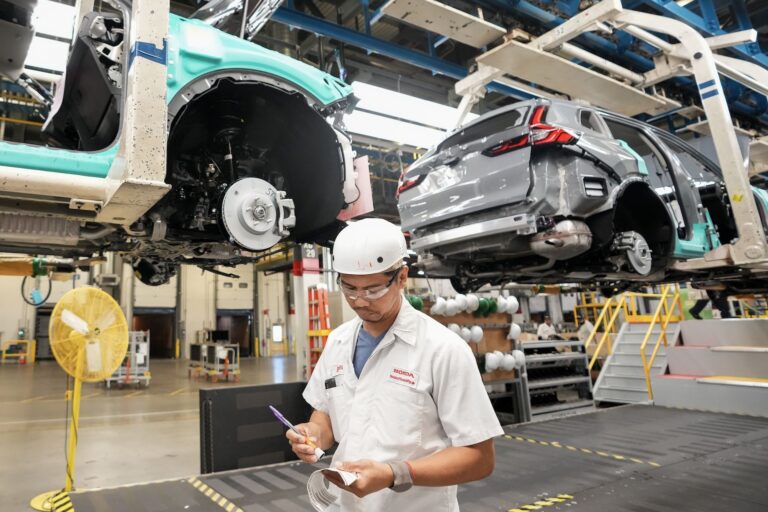
As the sun potentially sets on an era of north-south trade, Canada’s auto industry is looking east.
The White House has granted a 30-day tariff reprieve to automakers whose cars comply with the U.S.-Mexico-Canada trade agreement. But a lack of certainty in the wider auto industry, which includes parts makers that would be decimated by 25 per cent cost hikes, has many in the sector on the lookout for friendly trade partners.
One automotive powerhouse—Japan—has tentatively offered its friendship, and it’s an avenue many are eager to pursue.
A joint venture by Japan’s Mitsubishi and Ontario-based Frontier Lithium announced Tuesday it will spend hundreds of millions of dollars to build a lithium processing plant in the province. Japan’s consul-general to Toronto, Matsunaga Takeshi, said Canada and Japan share critical economic interests and a “design for the future,” reiterating the two countries’ memorandum of understanding of battery materials, and indicating that partnership is deepening.
“The international situation is becoming increasingly precarious. There are economic challenges galore looming over our heads,” Matsunaga said at the Toronto announcement. “In this challenging environment, the peoples of Japan and Canada are awakening to the truth of the two countries being true, persistent friends. We share fundamental values. We are bound by mutual respect.”
It was a welcome, if muted, overture at a time when Canada desperately needs trade allies. In the days leading up to the tariff deadline, Trent Mell, CEO of the Toronto-based battery metals firm Electra, highlighted Japan’s leadership in the stormy global trade environment at the Prospectors and Developers Association of Canada’s annual conference.
Mell’s company is partially funded by the U.S. Department of Defense, but much of its product is processed in Japan en route to one of its clients, the South Korean electronics giant LG. He does not foresee short-term tariffs unwinding the longstanding U.S.-Canada relationship, but said, “if you want to speculate on what the world may look like if alliances pivot a little bit—look, our product, Day 1, is going to Japan anyway.”
An interesting development, given that Japanese cars were once targets of Canada’s protectionist rhetoric and policies. Dimitry Anastakis, a professor at the University of Toronto who studies the history of the Canadian auto sector, noted that in the 1980s then-federal Industry Minister Ed Lumley targeted Japanese automakers with “a port blockade” to push them into investing in Canada.
The two countries worked it out. Honda and Toyota set up shop here soon after, and set about expanding. In 2023, Toyota and Honda were the top two auto producers in Ontario, respectively, and early estimates suggest they’ll account for two-thirds of Canadian production in 2024. Toyota alone employs about 8,500 Canadian workers, and J.D. Power rates production quality at both the Honda and Toyota plants among the world’s best.
The coming weeks will test whether the two countries’ partnership will stand the test of time. Japan fears it will be the next to face tariffs and faces its own nationalistic movements to block deals with Canadian companies like fuel station giant Couche-Tard.
Three weeks ago, with the Canada tariffs looming, Toyota Canada’s CEO, Cyril Dimitris, declared the company was here for the “long haul.” Spokesperson Michael Bouliane echoed him Tuesday in response to The Logic’s question about the future of Toyota’s Canadian plants, saying the company has “no plans to change our production within the foreseeable future” due to high demand for its vehicles.
Yet Bouliane added a note of caution: “This is still a highly fluid situation” he said, and Toyota will “work with our federal and provincial governments toward a sustainable solution.”
Honda declined to comment to The Logic on a Monday report that, due to tariffs, it was abandoning a plan to move Civic Hybrid production to Mexico and instead produce the model in Indiana. That vehicle was scheduled to be produced in both Indiana and Canada.
“The Honda Civic has been made in our auto plant in Alliston, Ont. since 1988 based on our long-standing approach to build products close to the customer,” wrote Ontario-based spokesperson Ken Chiu in an email. “We have the flexibility to produce products in each region based on customer needs and market conditions.”
On Wednesday, Honda Canada spokesperson, Laura Heasman, added: “We will take no immediate actions related to either our current manufacturing operations or future electrification plans in Canada.” The company is focused on protecting its operations and more than 4,000 manufacturing workers in Canada, Heasman said, adding, “we are confident we can pivot effectively.”
Read Shift—The Logic’s authoritative weekly newsletter on automotive technology industry news—for more; and if you know someone who should be reading it, they can sign up here.