By the end of next year, RetiSpec hopes to be screening people for incipient Alzheimer’s disease in unexpected places: optometrists’ offices.
Skip to content

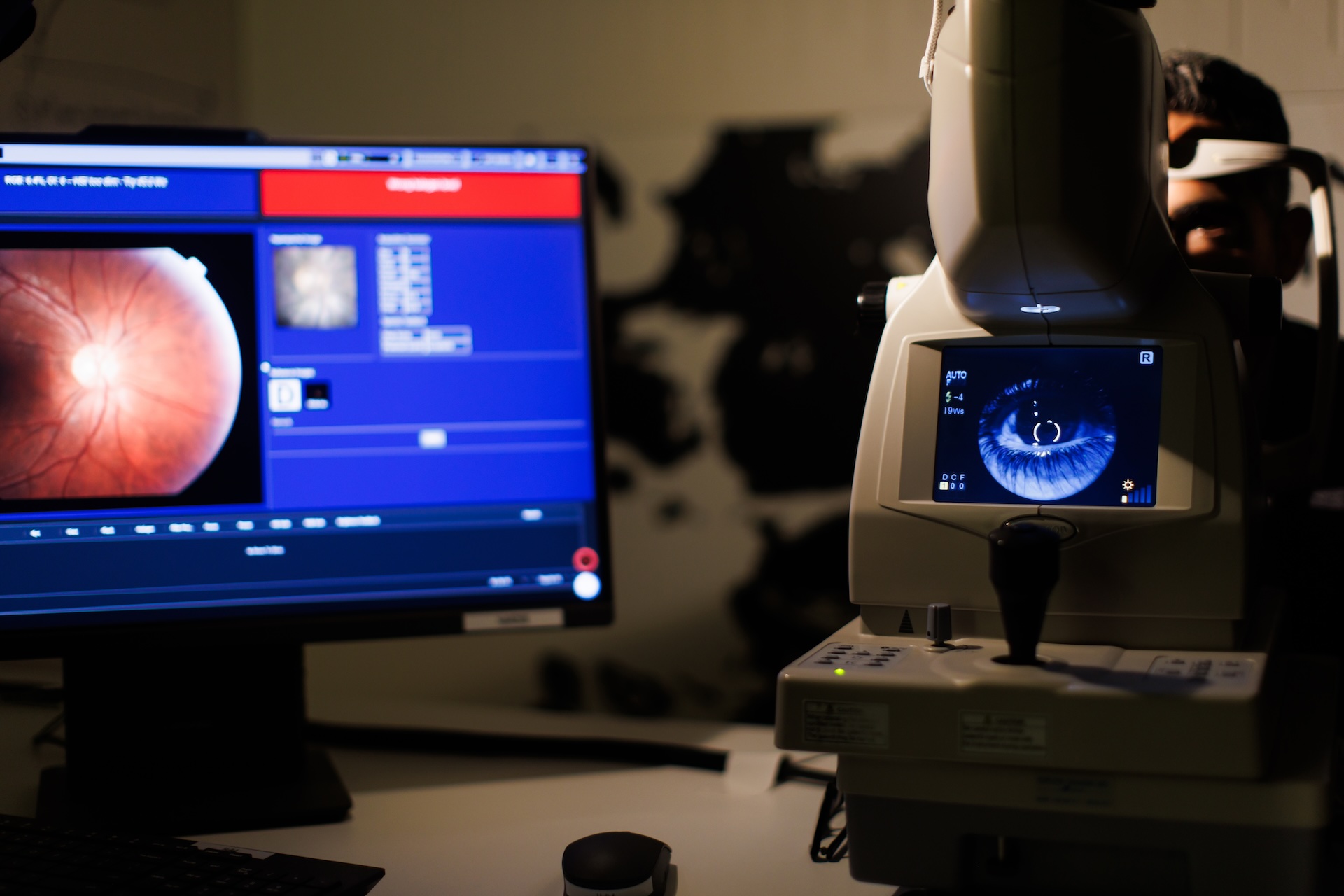 The eyeball of Eliav Shaked, the CEO of Retispec, appears on an optical imaging machine at the company’s office in Toronto, on August 28, 2024. Photo: Cole Burston for The Logic

News
Toronto’s RetiSpec pushes frontier of Alzheimer’s detection with retinal scan technology
Prospect of new treatments increases interest in novel ways to diagnose lethal illness early
RetiSpec CEO Eliav Shaked, with the company's retinal scanning equipment, in Toronto, on Aug. 28, 2024 Photo: Cole Burston for The Logic
By the end of next year, RetiSpec hopes to be screening people for incipient Alzheimer’s disease in unexpected places: optometrists’ offices.
The Toronto company is riding a wave of new research and investment in technology to diagnose the degenerative brain condition that’s behind most cases of dementia.
Talking Points
- Retinas and optic nerves are part of the nervous system, and the same toxic proteins that cause Alzheimer’s disease in the brain show up in the eyes as well—even before a patient starts showing any symptoms
- RetiSpec uses advanced lenses on ordinary equipment found in eye doctors’ offices to take images for artificial intelligence to scan for signs of those proteins
“The eyes of an Alzheimer’s patient are different than the eyes of non-Alzheimer’s individuals,” said Eliav Shaked, RetiSpec’s co-founder and chief executive. If you know how to look, you can spot deterioration in patients’ eyes before anything changes in their thinking.
Usually, the point of diagnosing an illness is to treat it, and until recently, Alzheimer’s had just a few treatments focused on specific symptoms. But with the approvals of new drugs, there’s new focus on identifying cases of Alzheimer’s early.
In late July, RetiSpec closed a US$10-million Series A funding round, led by iGan Partners, a Toronto-based venture capital firm specializing in health care. The round included Eli Lilly (which got U.S. approval earlier in July for a new drug for early-stage Alzheimer’s) and Topcon Healthcare (which makes optometry equipment, including retinal cameras).
RetiSpec was founded eight years ago and it’s been a slog. Shaked and cofounder Roy Kirshon are expatriate Israelis who left their “startup nation” for Canada in part because RetiSpec’s early work required brain tissue and eyes from people who had died with Alzheimer’s.
“Unfortunately, in Israel, to get access to human tissues is not possible unless you’re an academic institution, just because of the religious constraints related to Judaism,” Shaked said.
Related Articles

After the company moved to Toronto, the Ontario Brain Institute gave it $50,000 and helped get RetiSpec the tissues it needed.
Even so, the whole thing might have seemed like a fool’s errand.
“There’s no market for Alzheimer’s disease if there’s no drugs,” said Shaked. “So why would a VC invest in [something with] no market opportunities?”
Last year, the U.S. Food and Drug Administration approved one drug to treat early Alzheimer’s. This year it signed off on Eli Lilly’s. Now there’s money to be made.
RetiSpec’s technology takes finely detailed images of a patient’s retina, the structure at the back of the eye that detects light and sends the signals back to the brain. The image of the retina is fed to an algorithm trained on similar images from healthy and Alzheimer’s-afflicted people.
“Our secret sauce is not in the AI, it’s actually in the sensor,” Shaked said, patting an attachment on a standard optometrist’s retinal camera in RetiSpec’s office. Eye doctors routinely use the cameras to look for things like glaucoma and damaged optic nerves.
“We allow for the optometrist or ophthalmologist to review the regular image, but we capture an incredible amount of data in the back,” Shaked said.
The idea of looking for signs of Alzheimer’s in the retina isn’t new, or unique to RetiSpec.
Part of the illness is a buildup of “amyloid beta” proteins in brain tissue. The optic nerve and retina are linked parts of the nervous system, said Dr. Jean-Paul Soucy, director of the positron emission tomography (PET) unit at McGill University’s Montreal Neurological Institute-Hospital.
“When someone has Alzheimer’s disease, or a number of other neurodegenerative conditions, the retina is just as likely as other parts of the brain to be involved,” Soucy said.
PET scans, which involve injections of radioactive fluid and spending time in a large scanner that detects where the fluid accumulates, are the gold standard for diagnosing Alzheimer’s, but they’re expensive, rarely covered by public insurance for suspected Alzheimer’s, and hard to get even if you pay.
Testing cerebrospinal fluid for abnormal proteins is the other standard approach, but that takes a spinal tap—not as rare as a PET scan, but still not common, and many patients are reluctant.
Soucy said researchers are now looking for “biomarkers” in blood, urine, saliva or even tears.
“Any liquid that comes out, people are trying to see whether they can spot amyloid in there,” Soucy said.
RetiSpec isn’t even the only company in Canada applying AI to retinal scans, Soucy said, pointing to Montreal’s Optina Diagnostics. (Soucy has worked with Optina in the past, though he said no money changed hands.) Researchers at the University of Saskatchewan are working on it, too.
Some of RetiSpec’s published research indicates its screening isn’t perfect. In one trial, RetiSpec’s sensitivity (accuracy in identifying illness) was 80 per cent and its specificity (correctly identifying people with no illness) was 64 per cent.
It’s up against blood tests, which can be more than 95 per cent as good as PET scans, according to recent research. Soucy said he thinks those blood tests will become the norm.
Shaked said RetiSpec has been refining and adjusting and it has a paper awaiting publication showing results “comparable to emerging blood biomarkers.”
Where RetiSpec, or a company like it, might have an edge is in expanding its diagnostic capabilities beyond Alzheimer’s.
“We’re already underway with Parkinson’s,” Shaked said. That’s another brain disease caused by “pathological protein.” Retinal scans might also help with differential diagnoses—ruling out Alzheimer’s, for instance, in a patient with dementia symptoms but no amyloid buildup—and tracking disease progression and side effects of treatments, he added.
Health Canada hasn’t approved RetiSpec’s technology. Shaked said the new capital will help RetiSpec work with regulators in Canada and the United States and scale up production as it moves toward commercialization.



Loading...
Thanks for sharing!
You have shared 5 articles this month and reached the maximum amount of shares available.
CloseThis account has reached its share limit.
If you would like to purchase a sharing license please contact The Logic support at [email protected].
CloseGift the full article!
You have gifted 0 article(s) this month and have 5 remaining.
Recipients will be able to read the full text of the article after submitting their email address. They will not have access to other articles or subscriber benefits.
Photo: Cole Burston for The Logic
The eyeball of Eliav Shaked, the CEO of Retispec, appears on an optical imaging machine at the company’s office in Toronto, on August 28, 2024.
Most Popular This Week




In-depth, agenda-setting reporting
Great journalism delivered straight to your inbox.
The Big Read
Alberta’s referendum is just the start of the turmoil
Briefing
EverWind plans $10B data centre and wind development in Nova Scotia
Canada ready to force Stelco to sell its Canadian operations, Joly says
Feds plan a 60 MW defence-oriented data centre for Ottawa
Best business newsletter in Canada
Get up to speed in minutes with insights and analysis on the most important stories of the day, every weekday.
Exclusive events
See the bigger picture with reporters and industry experts in subscriber-exclusive events.
Membership in The Logic Council
Membership provides access to our popular Slack channel, participation in subscriber surveys and invitations to exclusive events with our journalists and special guests.






