Pierre Poilievre was five years old when Brian Mulroney’s Progressive Conservatives won the most seats ever in a federal election. Maybe that’s why his statement on the former prime minister’s death contained some revisionism. The Mulroney years are still too recent to have received thorough historical treatment. But after four decades, the details are beginning to get fuzzy.
Skip to content

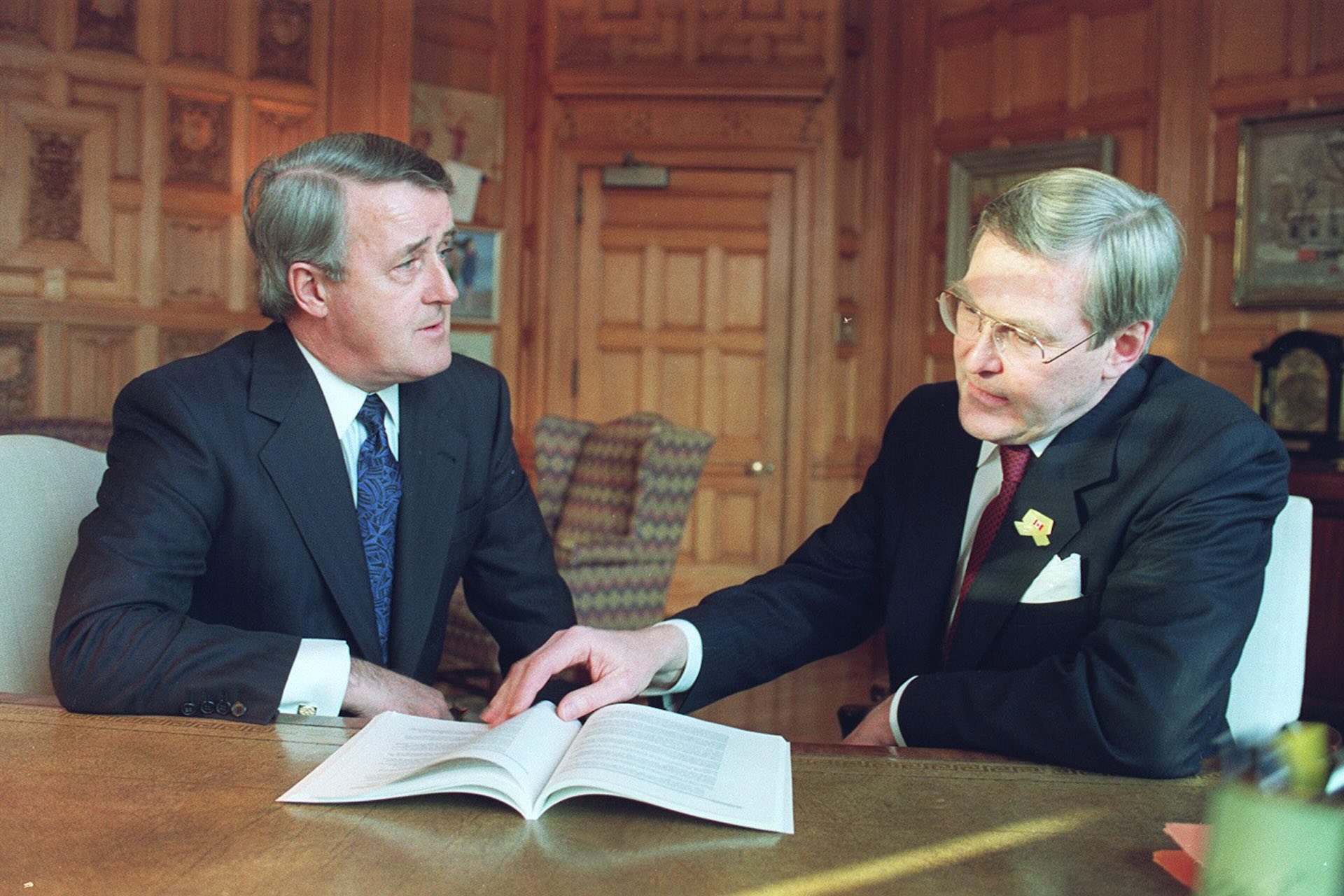 Mulroney and former finance minister Michael Wilson go over the budget in Ottawa in February 1991, the year that the GST was introduced. Photo: CP Photo/ Ron Poling

Commentary
Carmichael: What today’s leaders could learn from the Mulroney years
The late PM took heat for policies that served Canada’s economic interest, something his successors seem loath to do
Former prime minister Brian Mulroney in Ottawa in December 2016. Photo: The Canadian Press/Justin Tang
Pierre Poilievre was five years old when Brian Mulroney’s Progressive Conservatives won the most seats ever in a federal election. Maybe that’s why his statement on the former prime minister’s death contained some revisionism. The Mulroney years are still too recent to have received thorough historical treatment. But after four decades, the details are beginning to get fuzzy.
“It was the transformational change he brought to his nearly a decade as prime minister that is most important,” Poilievre wrote on X. “He unleashed free enterprise, crushed inflation, restored fiscal sanity and concluded one of the greatest free trade agreements the world has ever seen, which remains in place today.”
I was only 10 when Mulroney romped over John Turner’s Liberals and Ed Broadbent’s New Democratic Party in 1984. So, like the Opposition leader, my understanding of the Mulroney years is based mostly on what I’ve heard and read. Poilievre provided a good frame to assess how Mulroney changed the economy, but he exaggerated some things.
The free trade agreement with the United States definitely qualifies as transformational. It blew up the protectionist foundation on which the economy had been built, exposing previously coddled industries to competition and offering ambitious companies an opportunity to scale.
Easy access to the world’s largest economy probably dulled the incentive to look for trade opportunities elsewhere, as similar agreements with places such as the European Union, Chile and South Korea have done little to end Canada’s dependence on trade with America.
Related Articles

Economic gravity and the currents of history probably would have led to more liberalized trade no matter who was in power in the 1980s and 1990s. Still, Mulroney’s decision to embrace those forces, rather than fight them, introduced a period of creative destruction that the economy badly needed, although his political rivals enjoyed most of the rewards, as quarterly productivity growth averaged 0.4 per cent during Jean Chrétien’s and Paul Martin’s time in power, compared with 0.2 per cent during the Mulroney years.
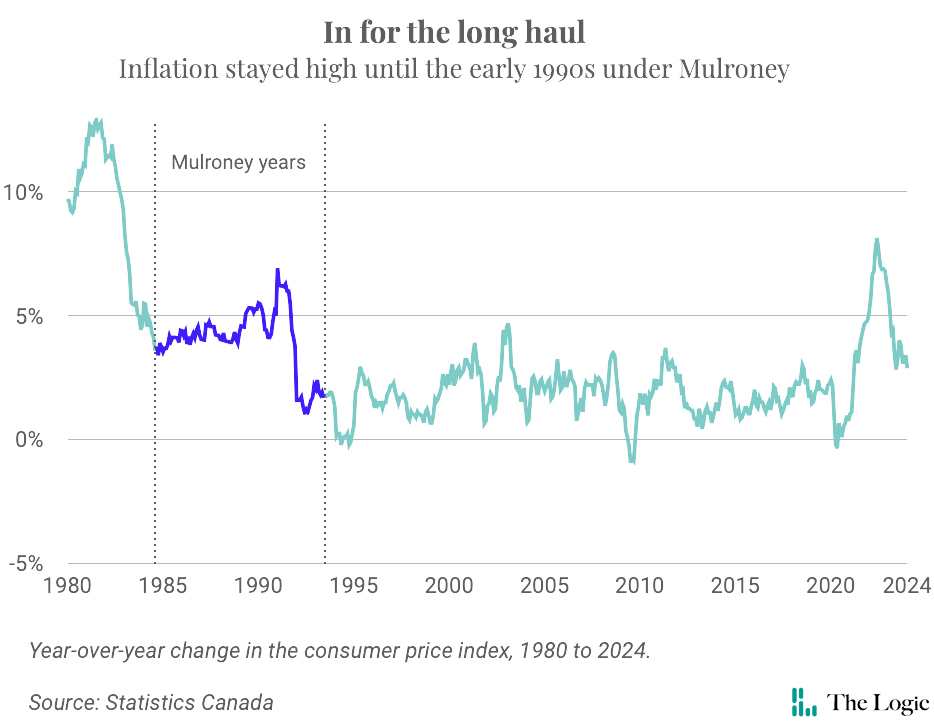
As for inflation, well, Mulroney didn’t exactly crush it. At least, not in the sense of a single stomp that quickly and violently brings a problem down to size. Price pressures were an issue for seven of the nine years Mulroney was on watch, and might have persisted for the duration if not for aggressive monetary policy and a recession between the springs of 1990 and 1992.
The consumer price index was growing at a year-over-year rate of 3.7 per cent when Mulroney came to power and never went much lower than that until 1992. Inflation peaked at 6.9 per cent in early 1991—just as the Bank of Canada began implementing a new approach to monetary policy called inflation targeting, under which a central bank independently sets interest rates at whatever level it deems appropriate to keep inflation at a specified rate.
The Bank of Canada tends to get the credit for inflation targeting, which eventually contributed to an extraordinarily long period of price stability. But Mulroney and his longest serving finance minister, the late Michael Wilson, had to endorse the project—and the Conservatives had to remain resolute in their support of the central bank, even as opposition politicians channeled the public’s frustration with higher interest rates and rising unemployment to their advantage.
Mulroney resigned as leader of the PCs in June 1993. Kim Campbell replaced him, and led the Conservatives to the worst defeat in history. If the Tories were tempted to make the central bank the scapegoat, they never went there. Bottom line: crushing inflation is hard. It requires implementing good policy and sticking with it, even when doing so could come at the expense of your job.
Free trade stands out as perhaps Mulroney’s greatest accomplishment because it was a choice—the economy would have muddled along without it. He weighed the opportunity cost of sticking with the status quo and opted to go for it.
But when it came to fiscal policy, Mulroney and Wilson struggled to work up the courage to move the needle. In nominal terms, the deficit was as big at the end of the Conservatives’ time in power as it was at the beginning.
“While generally aligned with the values of [Ronald] Reagan and [Margaret] Thatcher during the Cold War, that government turned out to be surprisingly tepid toward conservative economic reform,” former Conservative prime minister Stephen Harper wrote in his 2018 book Right Here, Right Now. “Its privatization and deregulation agendas were slow and wary. A timid approach to deficit reduction—limited spending restraint and modest tax increases—proved generally ineffectual.”
The GST didn’t feel timid at the time. It was an economist’s dream because consumption taxes are applied widely and therefore tend not to distort behaviour. And because consumption taxes are applied widely, they are a politician’s nightmare. The GST was a good policy, but that didn’t stop Harper from cutting it to five per cent from seven per cent.
Revenue from an efficient tax would be helpful, given the current system is a mess, and coping with everything from climate change to an aging population to geopolitical rivalry is going to cost money.
The price that Justin Trudeau put on carbon is such a tax, but Poilievre has vowed to axe it if he becomes prime minister. Mulroney’s economic legacy is ultimately about risking political backlash to enact policies that serve the country’s long-term interests. The politicians eulogizing him this weekend ought to keep that in mind.
Kevin Carmichael is The Logic’s economics columnist and editor-at-large. He has spent more than two decades covering economics, business and finance for outlets including Bloomberg News, The Globe and Mail and the Financial Post, where he also served as editor-in-chief.



Loading...
Thanks for sharing!
You have shared 5 articles this month and reached the maximum amount of shares available.
CloseThis account has reached its share limit.
If you would like to purchase a sharing license please contact The Logic support at [email protected].
CloseGift the full article!
You have gifted 0 article(s) this month and have 5 remaining.
Recipients will be able to read the full text of the article after submitting their email address. They will not have access to other articles or subscriber benefits.
Photo: The Canadian Press/Justin Tang
Mulroney and former finance minister Michael Wilson go over the budget in Ottawa in February 1991, the year that the GST was introduced.
Most Popular This Week


In-depth, agenda-setting reporting
Great journalism delivered straight to your inbox.
News
The Maple 8’s Canadian pledges may do little for startups and scaleups
Briefing
Trade remains greatest ‘downside risk’ to Canada’s economic growth: Deloitte
AMD to acquire Radical Ventures-backed World Labs in US$8.2B deal
Stelco to idle part of Hamilton steel plant for firm’s ‘survival’ amid U.S. tariffs
Best business newsletter in Canada
Get up to speed in minutes with insights and analysis on the most important stories of the day, every weekday.
Exclusive events
See the bigger picture with reporters and industry experts in subscriber-exclusive events.
Membership in The Logic Council
Membership provides access to our popular Slack channel, participation in subscriber surveys and invitations to exclusive events with our journalists and special guests.