OTTAWA — On a Tuesday morning last November, Dr. Robert Fahed of the Ottawa Hospital slid a camera into a major blood vessel feeding a patient’s brain and saw something nobody ever had before.
Skip to content

 Vena Medical founders Michael Phillips, left, and Phillip Cooper, right. Photo: Vena Medical/Handout
 Dr. Robert Fahed of the Ottawa Hospital with Vena Medical’s blood-vessel camera. Photo: Vena Medical | Screenshot

The Big Read
Waterloo undergrad project became $9M startup that sends cameras into human brains
Two engineering students, fibre optics, talent, drive and connections combine for possible breakthrough in stroke treatment
Dr. Robert Fahed of the Ottawa Hospital demonstrates Vena Medical’s blood-vessel camera, which is one-third of a millimetre wide. Photo: Vena Medical | Screenshot
OTTAWA — On a Tuesday morning last November, Dr. Robert Fahed of the Ottawa Hospital slid a camera into a major blood vessel feeding a patient’s brain and saw something nobody ever had before.
Talking Points
- A tiny camera that began as an undergraduate project for two friends in the University of Waterloo’s engineering program gives doctors treating strokes the ability for the first time to see the blockages and damage in blood vessels
- Getting Vena Medical’s innovation from kitchen-table chatter to a scope inserted into a patient’s head last November took seven years and a combination of drive, talent, connections and luck
“I felt like the first guy who ever walked on the moon,” said Fahed. “For the very first time in the world, [someone] saw the inside of the brain vessels of a patient who was alive and undergoing the procedure, and it felt amazing.”
Also among the crowd in the room: Phillip Cooper and Michael Phillips, who had invented the device in Fahed’s hands: a camera, one-third of a millimetre across, on the end of a guiding tube.
“We were white-knuckled the entire time,” Phillips told The Logic.
Seven years before, the device had been just an idea, one among several the two were batting around as undergraduate students in mechanical engineering at the University of Waterloo.
It took drive, talent, connections and luck. Just getting approval to build a prototype for school had been difficult. They had been through incubator and accelerator programs, refined their technology, raised capital, tested in animals, refined some more, finally received approval from Health Canada for a test in a person.
At last, here their scope was, feeding full-colour images from inside that person’s head.
Related Articles

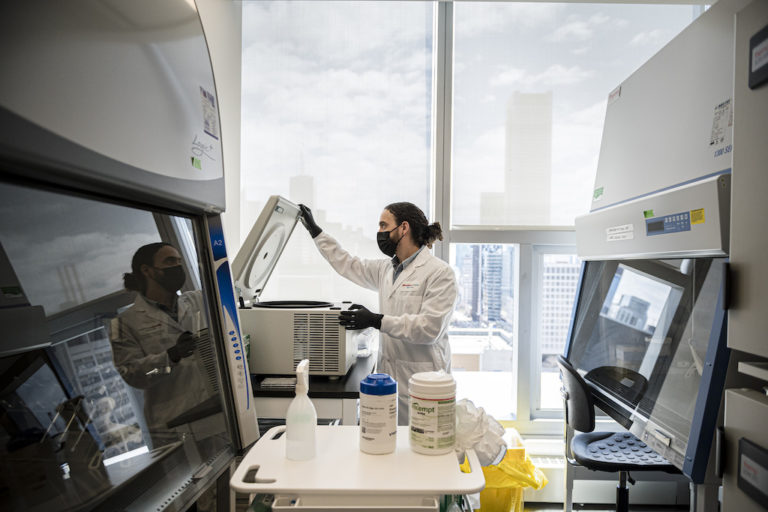
Fahed, an interventional neuroradiologist, treats victims of strokes. The man on the table in Ottawa was only in his 40s but had suffered several. None had been devastating, said Fahed, but “it’s like Russian roulette—you’re always afraid that the next one’s going to be the big one.”
Doctors could tell the man’s problem was in an internal carotid artery (one of a pair of major blood vessels that run deep into the brain), but not what it was. The correct treatment could be anything from drugs to major brain surgery. Only by seeing the inside of the artery could Fahed know for sure.
Hunting the causes of strokes has been done in much the same way for decades, Fahed said: a doctor like him injects special dye into the patient’s bloodstream and uses an X-ray to see where the blood is flowing normally and where it isn’t.
“We would see a cutoff in the progression of the dye, but we would not see what exactly is blocking the vessel,” he said.
The cause could be one of multiple types of clot, damage to the blood-vessel wall, an accumulation of plaque, or something else. Each cause demands a different treatment. Without knowing what exactly is causing a blockage, doctors have had to make educated guesses.
“Because we can’t visualize them, we try one technique and then another. It’s hit or miss,” he said. All the while, the patient’s brain is in danger.
Cooper and Phillips are the sons of four doctors, a pair who glommed onto each other in a tough linear-algebra course in their first weeks of university. Cooper wanted to design airplanes and Phillips cars—dreams that would wither during co-op placements. Over the next few years, the two became regular class partners, friends and roommates.
Cooper’s father is the same kind of specialist as Fahed, and had said for years that he wished he had a tiny camera that could see inside tiny blood vessels.
“He was telling me as early as second year and I never really listened to him,” Cooper said. “It sounded complicated, I wasn’t super interested. He just kept telling us and that kind of bubbled up as one of the key problems that we were kicking around in third year as we were thinking about our fourth-year project.”
The finalist ideas were the blood-vessel camera and a solar-powered kiln for drying wood. What helped make up their minds was a talk on campus by Chamath Palihapitiya, a Waterloo graduate turned tech maven turned venture capitalist.
“You may as well do the hard thing, the big thing that has a bigger opportunity,” Phillips recalls Palihapitiya saying, “because it’s going to suck just as much out of you.”
They ruminated on that for a couple of days before something clicked in Phillips’s mind.
“I remember walking back from class and I was just banging on Phil’s door. I said, ‘Hey, we’re doing it. We’re going to do the hard thing. Let’s do the tiny camera. We’re going to figure it out. Even if we fail miserably halfway through the term or something, we’ll regret it if we don’t try it,’” Phillips said.
They persuaded their department to let them work as a pair rather than the more usual foursome; they weren’t sure other classmates would share their drive or entrepreneurial imaginings, and were already thinking about the intellectual property rights. They also needed permission for a project with a budget of $15,000 instead of the more usual $500 to $1,000.
“I certainly was not thinking of myself as an entrepreneur at that point … We were just, you know, stumbling around, trying to figure things out.”
The device they produced used fibre optics—adapted from telecom—for a camera two millimetres across that could see about a millimetre forward.
“We were able to see through blood with infrared light which is very, very difficult to do,” Phillips said. They got their degrees, and a patent application.
Besides graduating, the duo had set themselves two goals.
Could they make a device that could fit into a blood vessel and produce useful images?
And could they win one of two $50,000 prizes at Waterloo—sponsored by Palihapitiya—for capstone undergraduate projects with commercial potential?
If they achieved either, Cooper and Phillips agreed, they would go into business. They managed both, and Vena Medical was born.
“I certainly was not thinking of myself as an entrepreneur at that point. I still don’t love that word,” said Cooper. “We were just, you know, stumbling around, trying to figure things out.”
Cooper and Phillips wanted to make their camera smaller and to switch from infrared to regular light, for clearer pictures.
The University of Waterloo took Vena Medical into its Velocity program, giving the team office and lab space. By fall 2017, the firm had been accepted to an accelerator in Houston, called TMCx, associated with a major hospital cluster. There, they caught the attention of Dr. Billy Cohn, a legendary cowboy-boot-wearing, trombone-playing cardiothoracic surgeon and medical-device developer who’s been a pioneer in artificial hearts.
“He saw a prototype and said, ‘Hey, I have an animal study in two weeks. Can you guys be ready to do an animal study and get your first images inside of a living animal?’ We were kind of taken aback but we were excited. So we said yes, obviously,” Phillips said.
Cohn arranged to test the camera, now a full-colour version, in an operating-room environment at a Texas Heart Institute research centre, as an add-on to his own experiment with an artificial blood pump. About 15 people were present to see Cohn feed the scope into the leg of an anesthetized calf.
“When they saw the first images, they saw the video from our camera, everybody was silent,” Phillips said.
Phillips and Cooper used the video to apply to Y Combinator and were in San Francisco by January 2018. There, they built business skills and prepared for one of the accelerator’s vaunted investor “Demo Days.” They still sometimes repeat the kind of work-sprint that took.
“Now that we can finally see, everything needs to be re-explored. Everything needs to be re-understood.”
Y Combinator helped Vena Medical raise money from angel investors, he said—about $1 million, added to the roughly $300,000 in grants it had put together—and connected Cooper and Phillips to medtech entrepreneurs.
One of those, Maria Aboytes, had co-founded a company called Medina Medical, which had been acquired a few years earlier for US$150 million. Medina had developed technology for treating cerebral aneurysms, weak spots in brain blood vessels that can burst into devastating hemorrhages.
“She was really excited about this, especially for the neurovascular space—looking at the neck up,” said Phillips. That focused their thinking.
The next stages of development took years. They experimented with different sorts of wires and tubes to mount their cameras on, needing to optimize small size, flexibility and a physician’s ability to direct the thing through a maze of blood vessels.
Vena Medical believed its scope was ready for a live test in early 2023. Fahed, an acquaintance of Cooper’s father, soon identified a patient and went to the hospital and Health Canada for special authorization to use the device on him.
“A CT scan had shown a blockage in one of the major arteries of [his] brain. But despite numerous CT scans, MRIs, ultrasounds, et cetera, no radiological technique and no radiologist was able to determine what kind of obstacle it was,” said Fahed.
Getting approval from the Ottawa Hospital and Health Canada took two to three months, and then arranging the operation took a further five, including giving the patient time to think over a procedure that had never been done on anybody before. Vena Medical spent the time fabricating, sterilizing and testing the actual device Fahed would use.
On Nov. 14, the man came in for the procedure. Fahed said it could have been done under mild sedation, but the patient chose to be put under because he was nervous.
Cooper and Phillips were there, as experts on the scope itself, along with Vena’s medical advisers, who had used it in animal studies. Cooper’s father, the doctor whose problem they had set out to solve, was present too.
Fahed fed the scope in through the patient’s neck. The internal carotid artery is a relatively large blood vessel—three to four millimetres across—but no scope had ever been small enough to enter it safely.
“I knew that we were at the first chapter of a complete new era for all of cerebrovascular disease because now that we can finally see, everything needs to be re-explored. Everything needs to be re-understood. Everything needs to be re-defined,” Fahed said.
(His enthusiasm is strictly medical, Fahed said, and he has zero financial stake in Vena Medical or its work.)
Upon seeing the inside of the man’s internal carotid artery on a screen, Fahed determined he needed a stent to hold the vessel walls apart, and slid one in.
“The patient was discharged 24 hours later, has been feeling great since then, hasn’t had a single stroke,” he said.
Two more people, both in Edmonton, have since been treated using Vena Medical’s scope, and Health Canada has authorized Fahed and the Ottawa Hospital to use it in more cases, which he said is “a great honour.”
The next steps will be to have doctors use the scope in more Canadian hospitals, and then abroad. Full approval from Health Canada for the angioscope will take “dozens to hundreds of patients” treated successfully and with no adverse events, Fahed said. For Vena Medical, formal peer-reviewed studies will be needed to support widespread use. The big prize will be approval in the United States, Phillips said.
The company still has just seven employees, counting Phillips and Cooper, a number that varies a little depending on how many co-op students they have. It has raised about $9 million so far.
“We’re a startup so we’re always raising money,” Phillips said.
To Fahed, Vena Medical’s product is already a success.
“It’s a major breakthrough,” he said. “It’s going to benefit every area of care that is related to conditions involving the brain. So the repercussions, the consequences, are huge.”



Loading...
Thanks for sharing!
You have shared 5 articles this month and reached the maximum amount of shares available.
CloseThis account has reached its share limit.
If you would like to purchase a sharing license please contact The Logic support at [email protected].
CloseGift the full article!
You have gifted 0 article(s) this month and have 5 remaining.
Recipients will be able to read the full text of the article after submitting their email address. They will not have access to other articles or subscriber benefits.
Photo: Vena Medical | Screenshot
Vena Medical founders Michael Phillips, left, and Phillip Cooper, right.
Dr. Robert Fahed of the Ottawa Hospital with Vena Medical’s blood-vessel camera.
Most Popular This Week


In-depth, agenda-setting reporting
Great journalism delivered straight to your inbox.
Commentary
Carmichael: Canada’s culture of risk aversion has created an economic doom loop
Briefing
TC Energy says North American natural gas demand is growing much faster than previously expected
Mississauga imposes data centre pause, as Toronto councillors scrutinize local projects
A third of Canadian workers are using generative AI, but not for everything
Best business newsletter in Canada
Get up to speed in minutes with insights and analysis on the most important stories of the day, every weekday.
Exclusive events
See the bigger picture with reporters and industry experts in subscriber-exclusive events.
Membership in The Logic Council
Membership provides access to our popular Slack channel, participation in subscriber surveys and invitations to exclusive events with our journalists and special guests.