Third-generation apple grower Kirk Kemp has been on the farm for over four decades. Now president of Algoma Orchards near Oshawa, Ont., his nearly 1.7 million trees supply major Canadian supermarkets. But apart from his two sons, he only has one Canadian-born full-time employee.
Skip to content

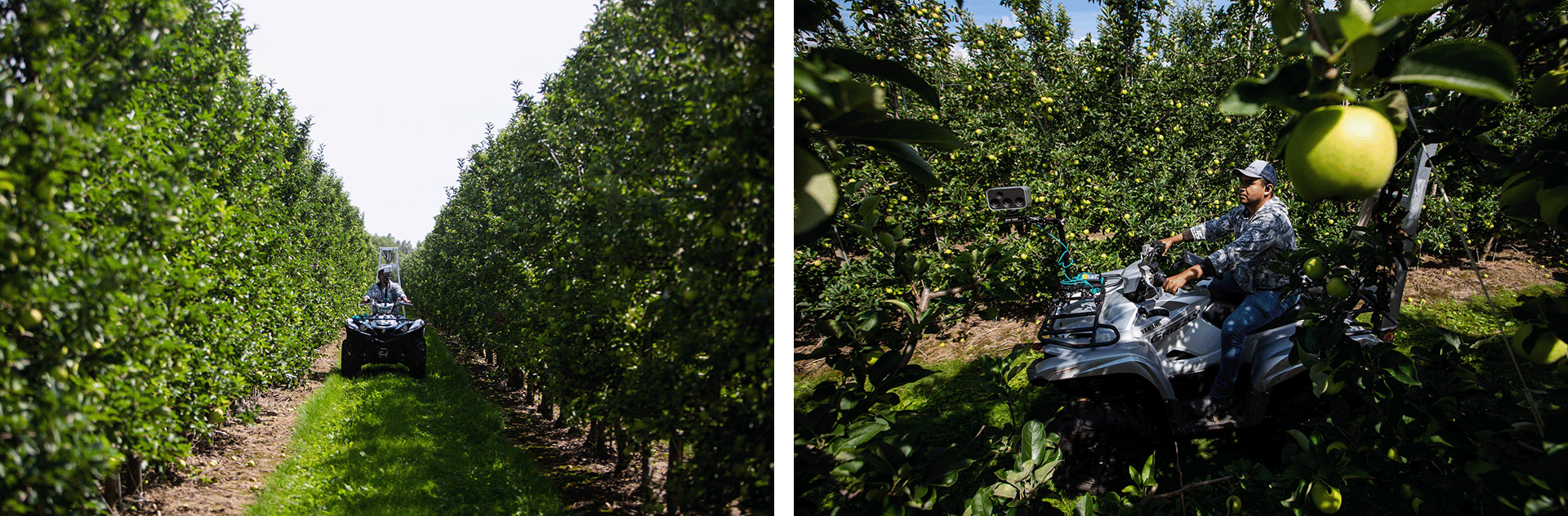 Antonio Cruz drives an ATV equipped with a Vivid XV2 camera at Algoma orchards in August 2023. Photo: Nick Lachance for The Logic
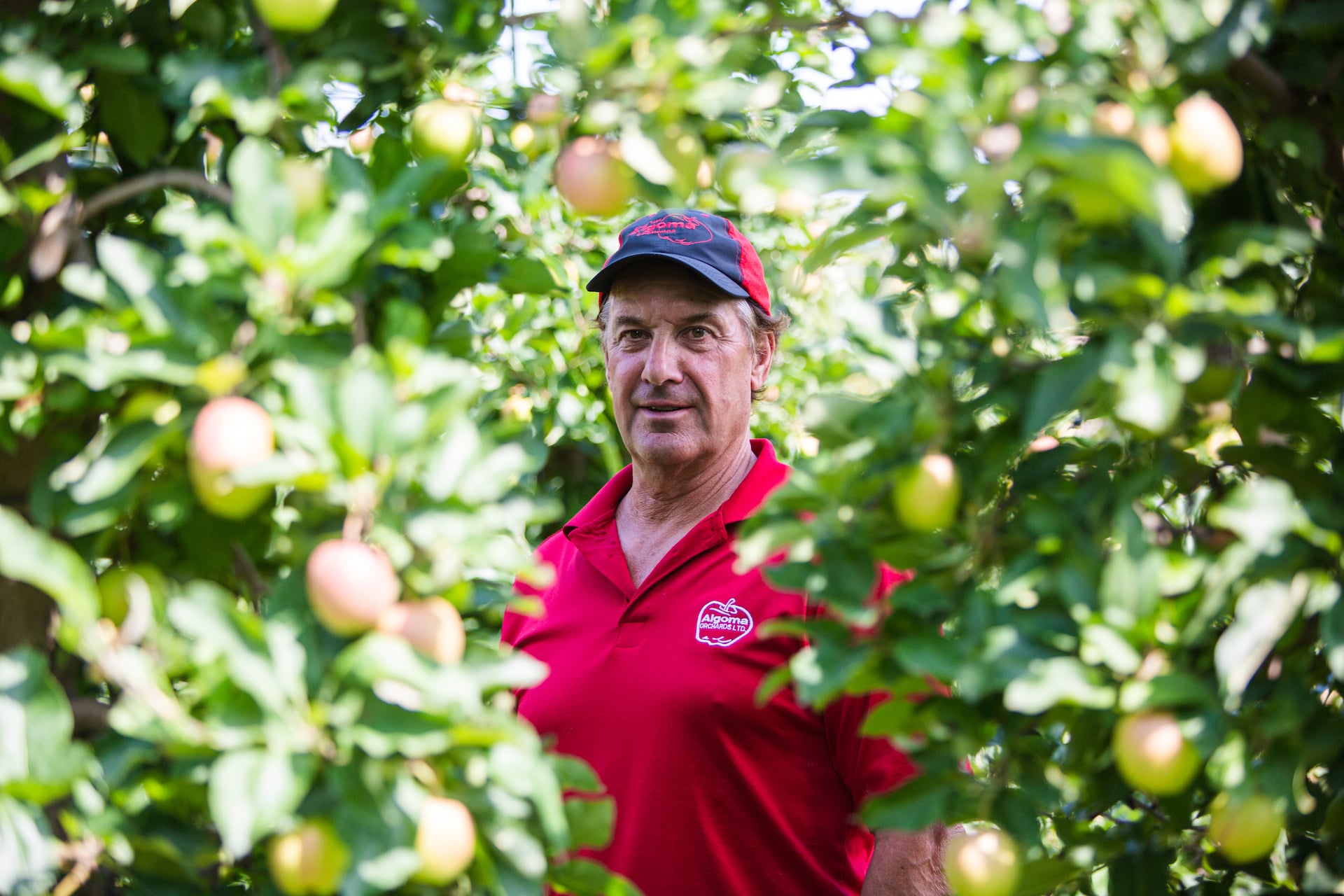 Third-generation apple grower Kirk Kemp has been on the farm for over four decades. Photo: Nick Lachance for The Logic

News
With agtech on the rise, Canada faces a shortage of tech farmers
Shortfall of skilled workers limits uptake for new solutions
Kirk Kemp tests the stabilization of the Vivid XV2 camera at Algoma Orchards in Newcastle, Ont., in August 2023. Photo: Nick Lachance for The Logic
Third-generation apple grower Kirk Kemp has been on the farm for over four decades. Now president of Algoma Orchards near Oshawa, Ont., his nearly 1.7 million trees supply major Canadian supermarkets. But apart from his two sons, he only has one Canadian-born full-time employee.
“Getting skilled labour on the farm is a real tough situation,” said Kemp.
Talking Points
- Agtech adoption by Canadian farmers is hampered by spotty rural internet and a lack of skilled farmers to operate the tech
- Permanent immigration is still the most important part of the solution, some say
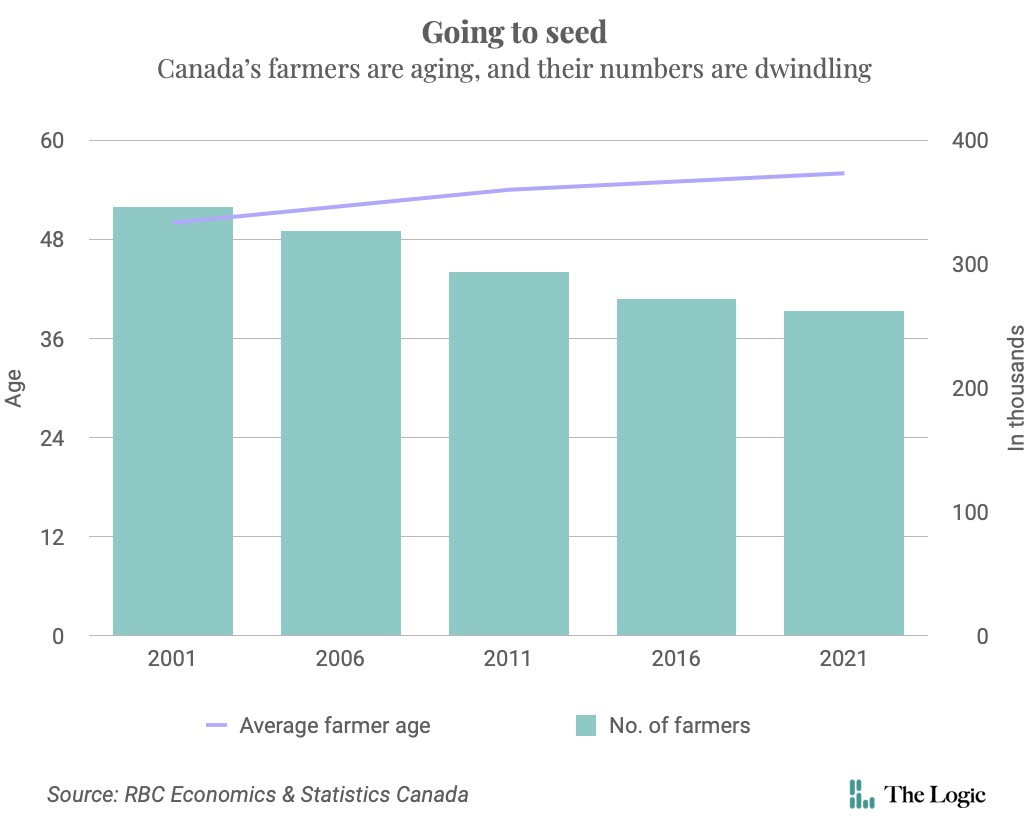
Canadian agriculture’s labour crunch has become more acute over the last two decades with no signs of easing. A study by RBC, the University of Guelph’s Arrell Food Institute and BCG’s Centre for Canada’s Future found that Canadian farmers are getting older, and their numbers are dwindling. From 2001 to 2021, farmers’ average age rose from 50 to 56 and their numbers shrunk from 346,000 to 262,000. Statistics Canada reported a shortfall of 63,000 agricultural workers in 2022, which it expects to almost double to 123,000 by 2029.
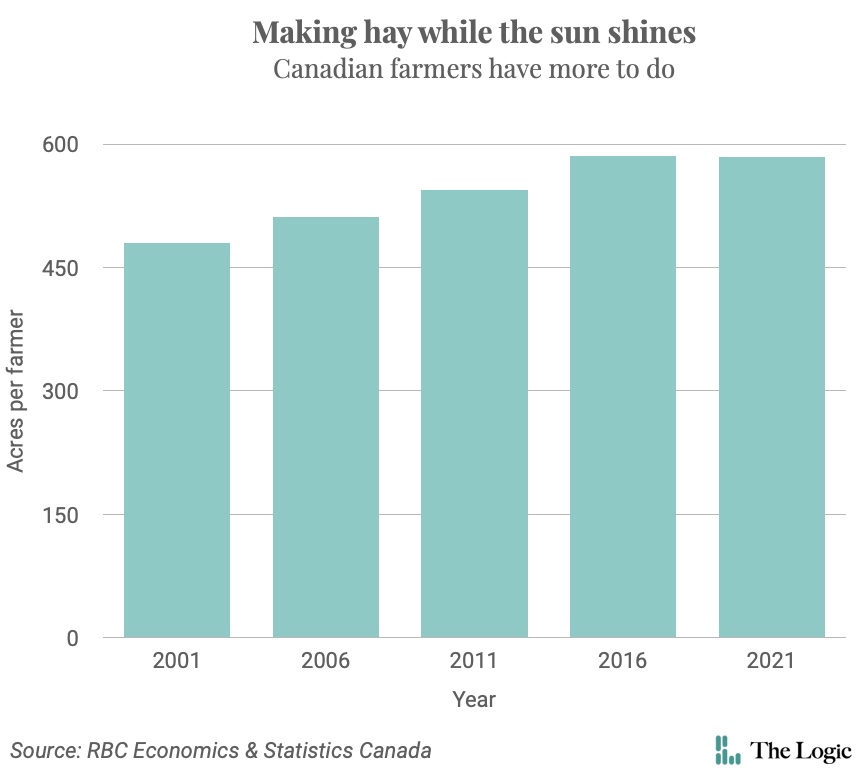
Aging farmers are harnessing agriculture technology to let fewer of them work the same acreage. The adoption of those technologies in Canada is being hampered, however, by spotty rural internet and by a shortage of skilled workers to deploy them.
Related Articles
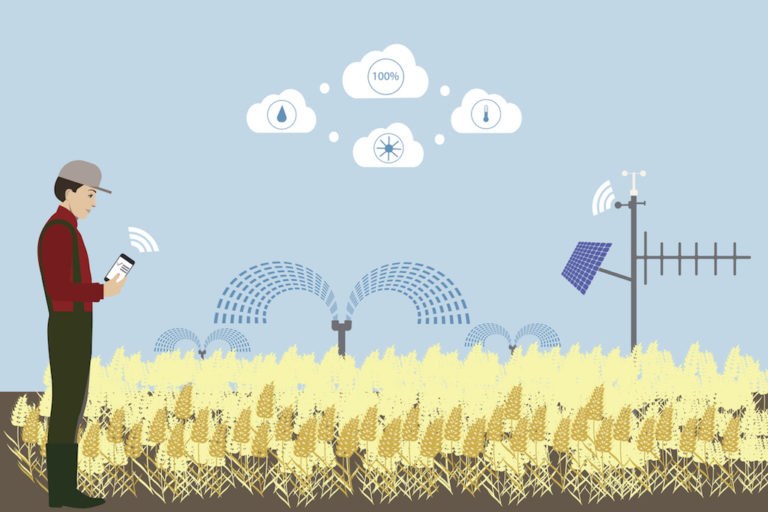

Kemp has GPS-guided gear that helps him plant apple trees at exactly the right distance apart, making them more efficient at producing fruit. However, on one property Kemp has had to drive his tree planter up to the top of a hill to grab a signal so it can stay connected even on a weaker connection when he drives it back down. “It’s an issue,” he said. “We need to run it off satellites, and if the service is poor, it can be difficult to run that equipment.”
He also uses a machine-learning yield-prediction camera made by Toronto’s Vivid Machines to help him plan how many workers and how much storage he will need for harvest. To circumvent the lack of rural internet, Vivid designed the camera to make real-time predictions offline, said CEO Jenny Lemieux. “It’s so much data that we’re seeing videos of every tree. … It would be impossible to stream that to the cloud, so it has to run on the edge,” she said.
Although agtech companies are working to build offline tools, the technology is still nascent. Vivid raised a US$4.3-million seed round in April and is building just 35 of its systems this year. Poor rural internet is “100 per cent a rate-limiting factor,” said Evan Fraser, director of UoG’s Arrell Food Institute, but he said he is optimistic that it will be solved in the next decade: “Is it happening in time? No. But is it happening? Yes.”
Even if the internet were up to speed, there would be the growing demand for a new type of tech worker—the tech farmer.
Allan Melvin, who is president of the Nova Scotia Federation of Agriculture and farms vegetables in the Annapolis Valley, said farmers in his area have a 15 to 20 per cent labour shortfall each year, which translates into unrealized production capacity.
During a video call with The Logic on his cellphone, Melvin drove his truck around his farm, showing off the property and the ways in which he’s incorporated technology into his operations. He pointed out a red automatic vegetable transplanter attached to the back of a green tractor that “took our labour force in the planting season from about six or eight guys in the field to three or four.” The transplanter requires upper-middle management oversight due to the technical nature of the equipment and the need to troubleshoot on the fly, Melvin said, but he struggled to find people in Canada for the demanding role.
“Engineering at Waterloo attracts gazillions of students and agriculture at Guelph doesn’t.”
With a lack of domestic workers, he relies on temporary foreign workers—but after training them, risks losing them if they retire or opt to return to their home countries. “Overnight, you can lose a lot of expertise and built-up capacity pretty quickly,” he said.
Fraser said a lack of student interest in the agriculture sector has contributed to the “absolute utter labour shortage.”
“We like to brag that there’s four jobs for every ag-food graduate in our programs … [but] we don’t really think about agriculture as a viable career,” he said. “Engineering at UWaterloo attracts gazillions of students, and agriculture at Guelph doesn’t.”
Engineering and agriculture shouldn’t be seen as separate disciplines, and universities need more cross-disciplinary pathways to encourage STEM students to find agricultural applications, said Fraser. “I would like to have more ag-facing co-ops in our computer-science and engineering degrees,” said the professor of geography. “Data science and computer engineering [and] robotics are increasingly needed skills in agriculture.”
If nothing is done, food will become more expensive. “It’s just supply and demand. If there’s less supply, that’s what ends up affecting food prices,” said Todd Lewis, the Canadian Federation of Agriculture’s vice-president.
Automation is only one approach to solving the Canadian agriculture sector’s worker shortage, said Fraser. While no single policy will fix the problem, he said that permanent immigration is the “North Star” and a significant part of the solution. “We can use our immigration policy, probably more effectively than it has traditionally been,” he said.
Kemp’s experience highlights that ineffectiveness, even if those workers have the right skills. Although he doesn’t need 250 low-skilled workers year-round, he needs his supervisors all 12 months of the year. ”When you have a diverse and vertically integrated business like we do, there’s lots of full-time jobs. We just need those guys to be able to come—and they want to come, I don’t have to coerce them, they’re begging to stay,” he said.
Editor’s note: This story has been updated with a more precise description of the connectivity issues on Kirk Kemp’s property, and to remove a paragraph in which a source provided inaccurate information.



Loading...
Thanks for sharing!
You have shared 5 articles this month and reached the maximum amount of shares available.
CloseThis account has reached its share limit.
If you would like to purchase a sharing license please contact The Logic support at [email protected].
CloseGift the full article!
You have gifted 0 article(s) this month and have 5 remaining.
Recipients will be able to read the full text of the article after submitting their email address. They will not have access to other articles or subscriber benefits.
Photo: Nick Lachance for The Logic
Antonio Cruz drives an ATV equipped with a Vivid XV2 camera at Algoma orchards in August 2023.
Third-generation apple grower Kirk Kemp has been on the farm for over four decades.
Most Popular This Week




In-depth, agenda-setting reporting
Great journalism delivered straight to your inbox.
News
Brookfield’s new CEO flexes the firm’s soft power with its $50B Canadian bet
Briefing
AI is pushing insurers to become asset managers, Canadian CEOs say
Trump administration faces lawsuit over 50% tariffs on Canadian goods
Canada-U.S. trade war to reduce real GDP by 1.4% over 2024 levels after five years: PBO
Best business newsletter in Canada
Get up to speed in minutes with insights and analysis on the most important stories of the day, every weekday.
Exclusive events
See the bigger picture with reporters and industry experts in subscriber-exclusive events.
Membership in The Logic Council
Membership provides access to our popular Slack channel, participation in subscriber surveys and invitations to exclusive events with our journalists and special guests.





