Jon Seary believes he is the first person to have driven the Ford F-150 Lightning across Canada, starting last fall from Victoria and ending at his Newfoundland home. He used Ford’s BlueOval network to charge during the trip, only to find that on multiple occasions the chargers didn’t work. “The BlueOval network sounds great, but really … it is an aggregation of existing charging equipment without really any real-time communication,” said Seary. He also owns a Tesla and said the difference between Tesla chargers and BlueOval is “night and day.”
“If I could have charged with the Tesla superchargers, the trip would have required no planning at all,” he said.
Ford’s announcement that it will adopt Tesla’s charging standard by next spring took the industry by surprise. It will provide current owners of Ford EVs, which use the Combined Charging System (CCS)—one of two direct-current fast-charging standards that compete with Tesla’s—with an adapter. Starting in 2025, new Ford’s EVs will have Tesla’s “North American Charging Standard” port. While the move is expected to improve Ford’s EV experience and push competing networks to improve, it’s still unclear which format will ultimately dominate in Canada.
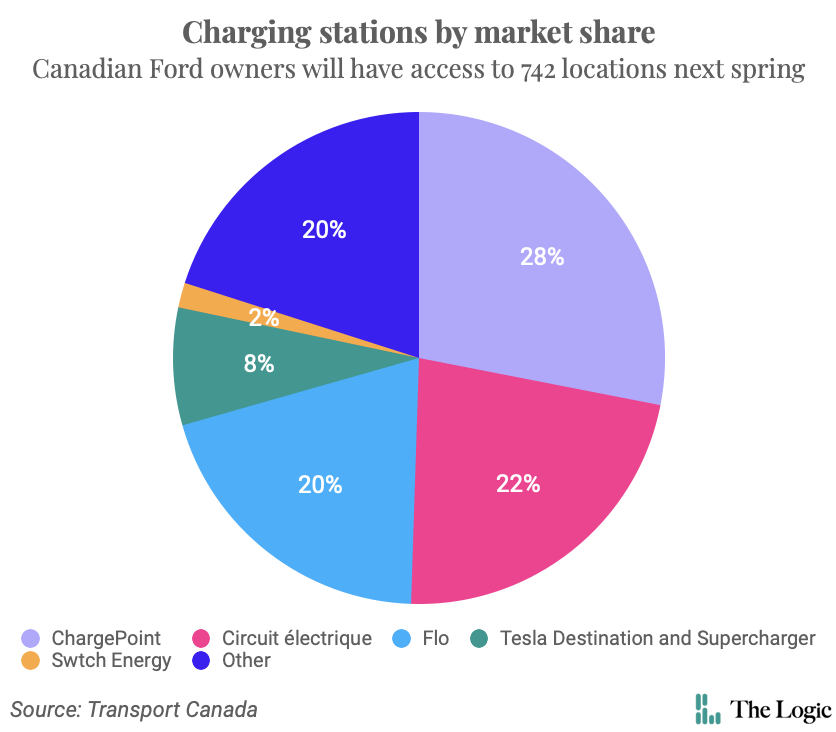
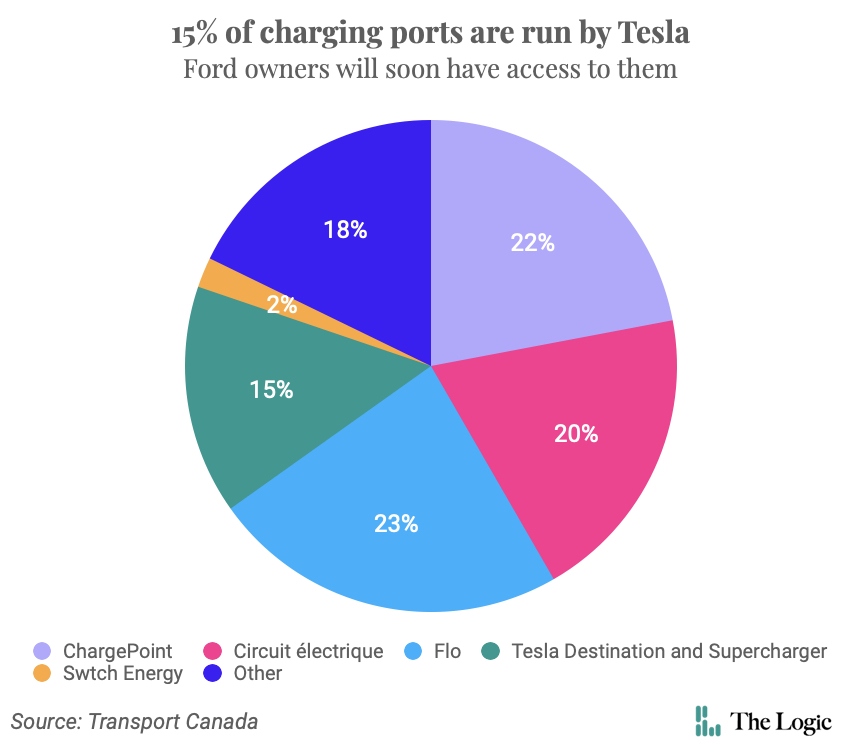
Tesla operates eight per cent of Canada’s 9,281 Level 2 and above charging stations and 15 per cent of 21,927 ports, according to Transport Canada. Although it doesn’t have a clear market majority, it benefits from a reputation of dependability and ease of use. Ford won’t be the only one to benefit from Tesla’s chargers; Tesla will open 750 of its connectors to all EVs by the end of 2025.
Drivers frustrated with BlueOval chargers may welcome Ford’s change. “You just have to go on PlugShare to see complaints about certain networks,” said Plug’n Drive’s president and CEO Cara Clairman, referring to the popular charging-locator app. “EV drivers are like, ‘Don’t use this charger, it’s terrible.’”
The deal will also open up a “huge opportunity” for Ford in rural areas like northern Ontario, said Devin Arthur, EV Society government relations director and a Sudbury, Ont., resident. For example, BlueOval currently has no locations on the 700-kilometre stretch between Thunder Bay and Sault Ste. Marie in Ontario, compared to Tesla’s four. Arthur also praised Tesla’s plug-and-play system with automatic billing: “You don’t need to mess around with different apps, you just plug it in and there you go—that seamless experience.”
The deal will pressure competitors to improve their user experience and reliability, said the Electric Vehicle Council of Ottawa’s president Raymond Leury. He described Tesla as a “gold standard” on both counts that he’d like to see other networks replicate. It’s “the only way they’re going to be able to survive and have a business case to operate,” he said.
Canadian chargers aren’t going to be standardized any time soon. The EV community agrees that CHAdeMO, the other major DC fast-charging format, is slowly disappearing from this country, but there still isn’t a clear winner between Tesla’s format and CCS. Ford’s move is a “pretty big domino to fall,” but there’s still a lot of weight behind CCS, said Arthur in Sudbury. In 2018, Volkswagen agreed to spend US$2 billion in the U.S. to establish clean-car infrastructure as part of a 2016 settlement with U.S. officials over its diesel-emissions scandal, and launched Electrify Canada, which uses CCS. “They’ve invested so much money, I’m not sure if they’re ready to really make that switch yet,” Arthur said.
As Seary observed: “It’s going to be a fight back and forth.”
Read Shift—The Logic’s authoritative weekly newsletter on automotive technology industry news—for more; and if you know someone who should be reading it, they can sign up here.