Listen Now
0:00
As Brookfield plans to double its core earnings in the next five years, its $50-billion partnership with the Canada Pension Plan Investment Board signals how the new CEO of its asset management arm, Connor Teskey, aims to win clients and outpace rivals.
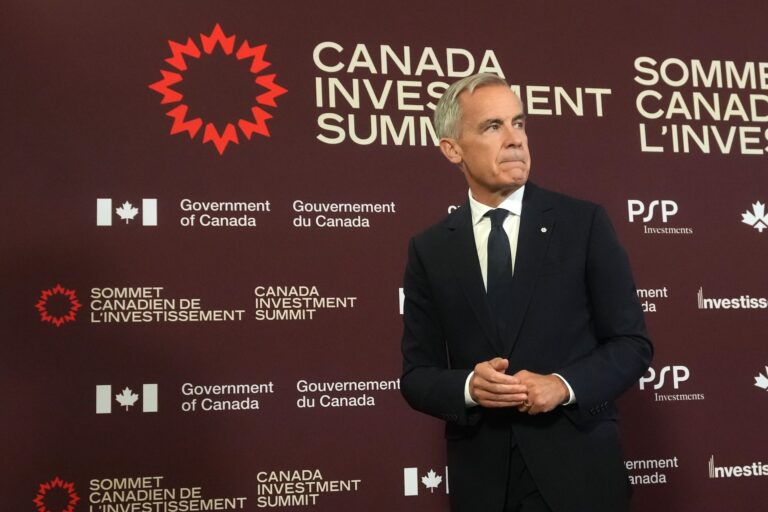
There are few public details about the new Maple Fund, announced alongside other pension plans’ domestic spending commitments at the Canada Investment Summit last month.
Talking Points
- In his first few months as CEO, Connor Teskey has advanced Brookfield Asset Management’s long-standing ambitions to work with Canadian pensions, launching a $50-billion Maple Fund that has been in the works since at least 2024
- Teskey is betting the fund will give him a front-row seat to global deals ahead of rivals as pressure mounts for Brookfield to differentiate itself and meet lofty financial targets
Unlike other funds, CPP Investments and Brookfield Asset Management describe the Maple Fund as a “a joint co-operation framework.” Each agreed to spend $25 billion over five years on Canadian projects worth more than $5 billion, which they will assess individually.
The fund has yet to announce any deals, and neither investor would answer The Logic’s questions about its structure and strategy. But it is one of several deals that Brookfield Corp. has recently struck to help countries build sovereign infrastructure, including AI-related commitments in Sweden and France.
The fund hints at where the asset management industry is headed, observers say. As Brookfield Asset Management aims to double its fee-bearing capital by 2031, the fund positions Teskey, just months into his tenure as CEO, as a well-connected broker. Brookfield’s involvement could also help CPP Investments back more domestic projects, despite constraints that typically limit pensions from directly backing early-stage ventures or less-tested business models.
Related Articles

As The Logic first reported, Brookfield has courted Canadian pension funds since 2024. Brookfield CEO Bruce Flatt has said the world’s aging population offers a new opportunity to unlock capital as retirement savings grow.
Since Teskey became CEO of Brookfield Asset Management at age 38, the firm has co-invested with U.S. rivals like Apollo, KKR and Blackstone in AI data centres. Despite growing overlap in their strategies and portfolios, Teskey maintains Brookfield stands out from other asset managers by identifying higher-quality deals.
CFRA analyst Kenneth Leon said Brookfield Asset Management’s long-term institutional relationships are a key differentiator, granting it access to more sophisticated governments and institutions.
“A joint launch with the Canada Pension Plan Investment Board is good for Brookfield,” Leon said in an interview, noting institutional investors are diversifying beyond equity markets, and Canada’s energy infrastructure projects play to Brookfield’s strengths.
“Small- to mid-sized alternative asset-management firms are having trouble, and we’re seeing funds flow from pension or from sovereign funds to the largest. Of course, Brookfield’s one of the largest.”
Teskey has identified relationships with pensions and sovereign wealth funds as central to Brookfield’s strategy of accessing the best deals. At a recent investor day, he told analysts that its existing relationship with Singapore sovereign wealth fund Temasek meant Brookfield was the first to hear of a deal hitting the market.
“Who are the largest investors around the world? They are the large plans, the large sovereigns. The other way that we are very differentiated is we do more than just be stewards of these partners’ capital,” he said. “We can invest in their countries.”
“Having a partner who’s able to do some of the development and operations, and reduce that risk, can be a bit of a gold mine.”
On the heels of Brookfield’s investor presentations last month, CIBC analysts wrote that “capital alone is no longer enough” for Brookfield as long-standing relationships become “increasingly valuable as investment opportunities grow larger.”
The joint co-operation framework—in which Brookfield will put its own money into Canadian investments and evaluate its own deals—differs from Brookfield’s 2024 pitch to act as a fund administrator for Canadian pension money.
Pensions want to reduce the fees they pay to outside asset managers, said Sebastien Betermier, executive director of the International Centre for Pension Management. Between 2010 and 2020, global pensions poured bigger shares of their coffers into alternative asset managers like Brookfield and Blackstone.
Canadians pensions are known globally to be more hands-on, said Betermier, noting Ontario Teachers’ Pension Plan’s active role in property manager Cadillac Fairview. Over the past decade, Canadian pension plans built in-house teams to do more direct investing, said Bart Dziarski, who covers Brookfield Asset Management at RBC Capital Markets.
But there are limits to what pensions can do internally. For years, Ottawa has pushed pensions to back major domestic projects, and CPP Investments has said it would consider it if large-scale infrastructure like pipelines and ports were on the table. But the Canada Investment Summit deal book described other projects as “pre-feasability” or “conceptual.” The International Centre for Pension Management’s “investable window” advises funds to seek operational businesses with proven models, a path to liquidity and opportunities large enough to justify due diligence.
A joint framework like the Maple Fund is potentially a tidy solution: Brookfield funds a project until it approaches the sweet spot for pensions, who gain direct access. Betermier expects to see more such partnerships.
“Pension funds don’t like to develop projects from scratch,” Betermier said. “Having a partner who’s able to do some of the development and operations, and reduce that risk, can be a bit of a gold mine.”
At Brookfield Asset Management’s investor day, TD Cowen analyst Cherilyn Radbourne acknowledged that pension funds’ internal teams might be stretched with big AI projects, but questioned how Brookfield’s involvement might affect its fees. Teskey said that “co-investment is misunderstood” and that partnering with pensions goes beyond accruing fees.
RBC’s Dziarski said Brookfield is unlikely to compromise its returns, but even a “no fee” partnership offers advantages for Brookfield.
“No one really underwrites or expects 15 per cent for infrastructure… That’s not the base case,” he said. Rather, working with CPP Investments, France and Sweden highlights Brookfield’s “unique” position”—and might motivate other potential clients to call Teskey.
“What you’re seeing,” Dziarski said, “is an evolution of the alternative asset managers becoming, basically, solutions providers.”