Listen Now
0:00
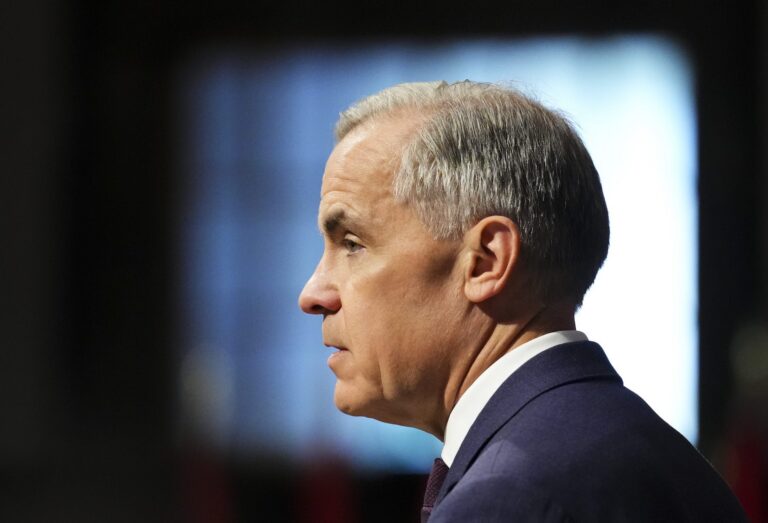
Prime Minister Mark Carney is trumpeting what his office calls “nearly $500 billion of new investment in Canada” tied to this week’s Canada Investment Summit—but getting to that number takes some generous math.
Heavy-hitting investors from around the world flocked to Toronto for the summit, organized with the ambition of growing the Canadian economy by attracting $1 trillion in new financing over the next five years. The announcements from the 14 Canadian investors the PMO celebrated in a release Tuesday bolster Ottawa’s pitch to foreign investors, demonstrating Canadian capital sees opportunities in the country.
Talking Points
- A release from the Prime Minister’s Office quotes Mark Carney as saying the Canada Investment Summit earlier this week “unleashed nearly $500 billion of new investment into Canadian businesses and infrastructure”
- An analysis of the 14 deals named in the release shows that not all of the funding is new, some of it isn’t actually going to be invested and foreign companies will be eligible to receive some of it
But Vass Bednar, managing director of the sovereignty-focused Canadian Shield Institute, said some of the investors used questionable math to get to the numbers they announced. Non-Canadian entities are eligible for funding from at least three of the investors, while the Big Five banks included non-investment metrics, such as advisory services and deal underwriting.
The summit’s high profile and ambitious goals put pressure on the institutions to announce funding commitments that are as large as possible, Bednar said. “It implicitly incentivizes very creative accounting to say that more capital has been deployed.”
The Prime Minister’s Office did not respond to a request for comment by deadline.
Foreign companies might be the beneficiaries of some of the funding committed by TD, Radical Ventures’ new venture fund for AI startups and BDC, a Crown corporation that provides financing to Canadian businesses. Non-Canadian companies can apply for financing under TD’s $150-billion commitment if they have a “documented Canadian nexus.” Radical’s US$1-billion Breakouts Fund plans to invest in “leading AI companies globally, including in Canada,” and has allocated existing deals in American companies Discovery Loop and Etched to the fund.
Related Articles

About half of BDC’s $1-billion commitment will go to its Defence Fund, which “will invest in Canadian and allied-nation funds with strong Canadian exposure.” Its first investment is in Intrepid Growth Partners, which invests in AI startups in the U.S., the U.K. and Europe in addition to Canada.
In an emailed statement, BDC spokesperson Roseline Joyal-Guillot said investments in non-Canadian funds “must create value for Canadian companies and strengthen Canada’s defence innovation ecosystem.” She added, “No one in Canada has ever done this before, as a result there is no generally accepted single numerical threshold for ‘strong Canadian exposure.’”
Radical did not respond to a request for comment, while TD confirmed it received the request but did not respond by deadline.
Most of the investors pledged to support the Canadian economy or back Canadian businesses. Defining and measuring those goals is more complicated than it sounds, however. For example, more than 70 per cent of contracts the federal government awarded under its Buy Canadian program over six months ending in June went to foreign-owned subsidiaries. They qualified because the rules didn’t require them to be Canadian-owned or headquartered, just that they have a “presence” in the country.
BDC’s Joyal-Guillot said the fund’s metrics “are all based on how many Canadian businesses we help start, grow, and scale.” RBC spokesperson Sharon Wilks said the bank’s new venture fund will focus on “technology companies that are headquartered and operational in Canada.” Ontario Teachers’ Pension Plan spokesperson Dan Madge said the fund looks at where companies are listed, where they own property and where their headquarters are.
Two investments—Bell’s $52.5 billion in capital spending on a Saskatchewan data centre, and the Canada Growth Fund’s $140-million investment in critical minerals miner Generation Mining—were unambiguously in Canadian companies or projects.
Additionally, some of the announced funding isn’t new. BDC’s $1-billion commitment to support Canadian defence investment is part of a previously announced $6-billion program. Some of the announcements specify that the funding is “new,” “additional” or “incremental,” but it’s unclear whether they would have spent the money anyway without the push from Ottawa. The Logic has previously reported that Brookfield has been pitching a $50-billion “Maple Fund” in collaboration with a pension fund since 2024—when Carney was the chair of the asset manager, not the prime minister.
These findings directly contradict the release from the Prime Minister’s Office. “We unleashed nearly $500 billion of new investment into Canadian businesses and infrastructure—and this is just the beginning,” Carney is quoted as saying.
Additionally, not all of the announced funding constitutes investments in the traditional sense. TD, BMO, Scotiabank, RBC and CIBC include advisory support, underwriting, capital markets activity or “sector insight” as part of their commitments. None of the banks responded when asked how they’ll count such activity towards their targets.
Methodologies the Big Five banks have published for calculating sustainable financing and decarbonization commitments offer clues about how they may be calculating these totals. All of them count the full transaction value of deals they advise on or underwrite. If a bank acts in two roles on the same deal—providing, for example, both advice and financing—TD, Scotiabank and CIBC let both count towards the commitment.
Canada’s big banks have faced allegations of overstating, or greenwashing, their sustainability claims in the past. Keldon Bester, executive director of the Canadian Anti-Monopoly Project, said the latest funding announcements raise a similar concern. “We’re back in this familiar territory,” he said. “This is a new flavour of it.”
TD is the only investor to promise to measure its progress towards its Canadian funding goal and update the public on it, outside its usual disclosures. CPP Investments and BDC also addressed The Logic’s questions on how they will be accountable for progress towards their funding announcements.
“Success will be measured by our ability to generate attractive investment opportunities and create value for the CPP,” spokesperson Michel Leduc said. BDC’s Joyal-Guillot said the institution will follow the same process it uses for every fund, tracking how investments perform, whether they stick to their mandate and whether they’re helping Canadian defence and dual-use companies.
Bednar said the math behind the funding claims raises larger questions about how to support the Canadian economy.
“What does it mean to invest here? And are we actually unlocking growth capital that we know companies are starved for? Are we investing in genuine Canadian companies?” she said. “Is it actually going to help us? Or are we chasing this—not sugar high, but lump-sum number?”