Listen Now
0:00
Exchange-traded funds are attracting record amounts of Canadian investment, pushing the industry toward the $1-trillion mark, according to Morningstar data, despite persistent inflation, economic uncertainty and bouts of market volatility.
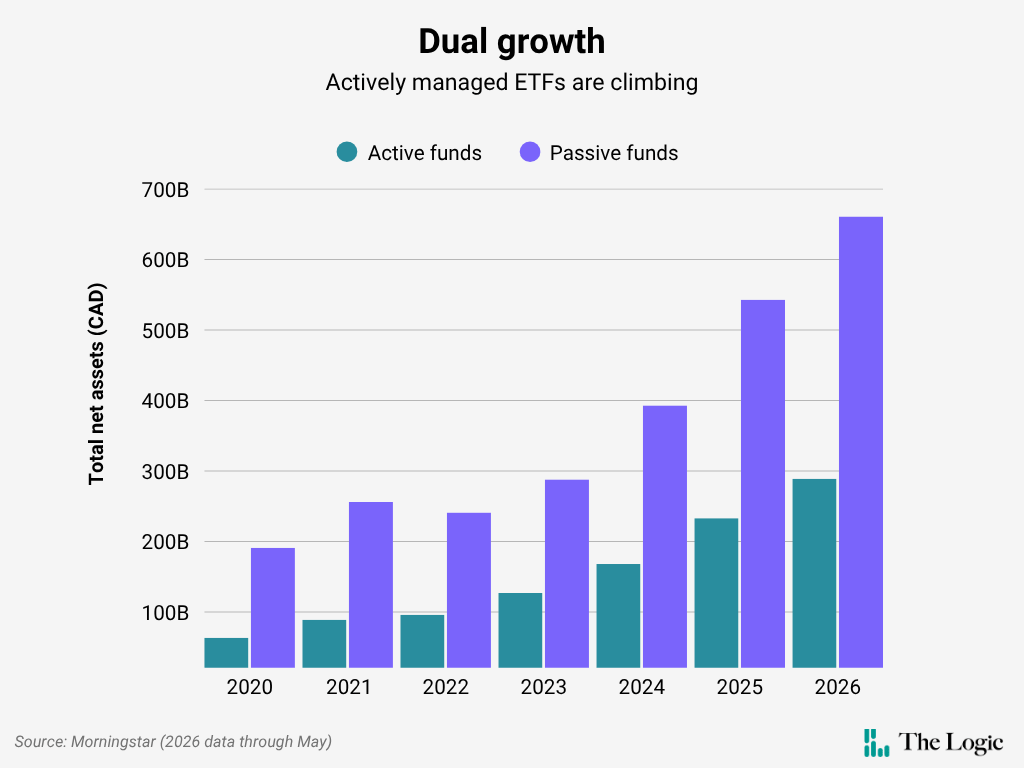
Canadian-listed ETFs held a record $978 billion in net assets as of May, up nearly 22 per cent from a year earlier and almost 280 per cent from 2020.
Talking Points
- Canadian-listed ETFs held a record $978 billion in assets as of May, up nearly 22 per cent from a year earlier and roughly 280 per cent from 2020, per Morningstar data
- Assets in actively managed ETFs have more than quadrupled since 2020, rising from $63.4 billion to $289.3 billion as of May
Ahmed Farooq, senior vice-president and head of retail distribution at Franklin Templeton Canada, said the ETF industry’s growth was initially fuelled by its reputation as a low-cost, tax-efficient way for retail investors to access markets once largely available only through actively managed mutual funds.
As adoption has widened—particularly among younger investors—and more options became available, ETFs have moved beyond simple index tracking to include actively managed strategies, Farooq said. Early ETF growth was driven by three groups: financial advisors who gradually embraced the structure, institutional investors seeking liquidity and global market access, and a much smaller base of retail investors, who in the past largely preferred picking individual stocks, he added.
Related Articles

That has opened the door for traditional asset managers, including Canada’s largest banks, to bring active management into the ETF market. Rather than creating entirely new products, many have repackaged flagship mutual funds into ETFs to meet growing demand. The approach appears to resonate with some investors: According to the Canadian ETF Association, 39 per cent of Canadians say they prefer to speak directly with someone when making investment decisions.
The shift is also showing up in asset flows. While passive ETFs still dominate the Canadian market, actively managed ETFs have grown much faster. Assets in active ETFs have more than quadrupled since 2020, according to Morningstar data, while passive ETFs have roughly tripled over the same period. Equity-focused actively traded funds have driven much of the industry’s expansion, attracting nearly $130 billion in net assets as of May.
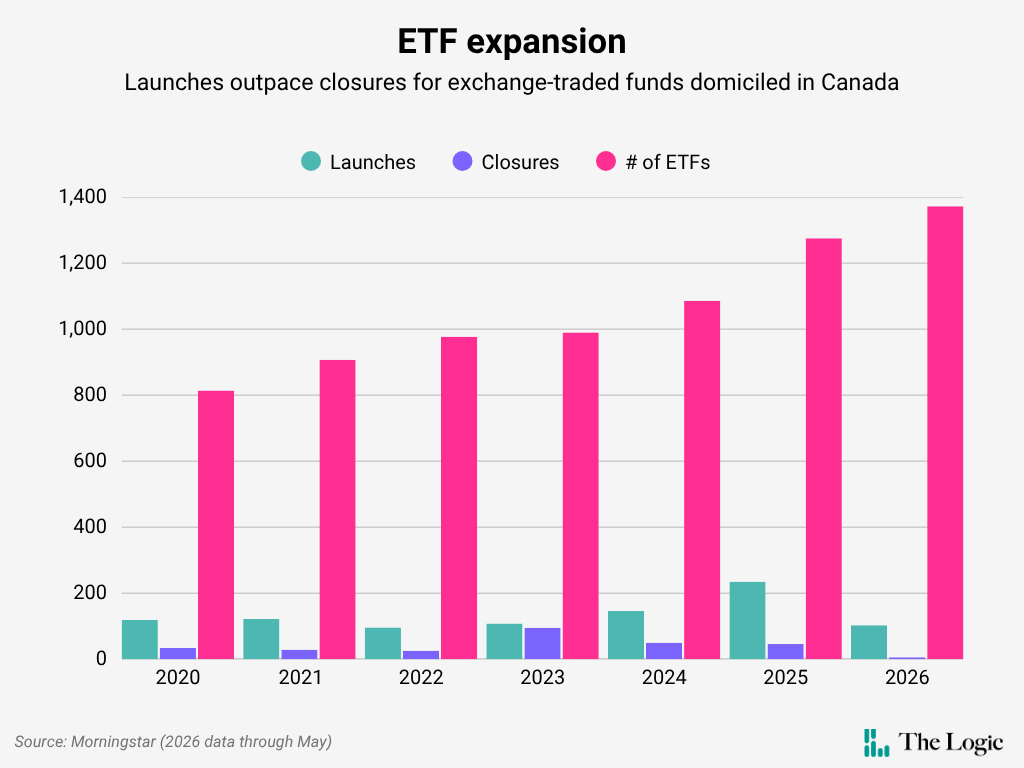
The ETF industry is not only setting a new record for assets under management, but also for product launches. More than 235 new ETFs began trading in Canada last year—the fastest pace on record—and another 103 products have already come to market this year, according to Morningstar. BlackRock Canada created the most ETFs in June, totalling approximately $3.7 billion, followed by Vanguard Canada with $2.3 billion and Fidelity with $1.3 billion, according to Scotiabank analyst Phil Hardie’s estimates.
The industry’s rapid growth has also drawn criticism from some investors, who argue the Canadian ETF market is suffering from “ETF slop” as providers rush to launch increasingly niche products. Canada recorded 235 ETF launches and 46 closures in 2025, implying a closure rate of roughly 20 per cent relative to new launches.
Farooq agreed the market has become crowded, but said much of the growth stems from multiple firms launching similar products and taking a “spaghetti-at-the-wall” approach to see which strategies gain traction. Thematic ETFs—funds tied to specific trends, sectors or market narratives—tend to face the highest risk of closure when investor interest fades or the underlying theme falls out of favour, he said.
A bigger concern for the industry may be the migration of assets south of the border. Canadians hold about $300 billion in the U.S.-listed ETFs, according to Eli Yufest, executive director of the Canadian ETF Association. He said that while Canada can’t match the scale and liquidity of the U.S. market, policymakers can make domestic investment products more competitive by reforming tax rules on management fees, U.S. dividend withholding taxes that disadvantage Canadian-listed ETFs, and capital gains allocations that he said discourage Canadians from investing domestically.
Despite pioneering the ETF industry by launching the world’s first ETF on the TSX in 1990, Canada’s ETF market remains much smaller than that of the U.S., where assets have climbed to US$15.6 trillion—nearly triple their 2020 level.
Canadians invested $57.1 billion in domestic securities in the first quarter but continued to invest heavily abroad in the first quarter, buying a net $40.3 billion of foreign securities, including $36.9 billion in foreign stocks and investment funds, while selling $7.7 billion Canadian assets, according to Statistics Canada.
Speaking at a TMX event earlier this month, Finance Minister François-Philippe Champagne said the government is open to levelling the playing field so more assets stay domiciled in Canada, and asked the ETF industry to bring forward concrete, practical fixes that would make investing in Canada easier, more accessible and more fluid.
“I want to make sure that as the stars are aligning for Canada, that [we build] the system, the processes, that would facilitate the decisions to have more investments in Canada,” he said.