Skip to content

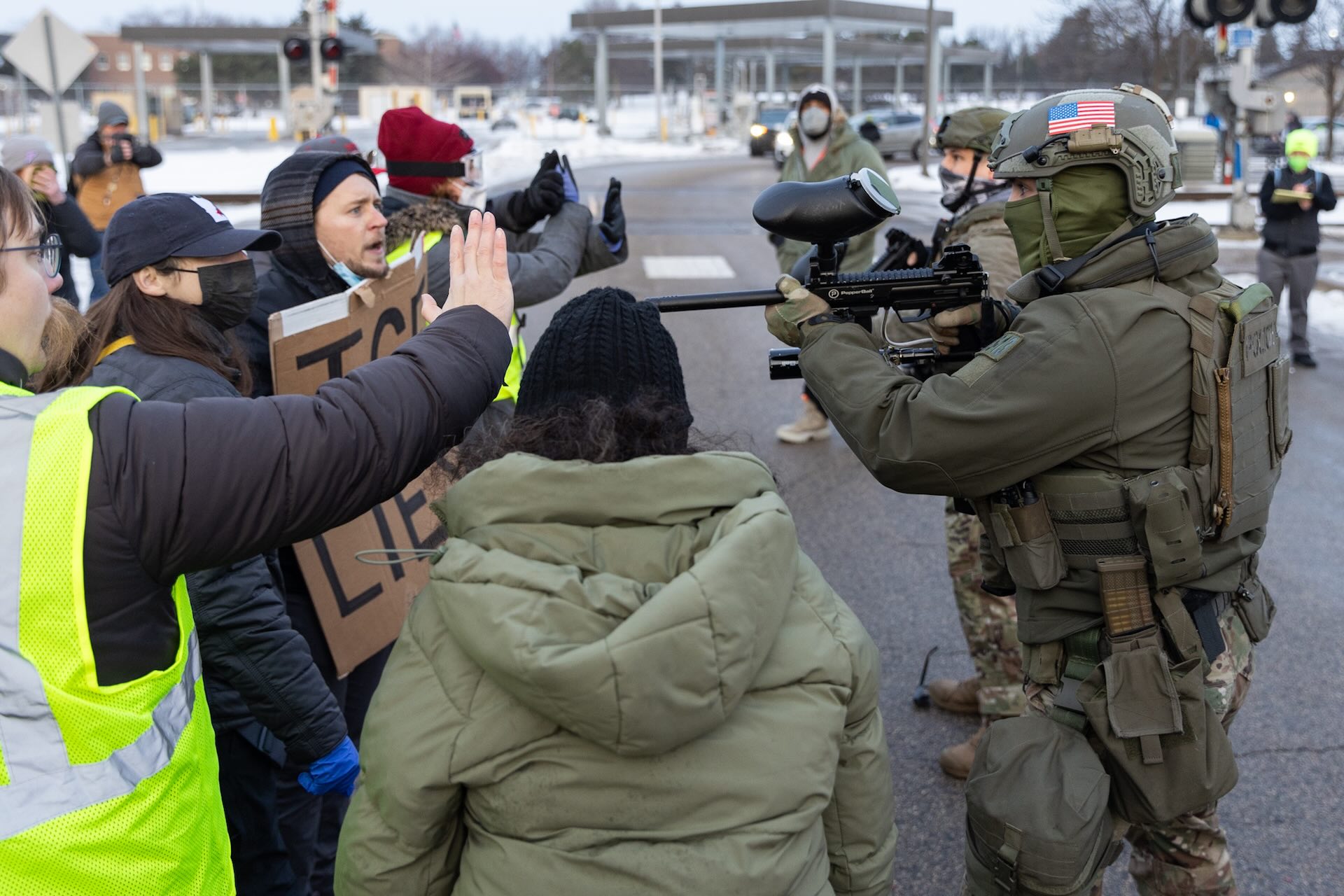 Protesters clash with law enforcement outside an ICE facility following the fatal shooting of Renée Good by a U.S. immigration agent in Minneapolis. The official is wearing what appears to be a Galvion Caiman helmet. Photo: Mostafa Bassim/Anadolu via Getty Images
News
Montreal’s Galvion, through U.S. reseller, is supplying US$15.5M of ballistic helmets to ICE
The helmets, which are designed in Montreal, have featured prominently in recent immigration crackdowns in Minneapolis and Illinois
Gregory Bovino, then U.S. Border Patrol Chief, photographed in Chicago, Illinois in Dec. 2025. Bovino is wearing a Galvion helmet. Photo: Scott Olson/Getty Images
MONTREAL — Galvion, a Montreal-based military hardware company, is supplying ballistic helmets to Immigration and Customs Enforcement (ICE), as part of a US$15.5-million deal between the agency and a U.S. reseller.
In September 2025, the Department of Homeland Security signed a year-long contract with military supplier LionHeart Alliance to provide Galvion Caiman ballistic helmets to ICE. The helmets are designed at Galvion’s Montreal headquarters and manufactured at the company’s factories in Vermont and Poland. LionHeart Alliance, a Virginia-based firm that supplies tactical equipment to U.S. federal agencies and state and local police, is an authorized reseller of Galvion products. The deal with ICE is by far the largest LionHeart has ever done with the U.S. federal government.
Talking Points
- As part of a year-long contract signed last September, one of Galvion’s U.S. resellers has provided helmets to Immigration and Customs Enforcement (ICE), the organization charged with crackdowns in states including Minnesota and Illinois
- The contract coincided with a ramp-up in ICE operations, which have resulted in the deaths of two American citizens on U.S. streets and the deaths of dozens more in custody
The Caiman helmets appear to feature prominently in recent photos of federal agents in Minneapolis, where authorities shot and killed Renee Good and Alex Pretti. Officers wearing what appear to be Galvion helmets can be seen subduing protesters, throwing tear gas canisters and forcefully pushing through crowds.
Galvion also directly signed a US$64,000 contract to supply helmets to U.S. Customs and Border Protection (CBP) in August, 2025. Gregory Bovino, who until recently served as the “commander-at-large” of the CBP, has been photographed wearing a Galvion helmet. Bovino was removed from the position following Pretti’s shooting.
The helmets can be identified by Galvion logos and several distinctive velcro-like shapes, which the company patented in 2020. “We do not speculate on outstanding programs, bids, or contract renewals,” Galvion founder and executive chairman Jonathan Blanshay told The Logic when asked whether recent ICE enforcement actions had changed Galvion’s strategy of supplying the U.S. government. “We are deeply committed to the individuals who carry out their duties on behalf of their governments,” Blanshay said. “Galvion operates as a non-partisan organization and does not take positions on conflicts, political leadership or policy matters.”
Galvion is one of a number of Canadian companies doing business with ICE. As The Logic reported, Canadian engineering giant Stantec signed two multimillion-dollar contracts with ICE to inspect its detention centres. The Canadian government has also given $1 million in subsidies to JSI, an Ottawa-based firm that provides wiretapping tools to ICE, while Toronto-based information giant Thomson Reuters has an open contract with the agency worth up to US$22.8 million for access to a law enforcement database.
In July 2025, ICE awarded a contract worth as much as $8 million to GardaWorld Federal Services, an American subsidiary of the Montreal-based security company, to provide security services to its immigrant detention centre in Florida known as Alligator Alcatraz. Vancouver-based social media company Hootsuite signed onto a US$95,000 pilot project to provide online monitoring services with ICE in September.
Earlier this month, B.C.-based Jim Pattison Developments said it wouldn’t sell a Virginia warehouse to ICE after public backlash. Outside of Canada, French technology firm Capgemini announced it intends to sell a U.S. division that has worked with ICE.
Related Articles

LionHeart’s contract to supply Galvion helmets came into effect as ICE operations ramped up towards the end of last year, including major operations in Chicago and the states of California, North Carolina and Minnesota.
On Wednesday, the Trump administration announced the withdrawal of 700 federal immigration enforcement agents from Minnesota—though 2,000 will remain in place as part of an ICE effort known as Operation Metro Surge. Following the Pretti shooting, which the medical examiner deemed a homicide, Minnesota Gov. Tim Walz called for an end to ICE operations in the state, saying ICE agents are “violent” and “untrained.”
The US$15.5 million for Galvion’s products was the largest part of the nearly US$22 million in contracts awarded to LionHeart in 2025—more than seven times its total from the year before, according to U.S. government records. The company did not respond to a request for comment.
A private company, Galvion was founded in 2002 as Revision, which sold eyewear to Canada’s Department of National Defence as the country was deploying to Afghanistan. The company sold its eyewear division in 2019 and rebranded as Galvion to focus on helmets, which retail for as much as $2,000 each. The company sells primarily to the U.S. and NATO. It opened a production hub in Poland last year.
In August of last year, Galvion’s U.S. subsidiary signed deals worth US$10.2 million with the U.S. Navy and US$9.2 million with the U.S. Army for helmets and “personal protective equipment.”
In a 2024 interview with The Logic, Blanshay said he kept Galvion’s headquarters in Montreal in large part because of the favourable exchange rate and ready access to engineers. The company limits its sales to NATO-friendly countries, he said. “For us, it’s got to be a market where they have real value on human life. They care about their troops. They’re not just cannon fodder,” he said. At the time, he also said the company was moving toward a “liquidity event” in the coming years.
With files from David Reevely in Ottawa



Loading...
Thanks for sharing!
You have shared 5 articles this month and reached the maximum amount of shares available.
CloseThis account has reached its share limit.
If you would like to purchase a sharing license please contact The Logic support at [email protected].
CloseGift the full article!
You have gifted 0 article(s) this month and have 5 remaining.
Recipients will be able to read the full text of the article after submitting their email address. They will not have access to other articles or subscriber benefits.
Photo: Scott Olson/Getty Images
Protesters clash with law enforcement outside an ICE facility following the fatal shooting of Renée Good by a U.S. immigration agent in Minneapolis. The official is wearing what appears to be a Galvion Caiman helmet.
Most Popular This Week




In-depth, agenda-setting reporting
Great journalism delivered straight to your inbox.
News
National Bank CEO warns AI alone won’t give banks a lasting edge
Briefing
Canada and Ontario commit over $5B to support tariff-hit steel sector
Hackers will see cars as major targets in next 3 years, 83% of car-tech workers say
EA shutting down Edmonton studio BioWare
Best business newsletter in Canada
Get up to speed in minutes with insights and analysis on the most important stories of the day, every weekday.
Exclusive events
See the bigger picture with reporters and industry experts in subscriber-exclusive events.
Membership in The Logic Council
Membership provides access to our popular Slack channel, participation in subscriber surveys and invitations to exclusive events with our journalists and special guests.





