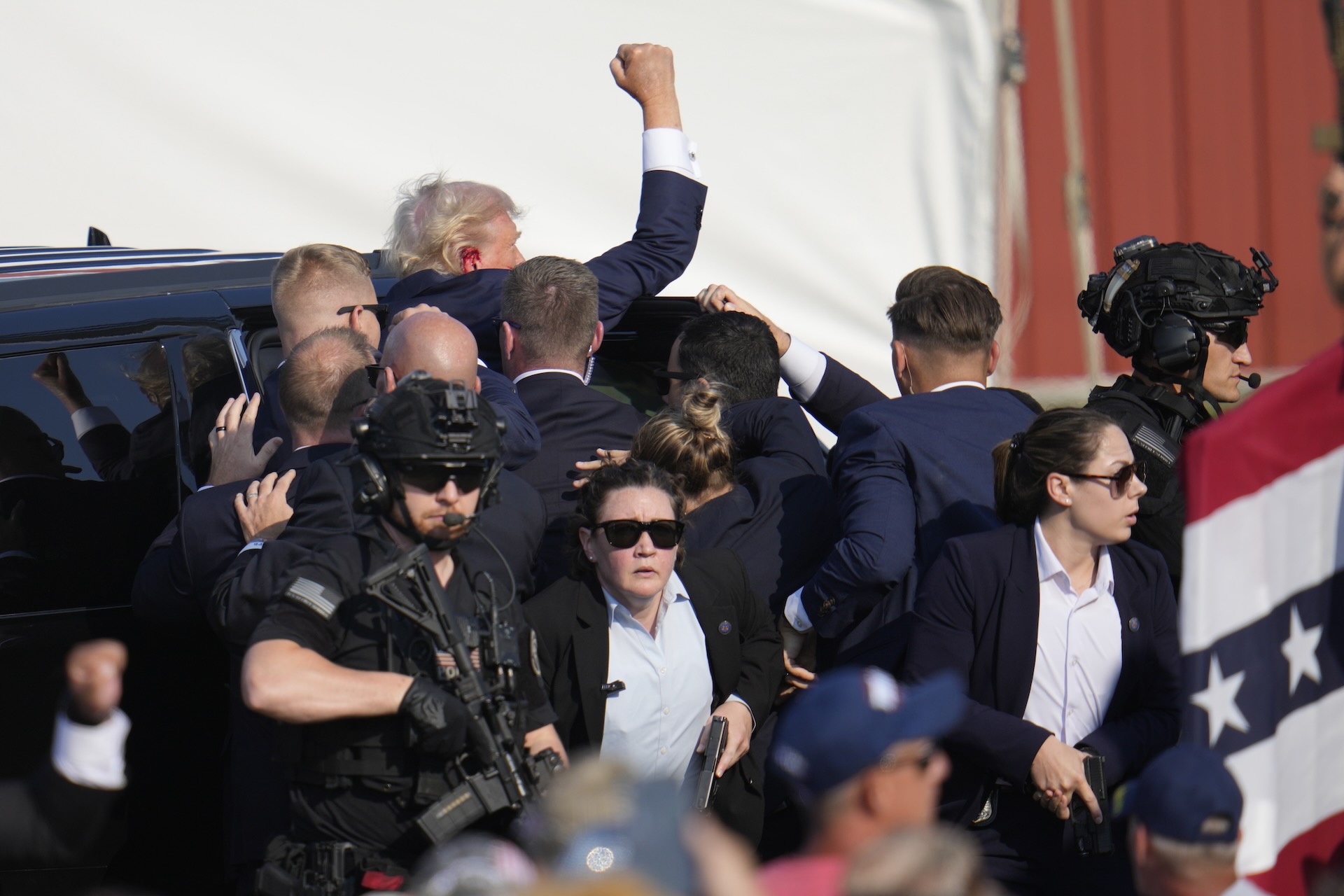
MONTREAL — At the centre of the picture is Donald Trump, his ear bloodied and his fist raised in defiance as he’s hustled into an SUV, moments after surviving an assassination attempt. Below him, Secret Service agents face outward, guns drawn, looking for further threats.
Two men framing the picture, members of the Secret Service’s Counter Assault Team, sport American flags on their biceps and a bit of Montreal on their heads—namely, the Caiman, a ballistic helmet made by Galvion, a private defence company founded in the city. Call it Canada’s contribution to this scene of bloody Americana: the people protecting the former U.S. president are themselves protected by gear designed in an office overlooking the Lachine Canal.
Galvion is doing quite well these days. Apart from supplying the U.S. Secret Service, which it has done since 2018, the company expects to have sold two million helmets around the world by the end of the year. It has outfitted armed forces in the U.S., Canada, the U.K. and Norway, among other NATO countries. With Ukrainian soldiers and the Israeli Defense Forces alike wearing Galvion protective gear into battle, the company has a presence in two of the world’s biggest current conflicts. It will soon open a new facility in Poland, built largely to accommodate rising European demand.
Galvion’s success underscores how the world is a particularly violent place right now. Deaths from armed conflict are at decades-long highs over the last three years, according to a Our World In Data report. Global military expenditure has risen for nine consecutive years, reaching a total of $2.4 trillion in 2023. Galvion made $170 million in revenue last year from selectively selling protection from that very violence.
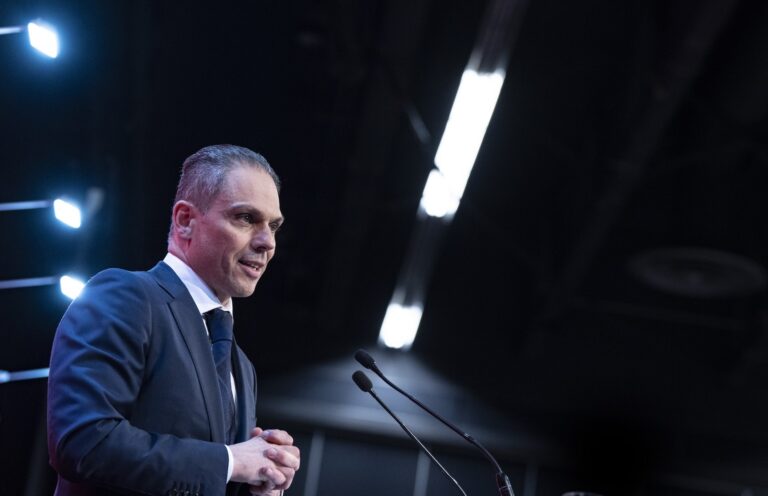
I met Galvion founder Jonathan Blanshay at Galvion’s headquarters in Verdun, about a 10-minute walk from Montreal’s Atwater Market. At six foot six, he towers over his desk, from which he spoke of what he calls his “addressable market” and Galvion’s de facto moral code. It might well have been ripped from the pages of U.S. foreign policy, in that China, North Korea, Iran, Syria and Russia need not apply. “For us, it’s got to be a market where they have real value on human life. They care about their troops. They’re not just cannon fodder,” he told me.
Jonathan Blanshay, the CEO of Galvion, at the company’s headquarters in Montreal on Sept. 19. Photo: Roger LeMoyne for The Logic
Blanshay fell into military procurement by accident. In 2002, he and a business partner founded Revision, and created a pair of glasses they hoped to sell to Harley Davidson. That year, a program manager from Canada’s Department of National Defence happened to see the glasses at a trade show in Indianapolis. Soon enough, Revision was outfitting Canadian soldiers with eyewear as they deployed to Afghanistan. The company sold 10 million pairs to armed forces around the world before selling its eyewear division to two U.S. private equity groups for US$75 million in October 2019.
The next month, Revision rebranded as Galvion to concentrate on helmets, which it produced at two U.S. facilities. Though the 25-to-35 per cent margins on the helmets aren’t as good as on sunglasses, the helmets themselves can cost as much as $2,000 each. The company sells primarily to the U.S. and NATO, yet Blanshay has kept its headquarters and R&D centre in Montreal, home to many of its several dozen shareholders, a favourable exchange rate and a reliable source of engineers, technicians and designers.
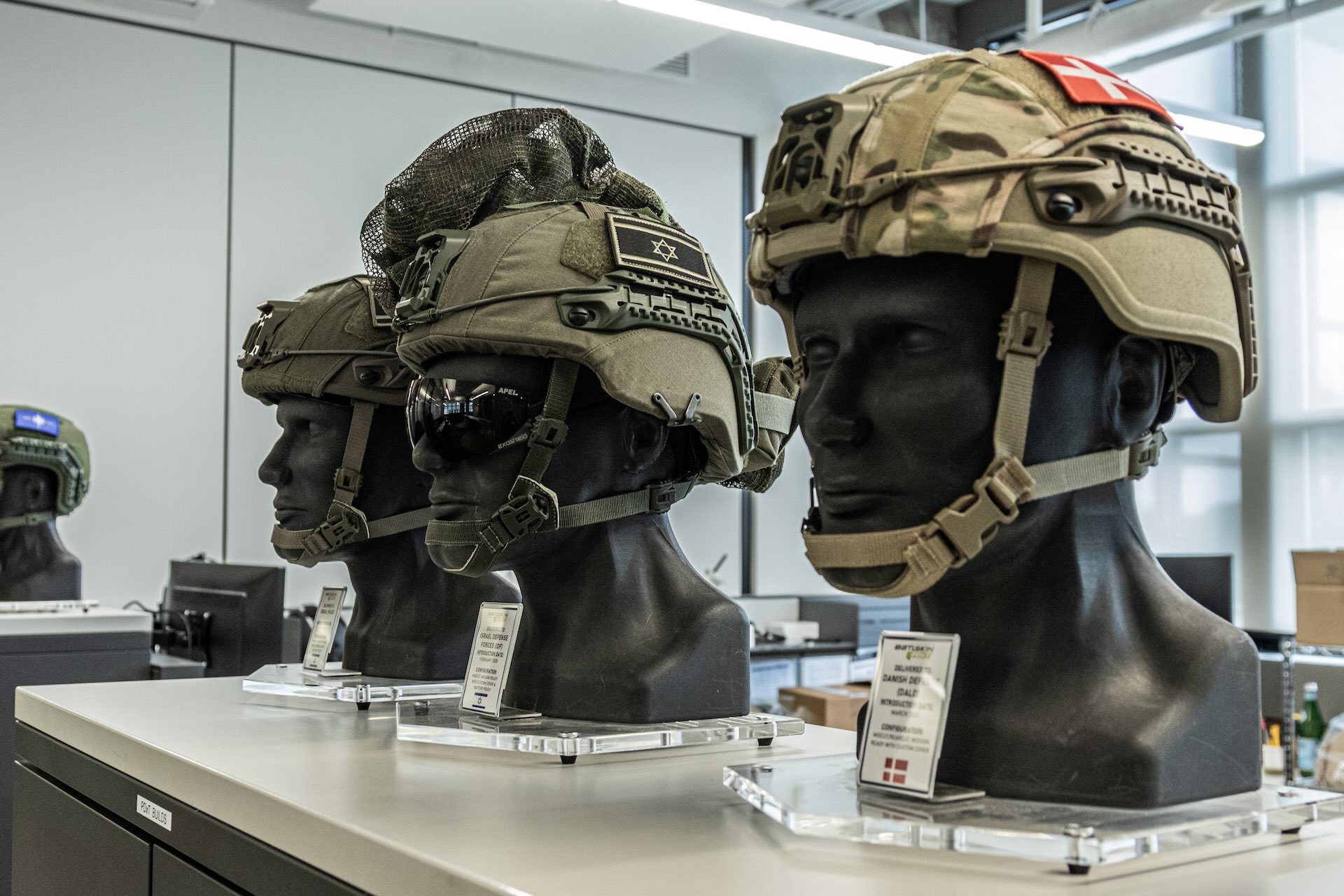
Helmets on display in the Galvion headquarters. Photo: Roger LeMoyne for The Logic
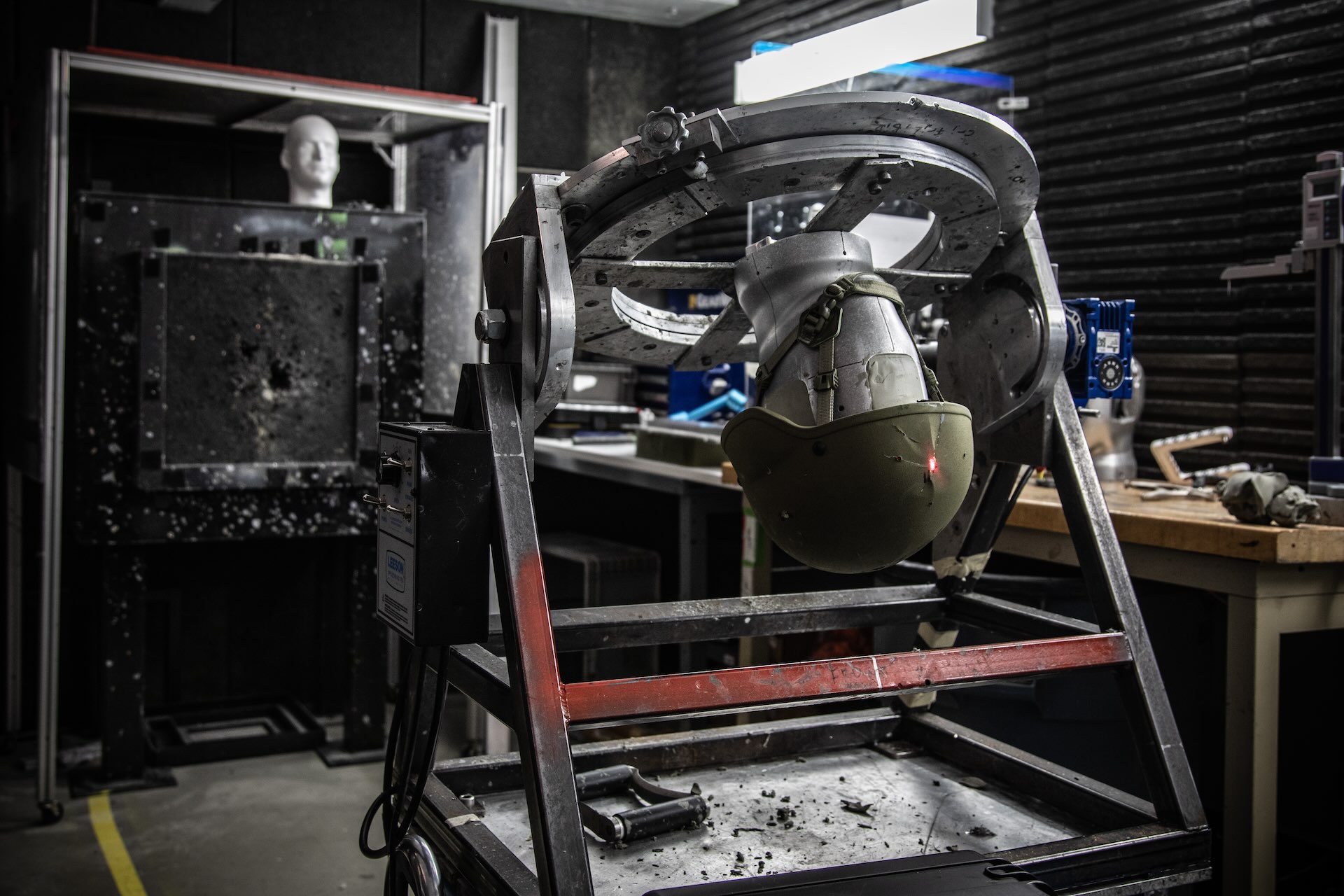
Mannequins of soldiers standing guard are everywhere at Galvion’s offices. Around them, engineers and techs are hard at work, looking very un-soldier-like. In one room, an injection mould machine pumps out helmet prototypes. In another, ballistic lab specialist Alexandru Tatarescu packs a nine-millimetre cartridge with gunpowder and a bullet as Alice Cooper’s “Poison” plays in the background.
In the adjoining gun range he loads it into a universal receiver, which is able to fire projectiles of varying calibre. He triggers the receiver remotely, then we return to the range to see the damage. The bullet, having travelled 4.5 metres at 364 metres per second, came to rest in a Caiman test helmet, leaving only a walnut-sized bump on its interior.
A dented helmet that’s been tested at Galvion’s headquarters. Photo: Roger LeMoyne for The Logic
Galvion’s marketing is the stuff of testosterone-fuelled daydreams, and it often belies the defensive nature of its chief product. Those aren’t blue-helmeted peacekeepers in a promotional video for the Caiman helmet and its high-tech accoutrements. Instead, stoic men in camo suit up for battle, then climb into the bed of a rumbling diesel truck. Green laser sites, German Shepherds and American flags abound. It’s less United Nations than Sicario b-roll—a nod, Blanshay said, to the U.S. ‘warfighter’ ethos, which helps when selling helmets to Americans. In this world, Galvion’s wares are part and parcel of a soldier’s lethality. After all, someone needs to be alive to kill.
There was a point, Blanshay said, when the company considered going into offensive weapons. It ultimately reneged—not for moral reasons, but because the stigma attached to the industry can ultimately hurt the bottom line. Case in point: under mounting international pressure, a number of countries have ceased selling arms to Israel, Canada included. Meanwhile, Galvion has supplied the Israeli Defense Forces since 2020 and the Israeli police since 2021.
This under-the-radar ability to conduct uninterrupted business in a fraught market will likely bode well for the company when it moves toward a “liquidity event” (read: sale) for its shareholder base, which Blanshay said is likely at some point in the middle term.
There’s money in selling bullets. But defending against them can be a much better investment.
Martin Patriquin is The Logic’s Quebec correspondent. He joined in 2019 after 10 years as Quebec bureau chief for Maclean’s. A National Magazine Award and SABEW winner, he has written for The New York Times, The Guardian, The Walrus, Vice, BuzzFeed and The Globe and Mail, among others. He is also a panellist on CBC’s “Power & Politics.”