Scam ads masquerading as political news continue to flood Facebook with the Canadian federal election just days away. The ads, some of which have received thousands of comments and reactions, have become increasingly political and sensational, with many using fake news reports about bogus political scandals.
Skip to content
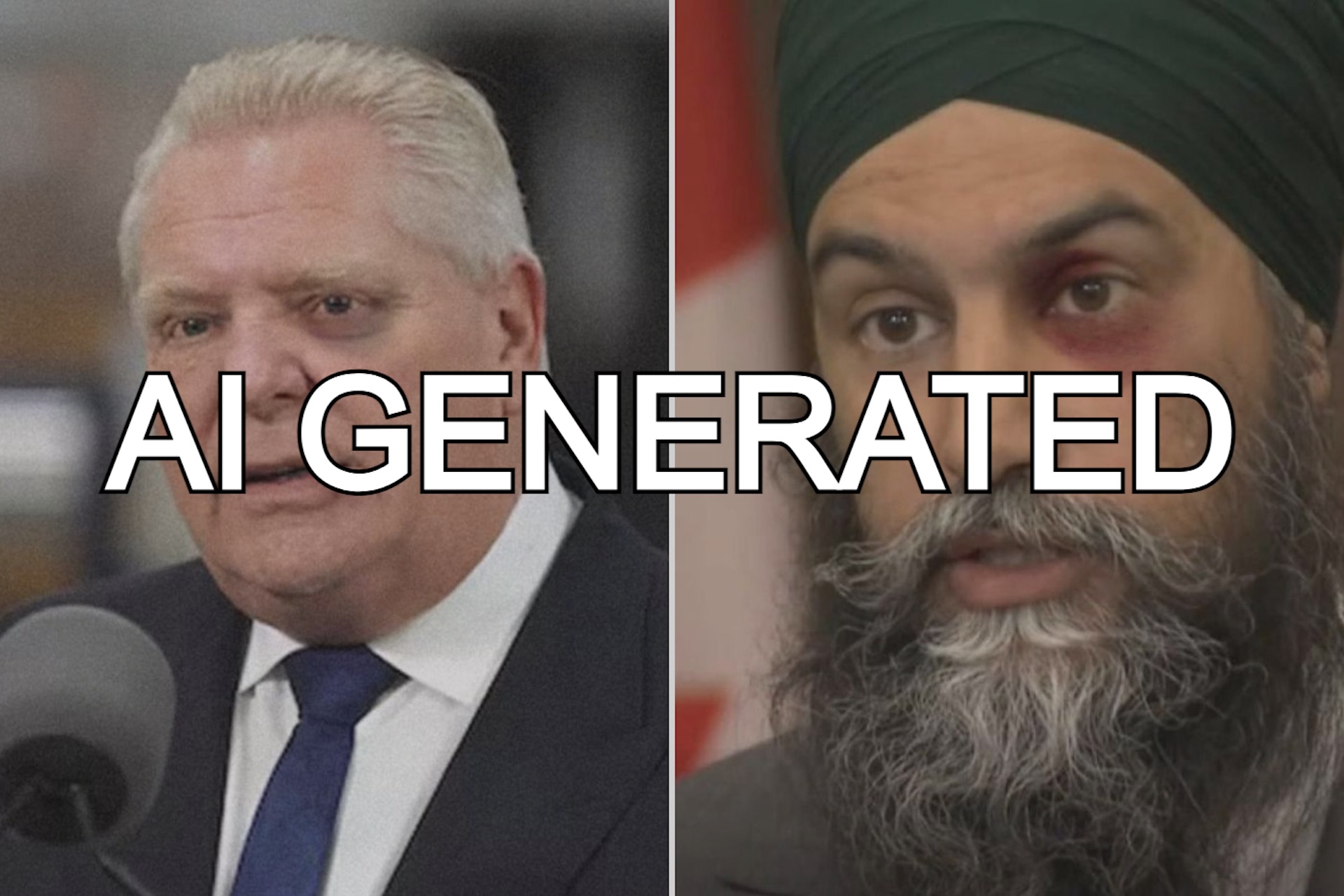
 A number of the scam Facebook ads link to fake versions of the CBC News website. Photo: Facebook/Screengrab

News
Scam political ads on Facebook take a dark turn as Canada’s election looms
The bogus ads show politicians with black eyes and make claims of major scandals for Pierre Poilievre and Doug Ford
A number of scam ads running on Facebook claim NDP leader Jagmeet Singh has been arrested and feature images of Singh and Ontario Premier Doug Ford with black eyes. Photo: Facebook/Screengrab
Scam ads masquerading as political news continue to flood Facebook with the Canadian federal election just days away. The ads, some of which have received thousands of comments and reactions, have become increasingly political and sensational, with many using fake news reports about bogus political scandals.
Some of the ads currently circulating feature a doctored image of NDP Leader Jagmeet Singh with a black eye. The ads link to a fake CBC News story claiming Singh has been arrested. Another scam ad, which has been made to look like a post from CBC News, features a doctored image of Ontario Premier Doug Ford with a black eye and busted lip with the text “the tragic end of Doug Ford” beneath.
Talking Points
- Nearly a quarter of Canadians have seen scam political ads on Facebook in the lead up to the election. The deluge of these advertisements comes as Meta continues to block all news content on Facebook and Instagram in Canada.
- In recent days, the scam ads have become more sensational and political. One campaign features a doctored image of NDP Leader Jagmeet Singh with a black eye and claims he has been arrested.
A number of new scam ads appeared on Facebook in the wake of the federal leaders’ debates last week, many of which masquerade as CBC News stories. Some of the ads feature images of Carney and Conservative Leader Pierre Polievre, claiming that Carney has exposed “the real agenda behind Poilievre’s plan.” Another ad featuring the NDP’s Singh claims his career is over after “allegations against him” were confirmed.
Facebook removed several of the ads after The Logic flagged them to the company. Yet in at least one case, a near-identical version of an ad reappeared on Facebook shortly after the company took it down. The ad in question, a falsified CTV News report, features digitally altered video of Elon Musk and Liberal Leader Mark Carney promoting a crypto scam.
Meta, the parent company of Facebook and Instagram, continues to block all news in Canada in response to federal legislation compelling tech companies to pay for journalism appearing on their platforms. An analysis by The Logic has found that dozens of Facebook accounts are running scores of scam ads masquerading as political news, with more appearing every day.
Related Articles



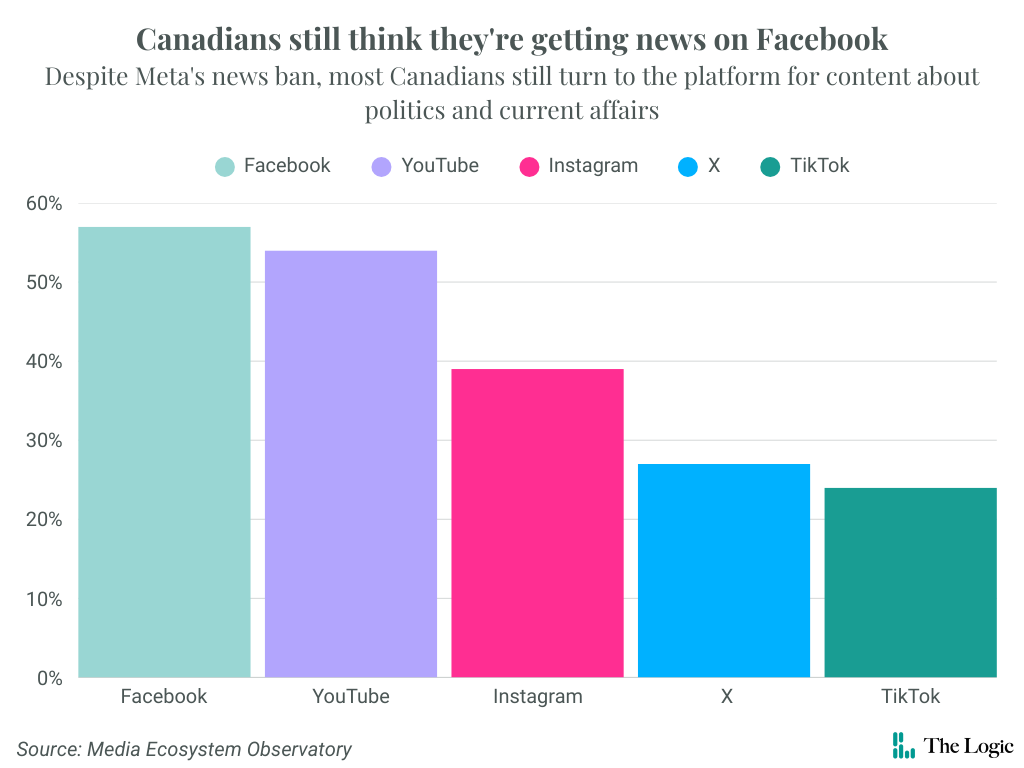
Nearly a quarter of Canadians have seen the fake Facebook ads, according to an analysis by the Media Ecosystem Observatory (MEO), a research group at McGill University and the University of Toronto. Nearly 57 per cent of Canadians continue to rely on Facebook as a news and current affairs source despite Meta’s blocking of news content on the site, according to the MEO.
“It is against our policies to run ads that try to scam or impersonate people or brands,” said
Meta spokesperson Julia Perreira. Fraudsters using elections and other societal events to target social media users is “an ongoing industry-wide challenge,” she said.
As The Logic previously reported, the ads appear to be part of a co-ordinated campaign to promote a cryptocurrency scam. Earlier versions of the ads featured deepfake generative AI videos of CBC and CTV News anchors and deepfake videos of Carney talking about a bogus passive income scheme.
Many of the scam accounts are operated by Facebook users based in Ukraine, page transparency details reveal. An analysis of the code behind some of the fake CBC News articles shows lines written in Cyrillic, the alphabet used by several Slavic countries including Russia. Other pages are run by Facebook users based in Angola, Indonesia, Romania, Vietnam and the United States.
The use of Cyrillic in the HTML structure of the false CBC websites “suggests possible Russian involvement,” with some of the scams related to financial services firm TwentyOneVC, according to a report that digital threat research group Reset Tech shared with The Logic. “TwentyOneVC is attributed with high confidence to Russian-speaking eastern European financial scam actors specializing in crypto investment fraud,” reads the report.
An email sent to TwentyOneVC’s general mailbox bounced back with a notification that the address doesn’t exist.
Some of the scam accounts appear to have been hijacked from legitimate businesses, with one previously belonging to La Tienda de las Pegatinas, a vinyl sticker firm based in Trobajo del Camino, Spain. In a statement, the firm said it was “aware of the identity theft” and was waiting for a response from Facebook. “It is not an easy task,” the firm added. Another seemingly hijacked account previously belonged to the Merton Holiday Inn, a hotel in Phnom Penh, Cambodia. Calls made to the hotel were not answered.
Another scam ad featured a fake CBC News story about the “political blood feud” between Carney and Poilievre. The ad, which was posted by an account using the name Caroline Robinson, featured a generative AI image of a smiling woman as its profile picture and listed a Utah-based phone number as a contact. A call to that number was answered with an alarm-like noise. Facebook deleted the account after The Logic flagged it to the company.
CBC public affairs director Kerry Kelly said the broadcaster is “committed” to fighting disinformation which “misleads the public and puts at risk their trust in legitimate media outlets” and that the organization was “especially troubled” by scams that use its trademarks and news presenters in fake ads. Kelly added that the CBC regularly contacts companies, including Meta, to request that such ads be removed. “However, the problem persists,” she said.
The network has also contacted the Competition Bureau, which investigates false advertising and deceptive marketing practices, said Kelly. Citing its confidentiality policy, Competition Bureau spokesperson Anna Maiorino wouldn’t confirm whether it had received complaints about ads on Meta platforms, or whether it was investigating the company. Neither Singh nor Ford responded to a request for comment.
Many of the scam accounts use similar generative AI photos of smiling faces as their profile pictures, while others use fake news network logos and account handles such as “Info Canada Now,” “Red Leaf Report” and “New Canada.” Facebook appears to be taking down some of the accounts, but new ones are regularly posted using the same or similar images and videos.
The Logic’s analysis of the scam ads shows that the text of the fake news stories was entirely AI generated. Comments beneath the ads on Facebook suggest most people recognize them to be scams, though at least some believe them to be real. “CBC. Enough said,” reads one. “Carney will kill any hope our children have,” reads another.



Loading...
Thanks for sharing!
You have shared 5 articles this month and reached the maximum amount of shares available.
CloseThis account has reached its share limit.
If you would like to purchase a sharing license please contact The Logic support at [email protected].
CloseGift the full article!
You have gifted 0 article(s) this month and have 5 remaining.
Recipients will be able to read the full text of the article after submitting their email address. They will not have access to other articles or subscriber benefits.
Photo: Facebook/Screengrab
A number of the scam Facebook ads link to fake versions of the CBC News website.
Most Popular This Week




In-depth, agenda-setting reporting
Great journalism delivered straight to your inbox.
Commentary
Carmichael: Canadian ignorance about India is a strategic weakness
Briefing
Aritzia shares pop after earnings rise 204%
First Nation in Alberta goes to court over fast-tracked oil pipeline
Chinese EV maker Geely Auto Group to launch in Canadian market in 2027
Best business newsletter in Canada
Get up to speed in minutes with insights and analysis on the most important stories of the day, every weekday.
Exclusive events
See the bigger picture with reporters and industry experts in subscriber-exclusive events.
Membership in The Logic Council
Membership provides access to our popular Slack channel, participation in subscriber surveys and invitations to exclusive events with our journalists and special guests.





