MONTREAL — On November 4, as much of the world’s attention was directed at a certain pumpkin-coloured also-ran, one of the biggest energy companies in the world announced its intention to use Quebec-sourced technology to create the Holy Grail of power generation: carbon-negative electricity.
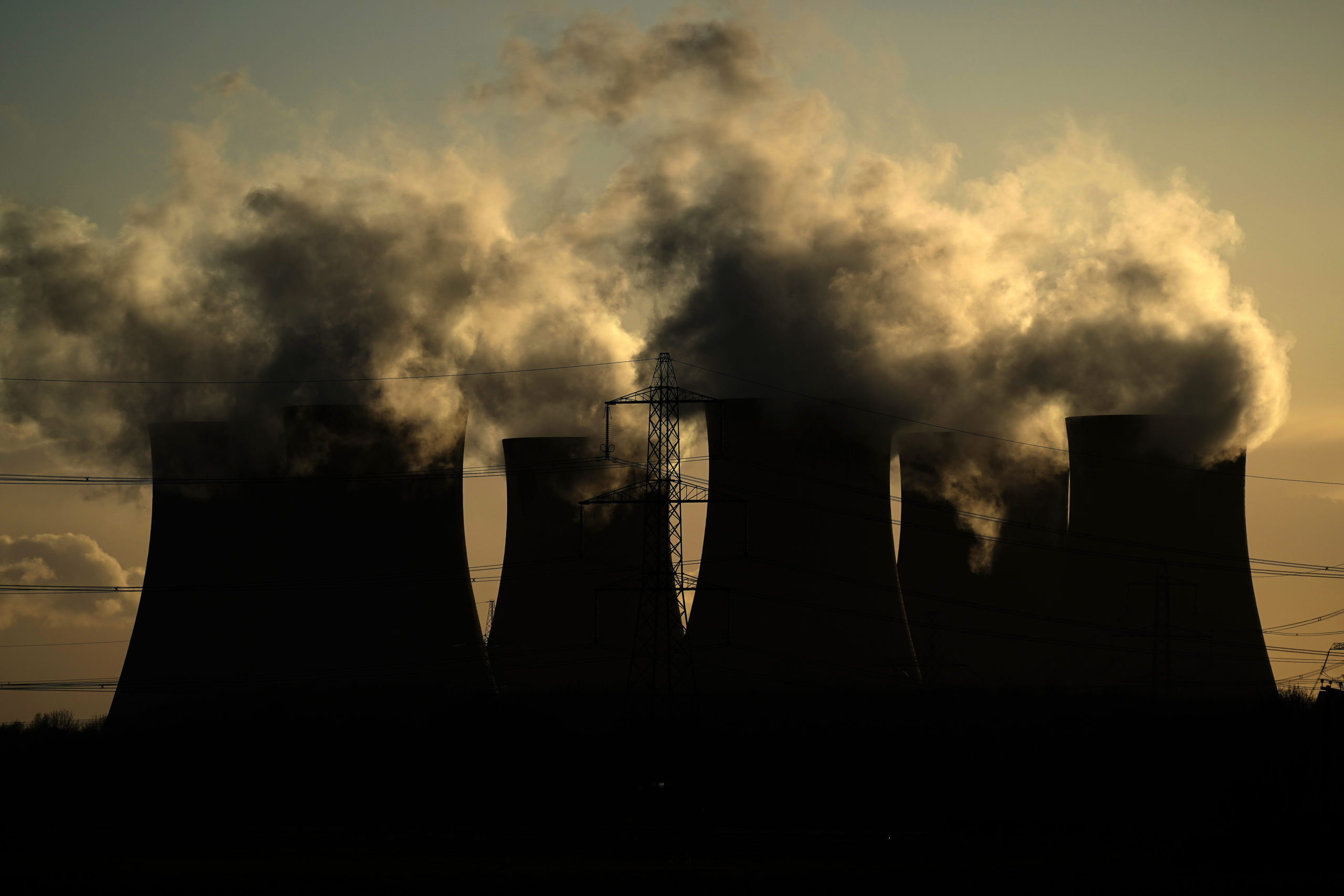
Should they be built—and it’s a massive, very expensive if—Shell’s carbon-capture units would be affixed to the two of the four stacks of the Drax Power Station in North Yorkshire, which supplies 12 per cent of the U.K.’s power.
These units would collectively filter out and separate roughly eight million tons of carbon per year. The offending gas would then be piped about 160 kilometres and pumped 3,000 metres beneath the bed of the North Sea, where it would remain, effectively, forever.
Talking Point
It is suddenly an auspicious time to be in the carbon-capture and -storage game. The process is central to Joe Biden’s environmental platform, with the U.S. president-elect promising to “double down on federal investments and enhance tax incentives” for the technology. Canadian Environment Minister Jonathan Wilkinson said his ministry is considering both tax incentives and an increase in the carbon levy to facilitate the development of more carbon-capture facilities in the country.
Because the power plant’s feedstock is wood pellets derived from lumber operations—little bundles of carbon—the process would have the net effect of removing carbon dioxide from the atmosphere, much as a living tree does—though without the carbon being released when the tree dies or is burned. As a result, the resulting electricity is arguably more guilt-free than the merely carbon-neutral stuff churned into being by Quebec’s mighty dams.
It is suddenly an auspicious time to be in the carbon-capture and -storage (CCS) game. The process is central to Joe Biden’s environmental platform, with the U.S. president-elect promising to “double down on federal investments and enhance tax incentives” for the technology.
The Canadian government is gung-ho, as well. Environment Minister Jonathan Wilkinson told me his ministry is considering both tax incentives and an increase in the carbon levy to facilitate the development of more carbon-capture facilities in the country.
“We are developing Canada’s enhanced climate plan, and we’re looking at all the potential tools, and that includes the potential for an escalation of the price on pollution,” he told me last week. (Currently, the federal carbon tax will top out at $50 a tonne after 2022.)
Already, 11 of the world’s 20 CCS power-generation plants under development as of June are in the U.S., while the world’s 51 CCS plants operating or under construction will have the capacity to capture and remove 40 million tonnes of CO2 every year. Saskatchewan’s Boundary Dam Power Station, a 61-year-old coal-fired power-generating plant retrofitted with the same technology as is planned for the Drax project across the pond, has kept millions of yearly tons of carbon from floating into the heavens since it came online in 2014.
And though Shell is headquartered in The Hague, the green technology behind this environmental sleight of hand behind Drax Group PLC’s proposal was born in Montreal’s east end.
Cansolv was born in 1997, when four former Union Carbide employees bought the company’s sulphur-dioxide-scrubbing technology and, in 2002, rejigged it to instead trap carbon dioxide. The threat of the gas to the earth’s climate wasn’t as widely known, and the company at first struggled to convince anyone of the necessity of its wares. So it lived on a host of Quebec research and development tax credits until the demand for carbon removal emerged.
“Quebec has the best R&D credit system in the country,” Cansolv co-founder John Sarlis told me. “We wouldn’t have survived without them.” (Cansolv was sold to Shell in 2008.)
Yet much like the Holy Grail, attaining carbon-negative energy by way of carbon capture and sequestration is a long, fraught process, with no guarantee of success. Like all CCS projects, the Drax Power Station is beset by caveats involving money, politics and a forever-wary environmental movement.
First, there’s cost. Burning stuff, then separating and capturing part of the effluent is an almost comically expensive endeavor. Though Drax Group hasn’t released any figures, the (much smaller) Boundary Dam project in Saskatchewan cost $1.5 billion—including a cost overrun of $200 million. These projects are necessarily large and capital-intensive. As such, they often live and die on government grants and tax breaks.
Once built, they still suffer the pratfalls of employing bleeding-edge technology, as well as the whims of the world energy market. Consider the case of Petra Nova, one of the largest carbon-capture operations in the world.
In theory, the Texas electricity-producing behemoth solved two problems at once. CCS technology diverted CO2 from Petra Nova’s furnaces, thus allowing the continued incineration of Texas’s bountiful coal reserves. And the resulting CO2 was in oil companies, who used the gas to coax more oil from their reservoirs. The U.S. Department of Energy ponied up US$195 million in grants, while two Japanese banks provided US$250 million in financing subsidize the plant’s estimated US$1-billion price tag.
In practice, Petra Nova suffered mechanical problems and missed carbon-capture milestones before being mothballed less than three years after it opened, victim of the COVID-19-era oil-price collapse.
Carbon capture also faces an arguably trickier problem: generally speaking, environmentalists don’t much like it. Greenpeace Canada called it “a great distraction,” while Liberal Heritage Minister Steven Guilbeault, back when he was a lowly environmental activist, said the technology mostly served as a fig leaf for Big Petroleum. Caroline Brouillette, a policy analyst at Climate Action Network Canada, told me that carbon capture was a “false solution” that only “perpetuates the status quo.”
One need look no further than in Quebec’s backyard to see the truth in Brouillette’s invective. The McInnis cement factory is a tale of old-school political favouritism, in which a powerful, politically connected family (the Beaudoins, of Bombardier fame) secured some $350 million in provincial funding in 2014 to build a carbon-heavy, arguably redundant and logistically dubious plant some 700 kilometres from Montreal. It is by far the largest carbon emitter in the province.
McInnis often lauds itself for its comparatively modest carbon footprint, and has said it wants to use carbon-capture technology to make it even smaller. This spiel amounts to a lot of hot air, at least according to one director who pitched the company on behalf of a large energy concern.
“They talk about carbon capture because people are yelling at them about emissions. They have no clue what they’re doing, and they’re doing it only to greenwash,” said the director, who didn’t want his name used because he’d get fired. (In the past, McInnis has said it is aware of its carbon emissions, and “is committed to gradually reducing its GHG.” Nonetheless, Quebec Premier François Legault recently called the entire McInnis project “a serious mistake” perpetuated by previous governments.)
Yet this debate over the role of carbon capture in the fight against climate change often overlooks a key fact: there is no Holy Grail. The carbon-capture technology developed in the east end of Montreal is but one tool that, cobbled together with other tools, we hope will amount to a solution to the most vexing and critical problem of our time. And as governments in Ottawa and across the country pour money into ambitious cleantech ventures, it’s worth remembering: with any emerging tech space, there will be hype and realities, successes and boondoggles.
Martin Patriquin is The Logic’s Quebec correspondent. He joined in 2019 after 10 years as Quebec bureau chief for Maclean’s. A National Magazine Award winner, he has written for The New York Times, The Guardian, The Walrus, Vice, BuzzFeed and The Globe and Mail, among others. He is also a panelist on CBC’s “Power & Politics.” @MartinPatriquin