Carney reveals plans for bigger deficits, billions in spending in costed Liberal platform
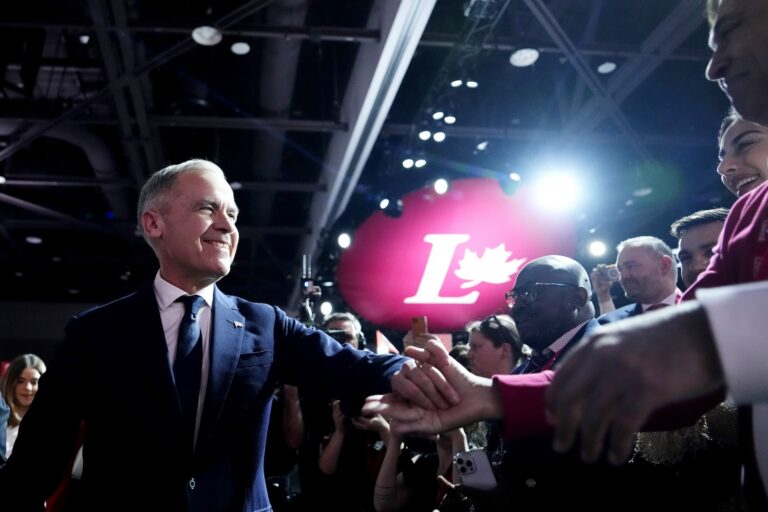
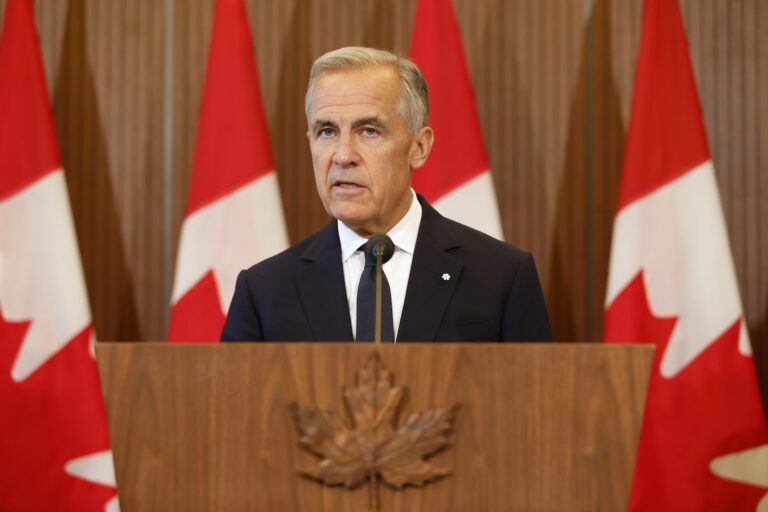
OTTAWA — A re-elected Liberal government would run steep deficits, according to the platform leader Mark Carney released at a college in Whitby, Ont., on Saturday. They’re needed, he said, to buttress Canada in a world where President Donald Trump’s United States is no longer a close friend or a global economic leader.
Here’s what you need to know.
News
Carney reveals plans for bigger deficits, billions in spending in costed Liberal platform
Liberal leader promises to use ‘overwhelming force’ of government to deal with fallout of Trump’s assault on global trade
Liberal Leader Mark Carney operates a robotic nailer for making prefab homes during a campaign stop in Delta, B.C.; Carney revealed his party's costed election platform on Saturday. Photo: The Canadian Press/Sean Kilpatrick
OTTAWA — A re-elected Liberal government would run steep deficits, according to the platform leader Mark Carney released at a college in Whitby, Ont., on Saturday. They’re needed, he said, to buttress Canada in a world where President Donald Trump’s United States is no longer a close friend or a global economic leader.
Here’s what you need to know.
Carney’s message: The government has spent too much on the wrong things under his predecessor Justin Trudeau, but now must spend aggressively to build a Canada that can stand on its own in the face of Trump’s threats, Carney said, claiming he is being prudent even while planning to spend a lot more public money.
“To succeed in a crisis, you have to act with overwhelming force,” he said. Carney was alluding to former U.S. treasury secretary Tim Geithner’s approach to shoring up confidence in the financial system during bank runs—like the one in 2008, when Carney, then governor of the Bank of Canada, made his own name as a crisis manager.
To quell a panic, authorities want to leave zero doubt about their willingness and ability to beat back all menaces, and the Liberals believe the trade war with the U.S. is such a fight, Carney said.
Geithner was talking about reassuring depositors that their accounts were safe when, in most cases, they already were. Carney is talking about protecting an economy under real threat. When the private sector retreats, the government has to step up, he said. “It’s said there are no atheists in foxholes. There should be no libertarians in crises.”
What’s new for the innovation economy: Carney has mostly stayed mum on the campaign trail about supporting Canadian innovators, but his platform includes policies intended to keep Canadian-grown ideas and businesses from migrating to the U.S.
Some of the ways Carney plans to do that were already announced last year by the Trudeau-led Liberal government. They include a pledge to put another $1 billion toward the Venture Capital Catalyst Initiative, with specific funding dedicated to spur the growth of defence companies. He also plans to move ahead with plans to reinstate the Accelerated Investment Incentive, which gives companies more immediate tax benefits when they invest in capital assets such as equipment for manufacturing or zero-emission vehicles. Carney also said he’ll make good on the government’s promise of a “patent box” system that would give firms a tax break on IP they hold in Canada.
The Liberals hope to expand private sector investment in research and development by increasing the claimable amount under the scientific research and experimental development tax incentive program (SR&ED) from $4.5 million to $6 million. The Liberals boosted the expenditure limit from $3 million just four months ago The campaign estimates the additional increase to the limit would support over $11 billion in private R&D over five years. However, the proposals fall short of the broader overhaul of the program that Canada’s tech industry has been calling for. Their asks have included expanding SR&ED to include the cost of commercialization efforts, and streamlining the application process.
Instead a Carney-led government would try to encourage investment in Canadian startups using flow-through shares to support companies in AI, quantum computing, biotech and advanced manufacturing. The special shares, used most commonly in the mining industry, are intended to draw in investments by giving shareholders a tax break. Cleantech firms have lobbied for access to that type of incentive for years.
Already promised: The Liberal platform is a hefty document, though a lot of it recaps pledges Carney has made already in the campaign. Those include cutting a point off the lowest federal tax rate (at an eventual cost of nearly $6.1 billion a year) and cancelling changes to the capital gains tax regime; creating a $2-billion “strategic response fund” for the auto sector; getting the federal government back into the homebuilding business ($2.9 billion a year); and boosting funding to the CBC by $150 million a year.
The bottom line: The Liberal platform promises noticeably bigger deficits in the coming years than the Trudeau government’s last fiscal update projected: $62.3 billion this fiscal year instead of $42.2 billion, shrinking to $47.8 billion in 2028–29 instead of $27.8 billion.
The plan projects that $62.3-billion deficit in the first year despite anticipating $20 billion in revenue from retaliatory tariffs against the United States. The Liberals aren’t assuming any revenue from retaliatory measures beyond this fiscal year. If the trade war is still raging next year, that’s bad for Canada, Carney said, but a Liberal government will deal with it if it happens.
“We don’t think to assume that those tariff revenues are in place is prudent at all,” Carney said.
By the end of the platform’s horizon, Carney promises to have found $13 billion a year in “savings from increased government productivity,” after a comprehensive review of spending and how the government operates.
The document also emphasizes how keen the Liberals now are to buy lasting things—military equipment, better transportation networks—instead of spending on social services and redistributing wealth. Canadian federal budgets have not traditionally made a distinction between capital and operating spending, but by 2028–29, what the Liberals consider “operating” spending will be in a small surplus of $222.4 million, the platform says. The deficit by that point would consist entirely of capital spending.
A deficit is still a deficit, but former parliamentary budget officer Kevin Page has previously told The Logic that he welcomes re-cutting the numbers this way, since it adds more transparency to spending and creates another target to measure the governing party’s performance. The U.K. and Germany are among the countries that do this, he said.
The New Democrats’ vision: The NDP, trailing badly in public polls, also released its platform, with its costs, Saturday. It promises the New Democrats would “fight to” provide universal access to family doctors by 2030, national rent control, price caps on essential groceries such as pasta and baby formula, and to remove federal sales tax on “basics like home heating, diapers, and internet.”
It also includes a wealth tax on people whose net worths are greater than $10 million, to raise nearly $25.1 billion a year by 2028–29, and ongoing revenue from tariffs.
The platform pledges a declining debt-to-GDP ratio by the fourth year of an NDP government, even under pessimistic economic scenarios.
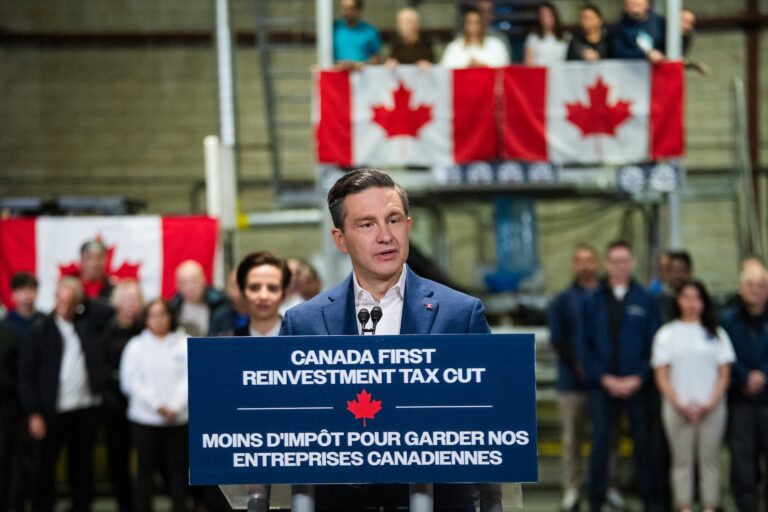
Conservative plan to come: Conservative Leader Pierre Poilievre criticized Carney’s plan to run even larger deficits than the former Liberal government led by Justin Trudeau, but still hasn’t revealed what his own plans will cost. With just over a week left in the campaign, Poilievre said his party’s costed platform “will soon be available.” Party spokesperson Sam Lilly did not respond to questions about whether they would release it before advance polls close on Monday.
Recipients will be able to read the full text of the article after submitting their email address. They will not have access to other articles or subscriber benefits.
Great journalism delivered straight to your inbox.
News
How Mark Carney plans to wage trade war against the United States
By
Laura Osman and Murad Hemmadi
Briefing
Roots to go private in deal led by Marquee Brands
By Catherine McIntyre |
Negotiations once again down to the wire as tariff countdown ticks toward midnight
By Laura Osman |
Domtar shutters B.C. pulp mill over reduced demand and poor prices
By Laura Osman |
Best business newsletter in Canada
Get up to speed in minutes with insights and analysis on the most important stories of the day, every weekday.
Exclusive events
See the bigger picture with reporters and industry experts in subscriber-exclusive events.
Membership in The Logic Council
Membership provides access to our popular Slack channel, participation in subscriber surveys and invitations to exclusive events with our journalists and special guests.