Sponsored Content
How AI can fight financial fraud
Inside BMO Financial Group’s artificial intelligence-powered quest to better handle money scams, —and help prevent them from happening in the first place
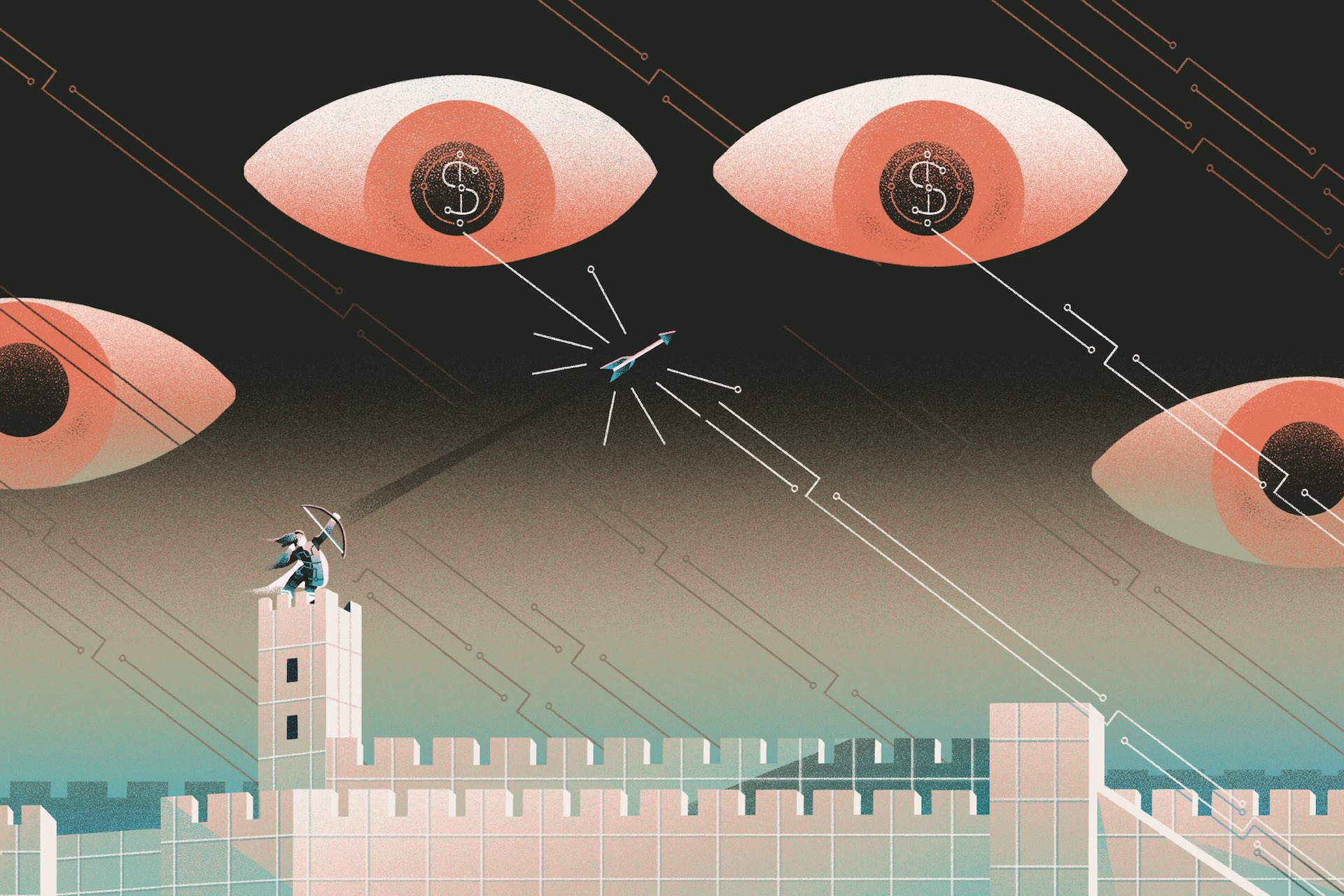
Photo: Illustration by Jeannie Phan

Sponsored by:
Sponsored by:
Once upon a time, financial fraud was physical business. The act of duping folks out of their money was—as it remains—dirty, devastating, and decisively illegal work, but its scope was constrained by having to involve, at some point, physical humans moving physical items (like cash) to physical places (like safes).
Those days aren’t gone, exactly—believe it or not, cheque fraud remains one of the most common money scams in the U.S. today—but for the past 30-odd years, the grift has gone digital, with scammers’ pool of potential marks mushrooming from “teller at a bank branch” or “person on the street” to, essentially, “anyone on the internet.” Now, with the ascent of AI, the front is expanding at an exponential and unprecedented pace. “The digital shift and the criminal use of social engineering tactics are creating a new frontier of fraud,” explains Ryan Ku, Director of Financial Crimes at the Canadian Bankers Association. “The risk-reward ratio for digital financial crime—often done at a distance—has become more attractive to criminals.”
The numbers bear Ku out. Fraud cases in Canada nearly doubled from 2012 to 2022, which Competition Board Canada attributes to more bad actors getting more skillful in their use of technologies like AI. Last year, Canadians lost $567 million to financial fraud schemes—including spear phishing and romance scams—up 40 per cent from 2021; globally, citizens were conned out of US$500 billion in 2023. And that’s just what people report: The Canadian Anti-Fraud Centre estimates that only five to 10 per cent of fraud victims bring the crime forward to officials, making this a multi-billion-dollar problem. Indeed, in October, the Office of the Superintendent of Financial Institutions flagged challenges related to AI—including its use by criminals to commit fraud—as one of the most significant risks facing Canada’s financial system today.
Governments, law enforcement agencies, consumer protection groups, and financial institutions are all rapidly scaling their offenses against fraud—and AI is an increasingly clutch weapon in their arsenals. Yet employing such bleeding-edge technologies is not without risk, especially with peoples’ financial futures on the line.
Related Articles


How can fraud-fighters proceed with the bold proactivity the situation warrants, while simultaneously maintaining the caution and care their stakeholders demand? Consider the strategy of BMO Financial Group, which has been on a multi-year journey to integrate machine learning and AI across its operations—including dealing with fraud. “The ways people get scammed are just heartbreaking,” explains Ash Khan, Head of Enterprise Fraud Management at the bank. “From government and law enforcement to financial institutions, online platforms, and telecommunication providers, each of us has a role to play in helping to prevent fraud before it occurs. When it does, it’s really important for us to use the best tools and capabilities that we have to stop it.” In that spirit, BMO is applying a holistic approach—powered by good data and guided by human judgment—to responsibly harness AI to help detect and prevent scams.
Understanding the potential
To level-set: The hype is real. AI now has the capability to amplify the scam-busting efforts of financial institutions in several key—and transformative—ways. The technology increases data-management capacity, processing far more information than a person with a laptop—or even many people with many laptops—would ever be able to do. It accelerates speed, automating previously manual activities and crunching numbers fast enough to trigger near-immediate responses to threats and incidents. And it expands scope, identifying patterns and anomalies that most human brains would simply miss. Bolstered with machine learning mechanisms like natural language processing and voice detection, AI is now sophisticated enough to predict some crimes before they happen.
“AI will help banks in terms of scalability, meaning they can handle and train [data] on a large amount of financial transactions on a daily basis, which is way superior to the manual method,” says Mark Lokanan, a Professor at Royal Roads University who studies how machine learning and AI is used to manage financial fraud, and who also serves as the CEO of Victoria-based AI and data analytics services firm Vedia Cloud Analytics. “These algorithms can allow banks to actually respond in real time to an actual fraud occurring.”
It’s easy to be dazzled by AI’s seemingly panacea-like potential to stymie scams, but Lokanan stresses that the technology’s efficacy is highly contingent on the environments in which it’s applied. Organizations—especially big, complex ones—need two key variables to leverage AI as a fraud fighter: clean data to fuel the engine and human expertise to check how it’s running.
Which brings us to BMO, a bank that is prioritizing both.
Pairing good data with good judgment
Today, at any given moment, BMO is running hundreds of machine learning algorithms to sniff out scams, deploying a roster of chatbots and virtual assistants to triage customer reports, and introducing new AI capabilities into established fraud prevention processes. None of this can happen without stores of reliable, quality, easily accessible information. “We know the answers are in the data,” Lori Bieda, Chief Data and Analytics Officer in North American Personal and Business Banking at BMO. Since scammers are on any advancement in AI technology the second it occurs, she says, the bank has to be equipped to do the same: “In many ways, it’s a race to who can be the fastest employer of intelligence at scale.”
To that end, BMO invests in making sure its data is clean, rich, and secure—an effort aided by its long history in the number-crunching game. Its data is accessible to all employees and applications that need it, thanks in part to the bank’s massive cloud transformation. And it’s all monitored by a team of hundreds of expert analysts, working to refine processes, apply nuanced judgment, and make sure the technology doesn’t cross any boundaries.
In Bieda’s view, these precautions are essential. “You need humans in the loop,” she says. “You need people to establish the guardrails for where your strategy is headed. You need people to validate that the models are detecting things that make sense. You need that combination of tech and talent to come together.” These levers are meant to not only embed prudence into the process, but also protect the bank from some of common critiques of AI in its application in finance, such as its tendency to inject biases and introduce privacy concerns.
Proactively working to address potential risks is a smart move during the adoption of any transformative new technology, says Masoumeh Shafieinejad, an applied machine learning scientist focused on privacy enhancing technologies at the Vector Institute, which BMO partners with on several initiatives to advance the integration of AI-enabled solutions. “You don’t construct a building and then think about making it safe; you need to embed the safety requirements while you’re making it,” Shafieinejad explains. “That’s the case with AI as well. Now, is that easy? No. But is it important? Yes.”
Building on a bank-wide mission
AI technology is meant to complement—not replace—what is already a bank-wide imperative to dissuade bad acts and disarm bad actors. “I consider every person at the bank to be a fraud fighter,” Khan explains. Bank employees—are trained on how to spot fishy activity. If they miss something, or if a fraudster is especially sophisticated, a range of detection and prevention tools are in place to clock anomalies and trigger responses—a growing number of which are powered by AI and machine learning.
Overseeing it all is a dedicated Financial Crimes Unit (FCU), an industry-first cross-functional team the bank created in 2019 to centralize its efforts against cyber threats, fraud, physical security, and crisis management. “We take a holistic approach, which allows us to understand the threat landscape because we don’t have silos or barriers between different parts of the organization,” explains Larry Zelvin, Head of the FCU, who points to AI’s value in focusing his team’s efforts to tackle matters of highest priority. “The ability to look across domains, to look across fraud attack vectors, enables organizations to bring up controls far more quickly. ”
While Zelvin—who has spent his entire career chasing bad actors—is quick to acknowledge there is no such thing as perfect security, he is energized by the results emerging from the bank’s tech-powered approach. “If it wasn’t for AI and machine learning, fraud losses would be significantly higher,” he says. “It’s that impactful.”
This content was paid for and directed by BMO Financial Group and was produced independently of The Logic’s newsroom in consultation with the advertiser. You can read our policies on advertising, sponsorships and partnerships here.



Loading...
Thanks for sharing!
You have shared 5 articles this month and reached the maximum amount of shares available.
CloseThis account has reached its share limit.
If you would like to purchase a sharing license please contact The Logic support at [email protected].
CloseGift the full article!
You have gifted 0 article(s) this month and have 5 remaining.
Recipients will be able to read the full text of the article after submitting their email address. They will not have access to other articles or subscriber benefits.










