VANCOUVER — The fourth quarter passed on Canada’s main stock exchange with no innovation-economy firm holding an initial public offering, as companies interested in joining the public markets waited for a window to open once inflation cools and rate hikes cease.
Skip to content


Why Axis
IPO drought in innovation economy continues through Q4
Only one of 26 innovation firms that have IPO’ed on the TSX since 2021 was trading in the black at the end of the most recent quarter
Steve Munford, CEO of ID-verification firm Trulioo, one of several Canadian companies positioned for an IPO once market conditions improve. Photo: Christopher Katsarov Luna for The Logic
VANCOUVER — The fourth quarter passed on Canada’s main stock exchange with no innovation-economy firm holding an initial public offering, as companies interested in joining the public markets waited for a window to open once inflation cools and rate hikes cease.
In 2022, only one innovation-economy firm held an IPO on the Toronto Stock Exchange: Bausch + Lomb, a spinout of Laval, Que.-based Bausch Health Companies, which went public in the second quarter. That’s down from 25 the previous year, according to data from TMX Group. The first and third quarters, like the fourth, had none.
Talking Points
- No firm in the tech, cleantech or life-sciences sectors went public via an IPO on the TSX in the fourth quarter
- Most of the shares of innovation-economy firms that IPO’ed since 2021 are trading below their initial offering prices
Innovation-economy IPOs are following the pattern of activity on the TSX as a whole. The exchange hosted only 20 IPOs in the fourth quarter of 2022, down from 32 the same quarter in 2021. Last year, there were 88 IPOs in total, down nearly 44 per cent from 157 in a record-breaking 2021.
‘Volatility in the market’ continues
“This is not a Canadian problem, but a global issue,” said Dani Lipkin, managing director of the global innovation sector at TMX Group. Changing market conditions in 2022—namely, rising interest rates and high inflation—created less-than-ideal conditions for IPOs globally, he said.
Around the world, markets saw 1,333 IPOs raise US$179.5 billion, according to the professional-services firm Ernst & Young. That’s 45 per cent fewer deals and 61 per cent less money raised than in 2021.
“We continue to see volatility in the market,” Lipkin said, noting the exchange has seen innovation listings on the TSX Venture Exchange, mostly through qualifying transactions, such as through the capital-pool company program. That remains “the No. 1 method for companies to go public with us on both of our exchanges.”
Related Articles


Companies likely did not consider IPOs in the past year as the changing economic conditions “crushed valuations,” said David Wismer, global head of technology investment and corporate banking at BMO Capital Markets. An IPO would have had a “dramatically lower” value than previously expected and institutional investors have been looking to put money into more defensive industries, rather than riskier new firms. “That’s, generally speaking, one of the last things to recover when the market comes back,” he said. “They will undoubtedly turn their attention to IPOs in the innovation sector again, but it’s not going to happen any time soon.”
Breaking markets open
Some firms that had planned to IPO last year or in the near future told The Logic they still intend to do so when conditions are right. Lipkin said he continues to discuss with companies the benefits of going public, and those that want to do so need to be ready when a market window opens.
“Conditions will turn around very quickly,” he said, noting inflation is starting to cool and that he expects the Canadian and U.S. central banks to have stopped raising rates by March. “I think that we’re starting to see more favourable conditions in the long run for IPOs and it’s always just a matter of time before that window will officially open.”
In the bigger U.S. market, Wismer expects a “very small number of IPOs” as early as spring; by the fall, he said, “we expect there to be a window for new issues.” In Canada, he doesn’t expect to see any before autumn.
The IPO drought will be ended by “the strongest businesses,” he predicted. That means a startup with significant scale and profitability. Zafin, Hootsuite, Hopper, Clio, Trulioo, GeoComply, Telus Health or TelusAg, count among the firms thought to be considering future IPOs. Wismer wouldn’t comment on any specifically, but said, “There’s certainly one or two on the list that sort of fit the description.”
Mostly negative results
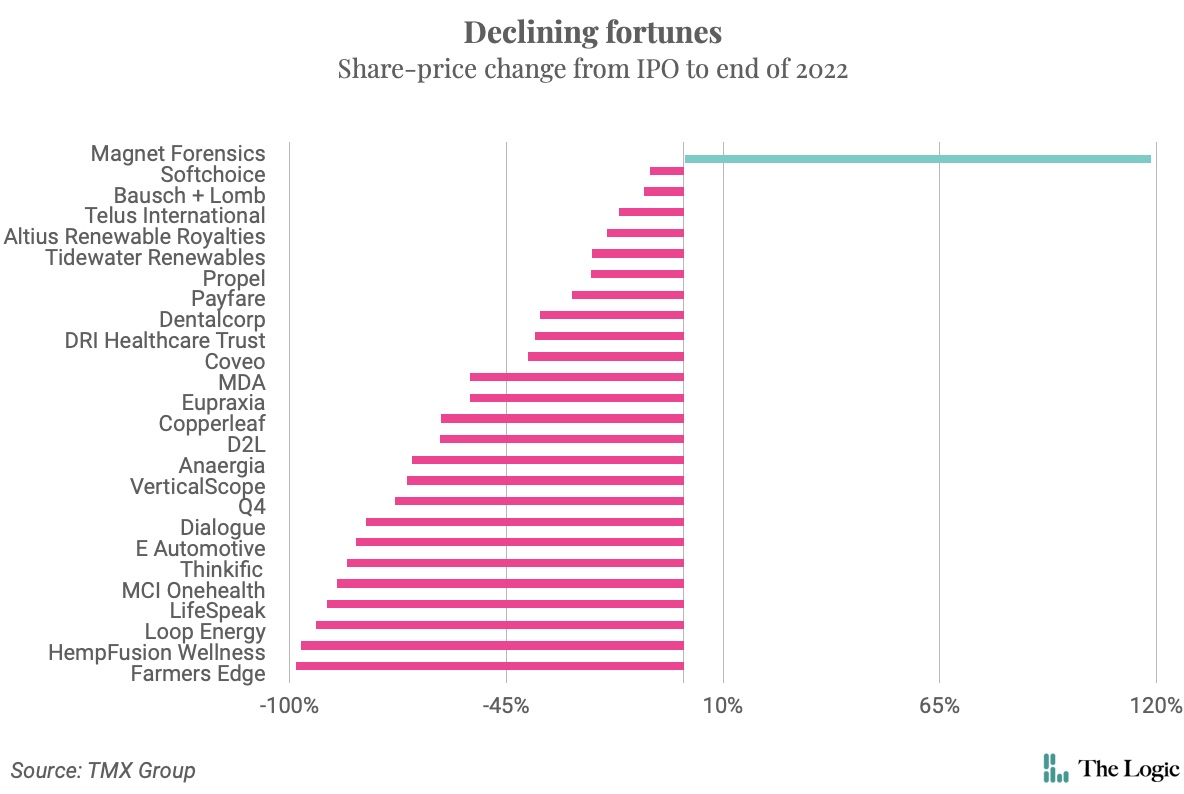
Meanwhile, the shares of the 26 innovation-economy companies that have gone public via IPO on the TSX since 2021 have mostly struggled. The shares of 25 closed the fourth quarter below their IPO prices.
Eleven had shed at least two-thirds of their worth, including the Winnipeg-based precision-agriculture company Farmers Edge, whose shares closed at $0.28 to end the quarter, down 98 per cent from its $17 IPO price. The company, which is in the midst of a turnaround plan under a new CEO, continues to report troubling financial results. HempFusion Wellness, Loop Energy and LifeSpeak also have shed more than 90 per cent of their share values since their respective IPOs.
Of those whose values declined, Softchoice, Bausch + Lomb and Telus International shares fell the least, at nine per cent, 10 per cent and 16 per cent, respectively.
“The universal poor performance is simply a function of multiple compression on all those companies,” said Wismer. Many have met their business expectations, he said, but the market is valuing them at much lower multiples than during the pandemic. “It’s really the market backdrop that explains the majority of that poor share-price performance.”
A rebound is possible, though that depends on market multiples expanding again and how well each company operates, he said. Those factors could result in “significant share-price appreciation.”
Magnet Forensics, a Waterloo, Ont.-based cybersecurity and digital-forensics firm, is the sole issuer whose shares were in the black, closing the fourth quarter at $37.15, up 119 per cent from its $17 IPO price. On Friday, the company announced it will be acquired by an offshoot of Thoma Bravo, a private equity firm, in a deal worth $1.8 billion. Since its public offering, Magnet has benefited from a growth in cyberattacks, expanding its workforce and opening a bureau in Australia. The company has exceeded expectations in many respects, said Wismer. It has a profitable business with a healthy growth rate, he said, in a market that now values those qualities “much more highly than it did a year ago.”



Loading...
Thanks for sharing!
You have shared 5 articles this month and reached the maximum amount of shares available.
CloseThis account has reached its share limit.
If you would like to purchase a sharing license please contact The Logic support at [email protected].
CloseGift the full article!
You have gifted 0 article(s) this month and have 5 remaining.
Recipients will be able to read the full text of the article after submitting their email address. They will not have access to other articles or subscriber benefits.
Photo: Christopher Katsarov Luna for The Logic
Most Popular This Week



In-depth, agenda-setting reporting
Great journalism delivered straight to your inbox.
Commentary
Carmichael: Canadian ignorance about India is a strategic weakness
Briefing
Aritzia shares pop after earnings rise 204%
First Nation in Alberta goes to court over fast-tracked oil pipeline
Chinese EV maker Geely Auto Group to launch in Canadian market in 2027
Best business newsletter in Canada
Get up to speed in minutes with insights and analysis on the most important stories of the day, every weekday.
Exclusive events
See the bigger picture with reporters and industry experts in subscriber-exclusive events.
Membership in The Logic Council
Membership provides access to our popular Slack channel, participation in subscriber surveys and invitations to exclusive events with our journalists and special guests.