Crypto Quarterly is The Logic’s recurring series assessing the overall state of the crypto market, with a focus on Bitcoin, Ethereum, Flow and Cosmos’s Atom, four cryptocurrencies with strong ties to Canada.
Bitcoin has always been billed as having the potential to reinvent the financial system, but for now, Shakepay chief executive Jean Amiouny is focusing on reinventing his own company instead.
Amiouny said the Montreal-based trading platform for Bitcoin and Ether has been implementing a tried and tested strategy for businesses weathering a cyclical downturn: revenue diversification. Fees from a prepaid Visa card that provides Bitcoin cashback rewards have been helping the company weather the prolonged bear market, Amiouny said, and the company has more new products in the works.
Talking Points
- Bitcoin, Ether, Atom and Flow all finished the third quarter of 2023 with double-digit price declines, as did all but one of the Canadian crypto stocks The Logic tracks
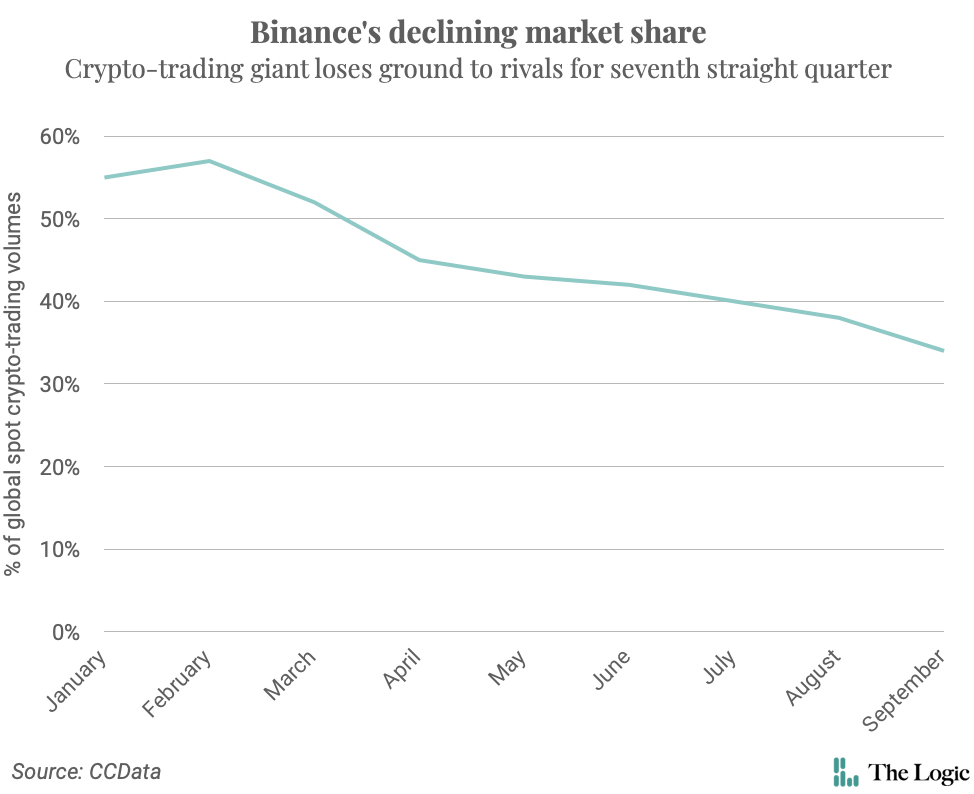
- After benefiting from the collapse of rival FTX in November 2022, Binance’s global market share of spot crypto-trading volumes has been declining for seven straight months
“We started as this place where customers would buy and sell Bitcoin,” Amiouny said. “We’re expanding beyond that and making Bitcoin be a part of people’s everyday lives.”
In the third quarter of 2023, crypto prices declined—just as they have been, as an overall trend, since the collapse of the stablecoin TerraUSD kicked off contagion and a price rout in May of 2022. But Canadian companies in the sector are finding ways to stay alive and hoping for a turnaround.
Bitcoin and Ether ended the quarter down 12 per cent and 14 per cent, respectively, from July 1. Cosmos’s Atom and Dapper Labs’ Flow posted another quarter of double-digit declines, dropping 23 per cent and 16 per cent.
But in September, however, Bitcoin and Ether rose three per cent and one per cent, outperforming the S&P 500 and Nasdaq Composite indices, which dropped five per cent and six per cent, respectively, that month. Bitcoin critics have long cited its historical price correlation with stocks and other risky assets as a reason to doubt boosters’ claims that the digital asset can act as a hedge against inflation or a store of value, but that correlation has been declining in recent months.
Pamela Draper, chief executive of the Calgary-based cryptocurrency-trading platform Bitvo, said Bitcoin’s price divergence from the stock market in 2023 may help convince investors to return. “I think the arguments for portfolio diversification by adding digital assets are stronger in the third quarter of this year than they were in the first quarter of this year,” she said.
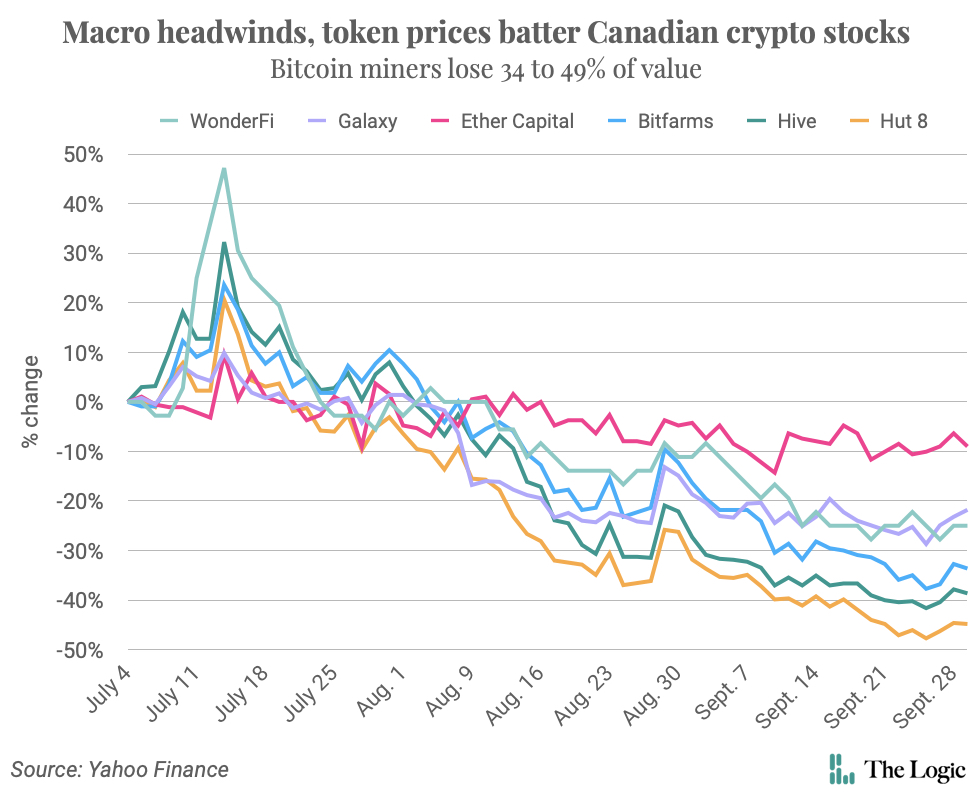
The combination of macroeconomic headwinds and declining crypto prices made for a tough quarter for Canadian crypto stocks. Crypto-trading platform company WonderFi and crypto financial-services firm Galaxy Digital finished the July to September period with stock prices down 25 per cent and 22 per cent, while Ether investor Ether Capital declined nine per cent.
“Historical precedent shows that the asset class has weathered substantial adversities in the past and, with time, would likely continue to do so.”
Crypto mining and high-performance computing companies Bitfarms, Hive and Hut 8 soared in the second quarter along with the price of Bitcoin, but came crashing down in the third quarter as the price of the digital asset dropped. Those companies’ stock prices lost 34, 39 and 45 per cent of their values, respectively.
The crypto sector’s tough times have also hit Binance, the world’s largest crypto-trading platform by volume, which announced it would exit Canada amid a regulatory crackdown in May. After benefiting from the collapse of rival FTX in November 2022, Binance’s global market share of spot crypto-trading volumes has been declining for seven straight months.
Jacob Joseph, a research analyst at the digital-asset data firm CCData, said in an email that Binance’s discontinuation of zero-fee trading promotions has contributed to its market share decline, along with its well-publicized legal and regulatory problems around the world. If Binance were to collapse entirely, it would likely push crypto prices down further and prolong the bear market, he said.
Even that, however, likely wouldn’t be enough to kill crypto, Joseph said. “Historical precedent shows that the asset class has weathered substantial adversities in the past and, with time, would likely continue to do so.”