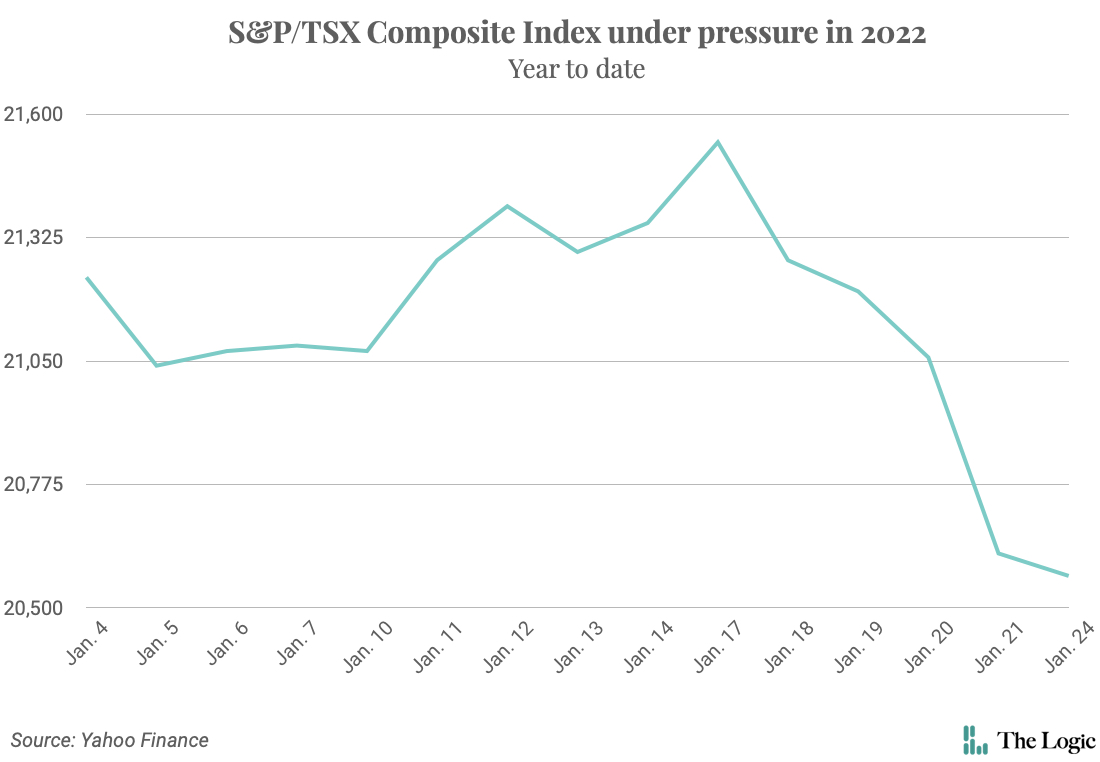
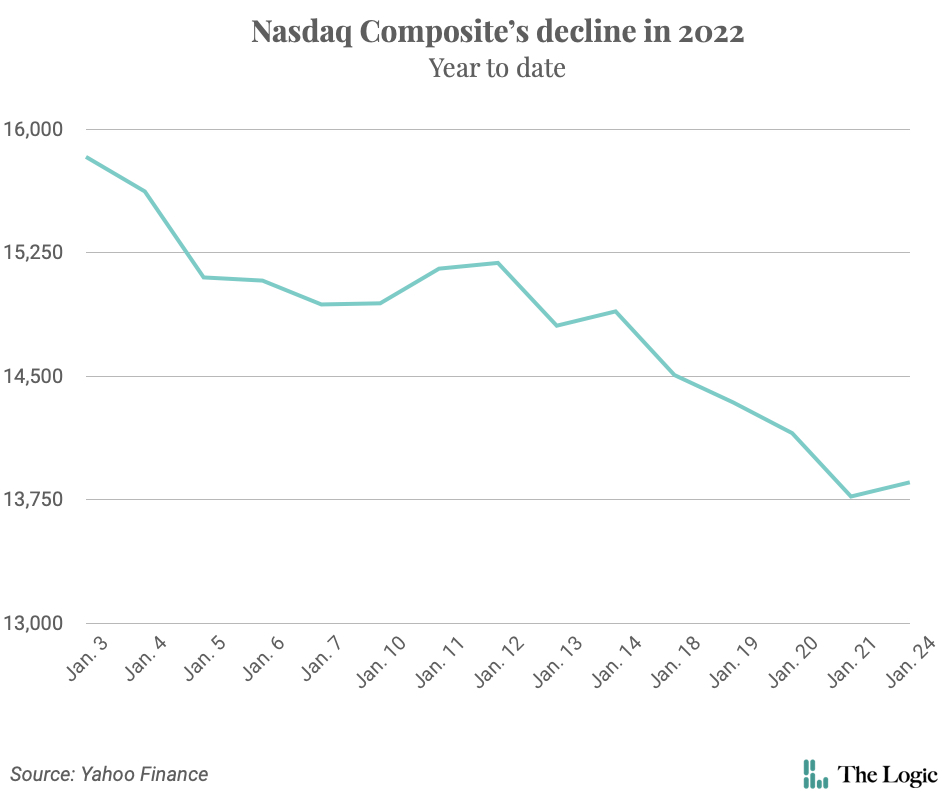
It’s been a rough few days for public companies, as stocks whipsawed amid rising tensions between Russia and Ukraine and ahead of Wednesday’s interest-rate announcements. U.S. markets were headed for their worst month since March 2020, and at one point the Toronto Stock Exchange’s S&P/TSX Composite Index was down nearly 400 points before easing off its lows at the end of the trading day.
Skip to content


News
What volatile markets could mean for Canadian IPOs
Traders work on the floor of the New York Stock Exchange in January 2022. Photo: Spencer Platt/Getty Images
It’s been a rough few days for public companies, as stocks whipsawed amid rising tensions between Russia and Ukraine and ahead of Wednesday’s interest-rate announcements. U.S. markets were headed for their worst month since March 2020, and at one point the Toronto Stock Exchange’s S&P/TSX Composite Index was down nearly 400 points before easing off its lows at the end of the trading day.
For the record-breaking number of tech and innovation companies that went public in Toronto last year, it’s a turbulent time to be finding their sea legs.
What’s causing Monday’s volatility: Geopolitical risk is always a consideration in market swings, said Denis Taillefer, a portfolio manager at Caldwell Investment Management. But Taillefer said that many young tech companies would also fall into a category that’s unpopular in an environment of potentially rising interest rates: high valuations, a lack of earnings or cash flow, and the prospect of cash flow being farther out in the future.
The context: Taillefer noted that while there was record IPO activity in 2021, the second half of the year was not as kind to new entrants, a trend that has continued into 2022. Of the top TSX financings in tech last year, only three of them are up year-to-date (D2L, LifeSpeak and MCI Onehealth). Some of the most volatile stocks from last year’s IPO rush are Coveo, down about 40 per cent year-to-date, and Thinkific, which fell about 32.5 per cent the same period.
In a Jan. 18 research note, CIBC Equity Research analysts Stephanie Price, Scott Fletcher and Natalie Zhang said that a recent pullback in tech names stemmed from interest-rate concerns and also “profit-taking after a period of outsized gains and a shift in sentiment from growth names to traditional value stocks.”
What it means for companies looking to go public: “From the entrepreneur’s standpoint when they’re thinking of doing their IPO …. they’re really looking to maximize the value of the stock. So in this kind of environment, sure, they would take a step back,” said Taillefer.
But Barry Schwartz, chief investment officer at Baskin Wealth Management, said that while companies may push back their IPOs for a couple months until the market stabilizes, investors will always be interested in amazing business models. A rush of IPOs and SPACs last year may have brought some lower-quality businesses to market, he said, arguing it may not be a bad thing to raise profitability expectations.
“It’s a correction, not a depression,” Schwartz said. “These things are healthy in markets.”



Loading...
Thanks for sharing!
You have shared 5 articles this month and reached the maximum amount of shares available.
CloseThis account has reached its share limit.
If you would like to purchase a sharing license please contact The Logic support at [email protected].
CloseGift the full article!
You have gifted 0 article(s) this month and have 5 remaining.
Recipients will be able to read the full text of the article after submitting their email address. They will not have access to other articles or subscriber benefits.
Photo: Spencer Platt/Getty Images
Most Popular This Week




In-depth, agenda-setting reporting
Great journalism delivered straight to your inbox.
The Big Read
Alberta’s referendum is just the start of the turmoil
Briefing
EverWind plans $10B data centre and wind development in Nova Scotia
Canada ready to force Stelco to sell its Canadian operations, Joly says
Feds plan a 60 MW defence-oriented data centre for Ottawa
Best business newsletter in Canada
Get up to speed in minutes with insights and analysis on the most important stories of the day, every weekday.
Exclusive events
See the bigger picture with reporters and industry experts in subscriber-exclusive events.
Membership in The Logic Council
Membership provides access to our popular Slack channel, participation in subscriber surveys and invitations to exclusive events with our journalists and special guests.






