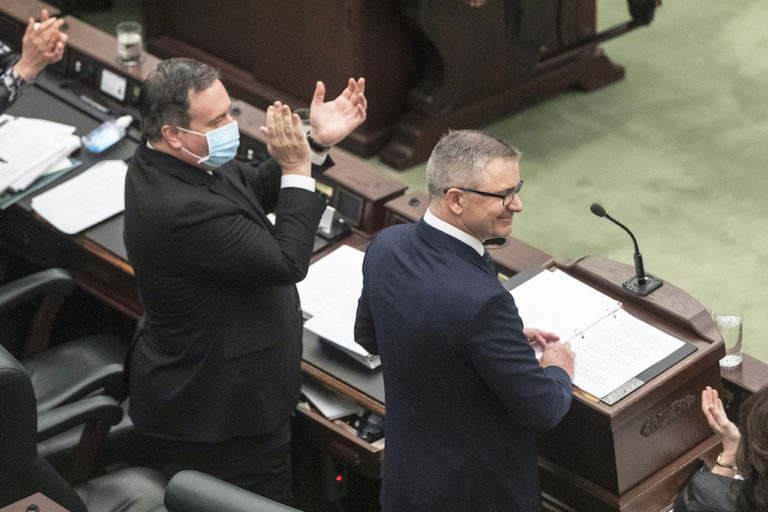
CALGARY — On Thursday night Danielle Smith finally succeeded in her turbulent, decade-long bid to become premier of Alberta.
She will officially replace Jason Kenney as early as Oct. 11 after winning a fiercely contested United Conservative Party leadership race, and will take the reins at a crucial moment: More newcomers than ever are coming to the province, drawn by soaring oil prices, new job prospects in tech and clean energy, and affordable housing. Venture capital investment is also growing fast.
But Smith’s leadership win also brings uncertainty, not least because of her bare-knuckled approach to constitutional matters that some businesses warn could hamper the province’s economic momentum.
Here’s what her election victory could mean for Alberta’s innovation economy:
Steady hands needed
Deborah Yedlin, head of the Calgary Chamber of Commerce, said companies and investors will be looking for signs of reassurance from the new UCP leader that the province will continue to prioritize economic diversification and investment.
“Whether they’re growing their operations, whether they’re establishing an office here, whether they’re looking to attract employees—certainty and stability are absolutely critical,” she told The Logic in an interview.
Yedlin said there has been some success in attracting investments—“we have unicorns in Calgary that we didn’t have four years ago,” she said—but competition for workers and investment dollars is fierce.
“We’re not the only jurisdiction trying to bid on labour. We’re not the only jurisdiction trying to diversify our economy.”
Listen to tech
Under Kenney, the UCP government touted its record in attracting investment, and the outgoing premier made a point of advising his successor to prioritize the tech sector.
Industry representatives say the UCP has been generally attentive to the tech sector’s needs, including labour and immigration programs, but also say the government has been delayed on critical files like the development of an intellectual-property strategy.
The Canadian Council of Innovators, for its part, said more collaboration is needed on key policies.
“To sustain this momentum, engagement with industry is required,” Bronte Valk, CCI’s Alberta manager, said in a statement.
Cryptic on crypto
Smith hasn’t laid out specific policies relevant to crypto companies, but the premier-designate is a staunch opponent of central-bank digital currencies, and has promoted decentralized tokens as a tool to reduce their influence.
“Bitcoin is essentially an antidote to central bank coins,” she wrote in a newsletter earlier this year.
That could be interpreted as a comforting message for crypto companies, who Alberta has sought to woo as part of its innovation agenda.