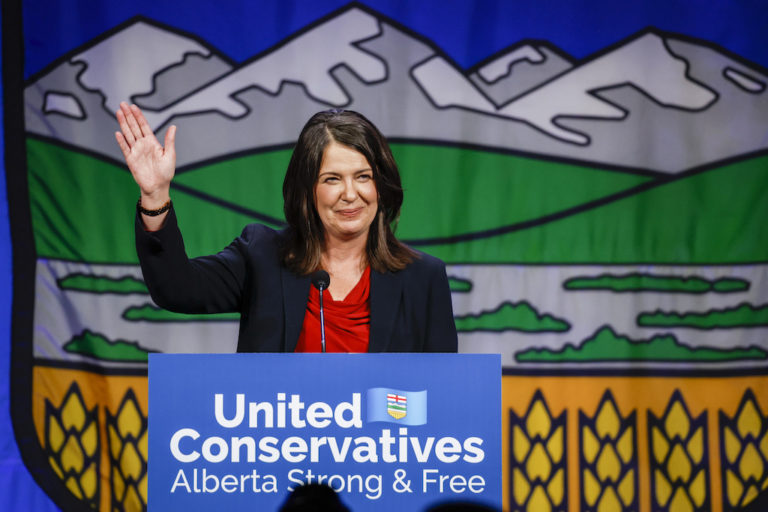
Alberta Premier Danielle Smith first struck conciliatory notes after her United Conservative Party won Monday’s election, calling her New Democratic opponent Rachel Notley “a loyal Albertan who loves this province as much as I or anyone else” and promising to listen to all Albertans.
All Albertans need to unite, Smith said, because they have a common adversary.
Talking Points
- United Conservative Premier Danielle Smith pledged to govern for all Albertans as she returns to power with a diminished majority, calling on the province to unite against federal interference with Alberta’s oil and gas industry
- Her promise to keep taxes stable or cut them suggests government finances will depend on high resource royalties, with little room to invest in economic diversification
“We need to come together no matter how we have voted, to stand shoulder to shoulder against soon-to-be-announced Ottawa policies that would significantly harm our provincial economy,” Smith said in her victory speech. Those include restrictions on generating electricity from natural gas and a “de facto production cap on our oil and gas sector” that will cost Alberta tens of thousands of jobs and tens of billions of dollars, she said to boos from her supporters.
As premier, Smith said, she cannot allow these policies to be “inflicted” on Albertans. She wants to negotiate with Prime Minister Justin Trudeau on cutting greenhouse-gas emissions by exporting Alberta gas and technologies, she said.
The UCP won 49 seats to the NDP’s 38, delivering Smith’s first general-election victory as leader of the party. She promised to defend the province’s resource sector, attract corporate investment and help Albertans prosper despite inflation.
One shared goal is “powering and diversifying our amazing economy.” Alberta’s doors are wide open for businesses large and small, she said. To show it, her government’s first bill this fall will require referendums for tax increases, she said, because Alberta’s economy is based on free enterprise, entrepreneurship and economic growth.
Smith also said Alberta’s health-care and education systems should be examples for the world.
Doing both will be difficult, said University of Calgary assistant economics professor Kent Fellows, in an interview with The Logic. Locking in steady or lower taxes with the referendum mechanism ties Alberta to royalties from natural resources, he said, which have sent the provincial finances on a roller-coaster for generations.
“There’s no indication that we’re going to be getting off that any time soon,” Fellows added, “which will, longer-term, raise potential questions about building deficits or debts or how we get the economic house in order.”
If oil and gas royalties are strong, there’s no problem. “If they drop, it’s an issue that we’ll have to confront sooner rather than later,” he said. Indeed, Alberta’s last budget was based on higher oil prices than the market has produced.
Neither the UCP nor the NDP overwhelmed the campaign with detailed plans. In a pre-election comparison, the Council of Canadian Innovators’s Alberta director Jess Sinclair—a former aide to Smith’s predecessor Jason Kenney—wrote that Smith’s UCP had made just a handful of specific promises, not many of them directly relevant to the tech sector, amid a broad message of making Alberta affordable and attractive to all comers.
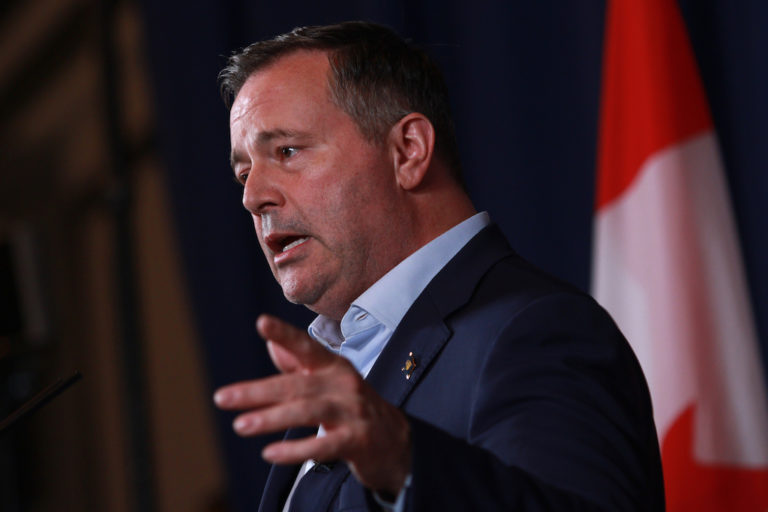
As he headed for the door late last summer, Kenney told The Logic he regretted not listening more carefully to the tech community as he built the UCP’s 2019 election platform.
The tech community has complaints the re-elected government can address swiftly if it wants, said Benjamin Bergen, the Council of Canadian Innovators’s president, after the results were in. It should let coders and programmers call themselves “software engineers,” despite objections from the provincial engineers’ regulatory body, modernize government procurement, prioritize intellectual property and create an overall provincial digital strategy, Bergen said in a statement.
“Alberta’s innovation economy has all the components to be an engine of prosperity for the 21st century if the talent and natural entrepreneurial spirit of the province’s innovators are supported by a few essential practical policies at the government level,” Bergen said. “If Premier Smith works collaboratively with us to drive growth in the tech sector, the province will be better for it.”
Hearing those voices could be more challenging than it was before the election, as the UCP returns to governing with a diminished caucus.
Finance Minister Travis Toews and Environment Minister Sonya Savage left politics on their own, and the NDP took out much of the rest of the party’s front bench. Deputy Premier Kaycee Madu, Justice Minister Tyler Shandro, Health Minister Jason Copping and Social Services Minister Jeremy Nixon (Shandro by seven votes, which a recount could change) all lost their seats. So did Mental Health Minister Nicholas Milliken and Culture Minister Jason Luan.
The governing party is also distinctly more rural. Innovation Minister Nate Glubish kept his seat on the outskirts of Edmonton and the UCP won some similar suburban seats, but the NDP owns urban Calgary and Edmonton.
One current UCP pledge that is relevant to the tech sector, Sinclair pointed out, is for an “‘Alberta is calling’ signing bonus”—a $1,200 tax credit for workers in high-demand occupations who move to Alberta and stay for at least a year. The party also promised a $100-million boost to the Alberta Enterprise Corp., the government-sponsored agency that invests in venture capital funds.
On climate change and decarbonizing the economy, an analysis from BMO Capital Markets on Sunday contended that behind the parties’ rhetoric, there really wasn’t much difference between the UCP and the NDP.
“In our view, industry’s motivation is increasingly driven by investor expectation and licence to operate vs. regulatory burden,” BMO analyst Jared Dziuba wrote. By tangling with the federal government, a combative UCP government under Smith might slow progress on measures like federal tax credits for carbon sequestration; the NDP promised to raise corporate taxes, which BMO didn’t like, but might have been better placed than the UCP to make a deal on carbon capture and storage.
An open conflict between Alberta and Ottawa over an emissions cap could make that agreement even more difficult, Fellows said, and if the federal government imposes too stringent an emissions cap, it could threaten carbon-capture investments—and the Alberta economy—by forcing overall oil and gas production down.
“I don’t know exactly how that’s going to go. But that’s definitely what I’m going to be watching,” Fellows said.
The UCP does have a climate plan with a stated intention to make Alberta’s economy a net-zero emitter of greenhouse gases in 2050, but it is expressly an “aspiration,” with measures to achieve it put off until later.
The critical question for Alberta’s economy in the coming few years may be whether Smith’s renewed government will provide the stability that would-be investors crave.
She finished her only campaign debate with Notley by disavowing “whatever I may have said and thought in the past, while I was on talk radio.” But as premier, Smith inserted herself into the prosecution of preacher, anti-COVID-restrictions crusader and border-blockade supporter Artur Pawlowski, which got her a scolding from Alberta’s ethics commissioner.
More disturbing still to business groups like the Calgary Chamber of Commerce was Smith’s symbolic first priority as premier in the last legislative session, Bill 1, the Alberta Sovereignty within a United Canada Act.
The law either claimed new powers for the provincial government to nullify “harmful laws and policies” from the federal government or, because it applies only to matters in Alberta’s constitutional jurisdiction anyway, did nothing new—the provincial government made both arguments at once.
Fights between the Alberta and federal governments don’t make Alberta attractive, the Calgary business group’s CEO Deborah Yedlin said when the bill was being debated late in 2022, pointing to the exodus of corporate headquarters from Montreal to Toronto after the Parti Québécois won power in 1976.
During the campaign, the chamber emphasized the point with its booklet of policy recommendations. More than 71 per cent of responding members in a fall 2022 survey agreed with the statement that “the provincial government should work collaboratively with other levels of government,” the group reported.
Furthermore, it argued, with access to talent and labour its members’ biggest concern, and tech and innovation their top priority for economic diversification, Alberta should increase funding for health care, higher education and child care to attract the workers it needs.
That’s precisely where the Smith government’s reliance on oil revenue will create challenges, Fellows said.
“I’m really interested to see what the upcoming announcements are on the spending side,” he said. “It will be a tough spreadsheet to balance.”