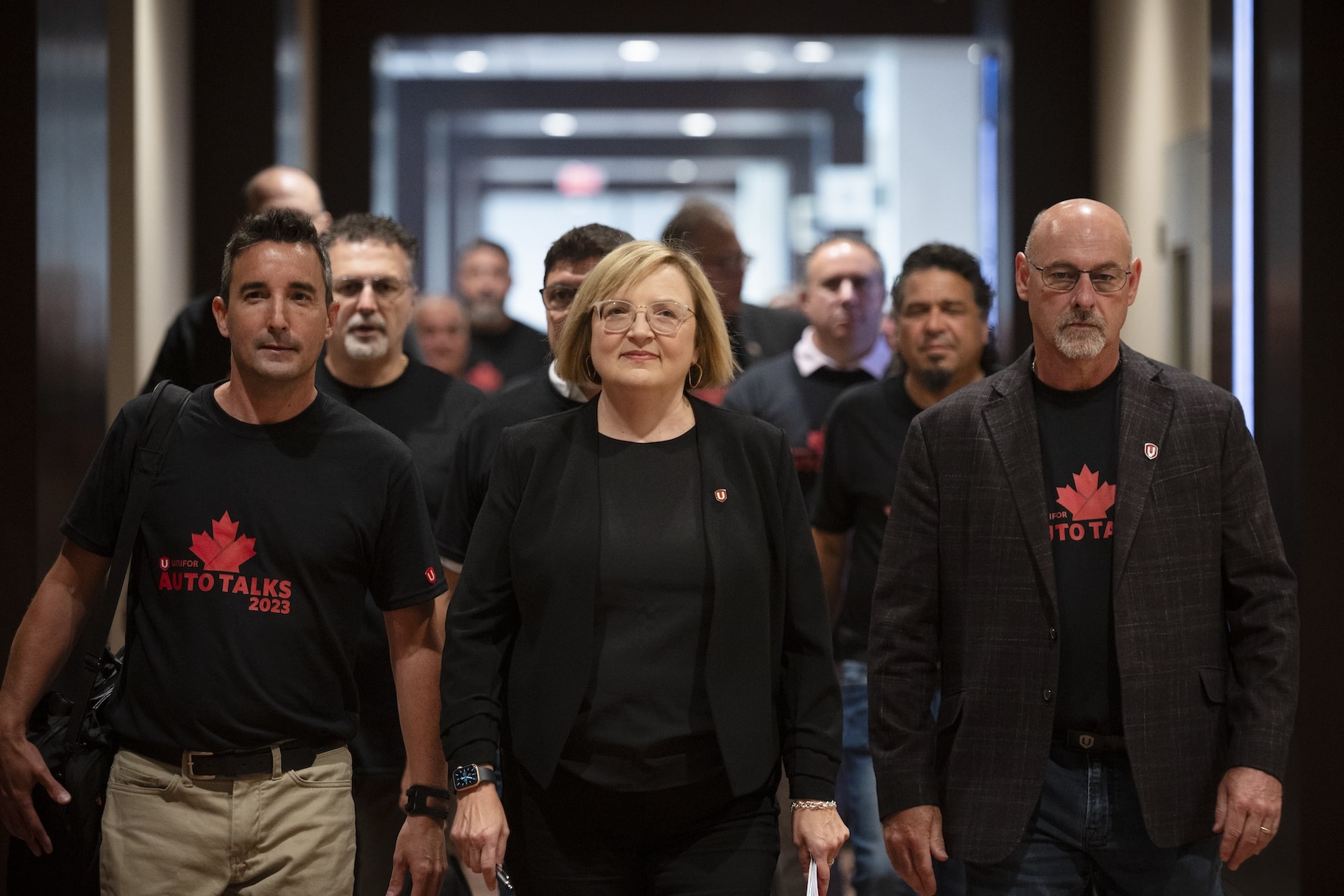
In a meeting room in a downtown Toronto hotel late Thursday afternoon, roughly a dozen auto workers assembled wearing black and red T-shirts inscribed with the slogan “Auto Talks 2023.”
Skip to content
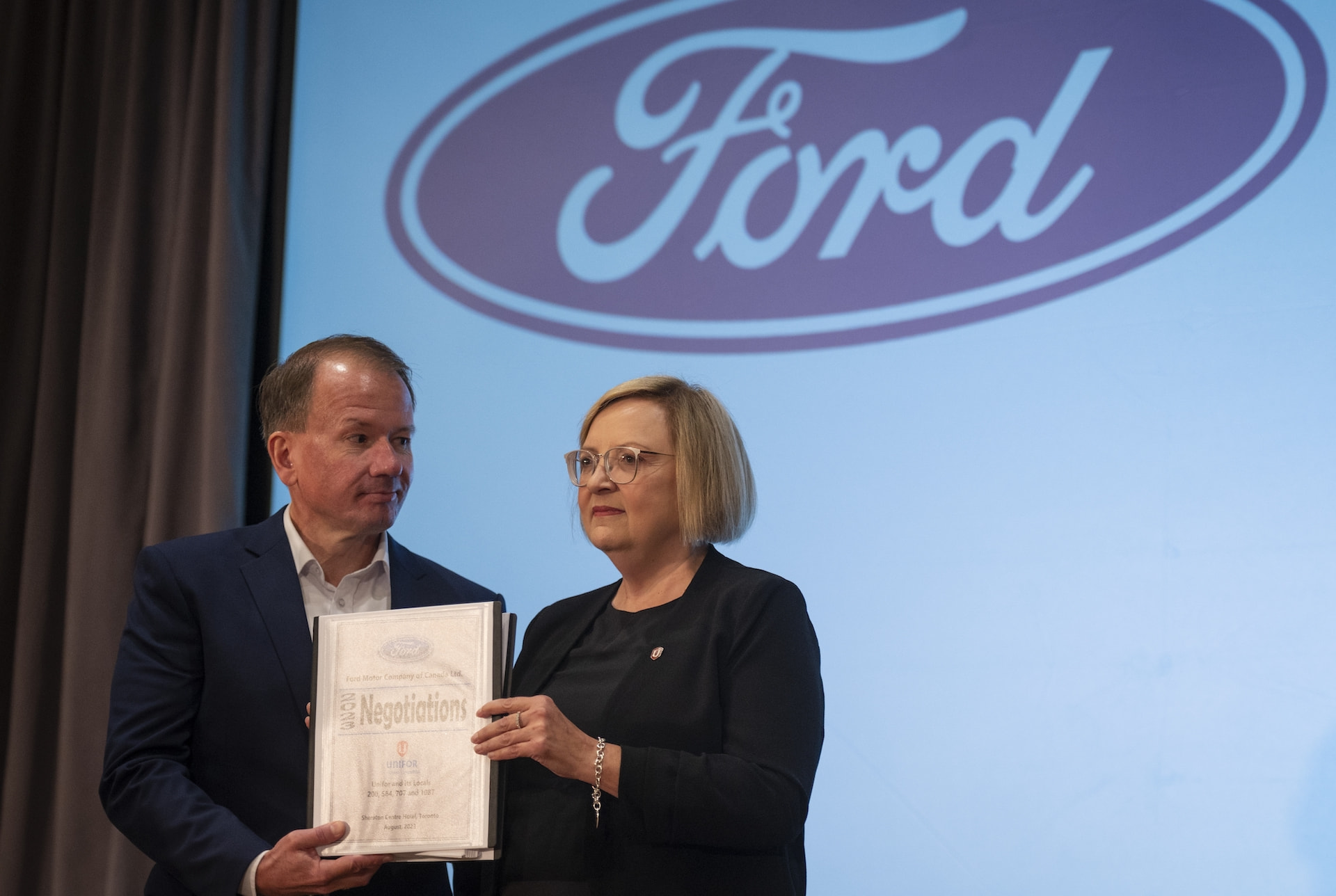 Lana Payne, Unifor national president, and Steve Majer, vice-president of Ford's human resources, in Toronto on Aug. 10. Photo: The Canadian Press/Tijana Martin
News
Unifor head eyes ‘unfinished business’ as EV transition looms over first day of auto talks
Workers ‘prepared to fight and to strike if necessary,’ Payne says as negotiations begin
Unifor national president Lana Payne leads the way toward a meeting with Stellantis as part of the auto talks in Toronto on Aug. 10. Photo: The Canadian Press/Tijana Martin
In a meeting room in a downtown Toronto hotel late Thursday afternoon, roughly a dozen auto workers assembled wearing black and red T-shirts inscribed with the slogan “Auto Talks 2023.”
They had just wrapped the first day of what Unifor national president Lana Payne expects will be a month (at least) of intense negotiations between the union—which represents over 18,000 Ford, GM and Stellantis workers in Canada—and the U.S. auto giants, collectively known as the Detroit Three.
The negotiations—Payne’s first as national president and the union’s first since 2020—are happening at a time of drastic change for the industry.
In the years since signing their last contract, the automakers have been straddling two realities: one in which supply-chain challenges threaten job security and soaring inflation outpaces wages, and another where billions of dollars—including extraordinary government subsidies—are fuelling the sector’s massive electric-vehicle transition. Those pressures are expected to make these negotiations the “most complex” in recent memory, one Ford senior official told the Windsor Star.
Related Articles


In a press conference following the first day of Canadian negotiations, Payne said the union is ready for a fight. “I made it very clear to the companies today that our members’ expectations are very high,” she said.
What Unifor wants: The union’s top priorities are securing its members better wages and pensions—which Payne has called “precarious and sub-standard.” Unifor also wants “transition support” for workers—including job protections while factories are offline for EV retooling—and more investments along the EV supply chain in Canada.
How it plans to get it: Payne said Unifor will pick one of the three automakers to be the “target.” The union will first negotiate a contract with that company, which will serve as a template for the other two automakers to adopt.
Unifor hasn’t made its final decision on the target, Payne said, but the union is “seriously considering” Ford. “There is a continuity with Ford that we see as advantageous,” she said. Ford was the strike target in Unifor’s 2020 negotiations, which led the automaker to become the first to make electric-vehicle commitments by agreeing to retool its Oakville, Ont., plant.
“I see this as a bit of unfinished business for our union,” said Payne. “When it comes to the EV transition, we have the clearest picture of what the Ford Oakville retool will look like. And we think that provides us with a useful baseline on which to negotiate.”
Will workers strike? Unifor members will vote on Aug. 26 and 27 on whether they’re willing to strike in the event they don’t reach a contract agreement by the Sept. 18 deadline.
It’s too soon to know if Canadian auto workers will walk off the job. But Payne—who’s also leading negotiations for Metro grocery workers now striking in Toronto—expressed confidence in workers’ overall willingness to picket in this economy. “Workers have shown time and time again that they are prepared to fight and to strike if necessary to have their demands met,” she said.
The Canadian auto workers’ U.S. colleagues look to be heading in that direction. Talks between Unifor’s sister union the United Auto Workers and the Detroit Three are off to a rocky start, with a strike looming south of the border. Like Unifor, the UAW is seeking better wages and pensions. It wants a more than 40 per cent pay raise over four years for workers, along with more time off and for management to restore defined-benefit pensions they had eliminated for newer workers. That union’s president Shawn Fain dramatically rejected a bargaining proposal from Stellantis on Tuesday, tossing it in the trash, “where it belongs,” he said.
While Payne said Unifor and the UAW have discussed expectations around bargaining, she emphasized that what happens in the U.S. won’t necessarily reverberate in Canada. “Unifor charts its own course,” she said.



Loading...
Thanks for sharing!
You have shared 5 articles this month and reached the maximum amount of shares available.
CloseThis account has reached its share limit.
If you would like to purchase a sharing license please contact The Logic support at [email protected].
CloseGift the full article!
You have gifted 0 article(s) this month and have 5 remaining.
Recipients will be able to read the full text of the article after submitting their email address. They will not have access to other articles or subscriber benefits.
Photo: The Canadian Press/Tijana Martin
Lana Payne, Unifor national president, and Steve Majer, vice-president of Ford's human resources, in Toronto on Aug. 10.
Most Popular This Week




In-depth, agenda-setting reporting
Great journalism delivered straight to your inbox.
News
National Bank CEO warns AI alone won’t give banks a lasting edge
Briefing
Canada and Ontario commit over $5B to support tariff-hit steel sector
Hackers will see cars as major targets in next 3 years, 83% of car-tech workers say
EA shutting down Edmonton studio BioWare
Best business newsletter in Canada
Get up to speed in minutes with insights and analysis on the most important stories of the day, every weekday.
Exclusive events
See the bigger picture with reporters and industry experts in subscriber-exclusive events.
Membership in The Logic Council
Membership provides access to our popular Slack channel, participation in subscriber surveys and invitations to exclusive events with our journalists and special guests.





