Market volatility is staving off a wave of initial public offerings that were expected to come this year, as U.S. President Donald Trump’s tariff policies drive up uncertainty on both sides of the border.
Skip to content


News
Trump’s trade war derails IPO comeback
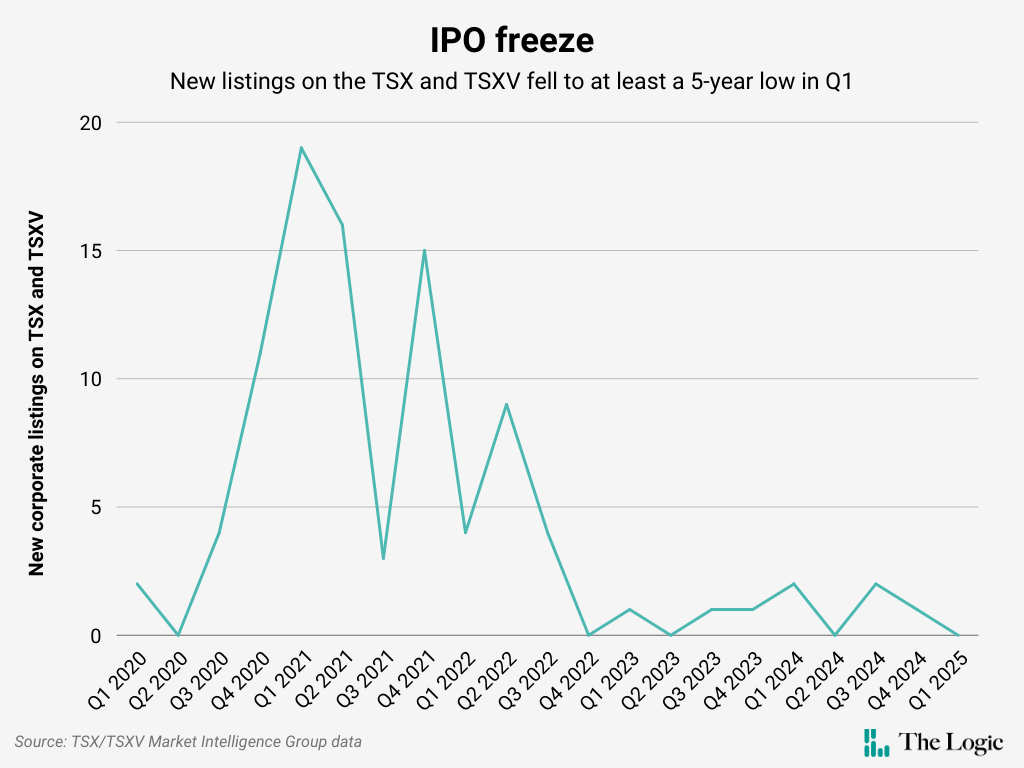
New corporate listings on the TSX and TSXV fell to at least a 5-year low in the first quarter
A screen displays a TSXV and Emerge banner in front of several skyscrapers in Toronto’s downtown financial district. Photo: Emerge Commerce/Handout
Market volatility is staving off a wave of initial public offerings that were expected to come this year, as U.S. President Donald Trump’s tariff policies drive up uncertainty on both sides of the border.
There were no new corporate IPOs completed on the Toronto Stock Exchange or the Venture Exchange last quarter. It was at least a five-year low for the quarter, in terms of number of listings on the two exchanges combined.
Talking Points
- Most companies that had planned to go public in the first half of the year are delaying plans until the fall or early 2026
- The outlook for gold and precious metals companies, meanwhile, has stayed largely resilient, as investors seek out stable equities
Companies are waiting for markets to stabilize before they go public, Loui Anastasopoulos, chief executive of the Toronto Stock Exchange said in an interview.
“They’re just delaying their plans,” he said. “If things materialize the way we think they will, based on our pipeline and the conversations that we’re having, 2025 will be a stronger year than 2024,” he said.
Were it not for the “noise” tariffs have created, conditions would be favourable, Anastasopoulos added. He pointed to a rise in market liquidity, and the expectation that interest rates will come down.
Still, Anastasopoulos acknowledged that valuations on the TSX have been lower than usual, noting a year-on-year decline. It’s difficult to pinpoint why that might be—besides the tariffs, investor appetite is lower than usual, he said. “Investors are distracted. They’re unsure, they’re worried, they’re scared.”
It’s a marked shift in sentiment from late last year, when industry insiders said the market was poised to bounce back. Montreal retailer Groupe Dynamite, which debuted last November, has since lost around 40 per cent of its value.
Related Articles


The CBOE Volatility Index (VIX), largely viewed as Wall Street’s fear gauge, hit 65 last week—its highest point since the COVID-19 pandemic. The index remained elevated all week, dipping slightly as Trump announced a 90-day pause on tariffs, and ended up just above 30 when as of 3:15 p.m. in Chicago on Tuesday.
Companies are postponing plans until a “clean couple of weeks,” Daniel Nowlan, vice-chairman and managing director of equity capital markets at National Bank, told The Logic. “You almost never see this type of volatility.”
When the VIX hits 30, it reaches a “demarcation point” where companies tend to avoid going public, Nowlan said. There have only been two periods over the last two decades that the VIX has passed 60—the 2008 financial crisis and the pandemic. Nowlan likened the environment to the uncertainty during the Great Recession.
Most companies that previously planned to go public in the first half of 2025 are now pushing that timeline to the fall, or early 2026, said KPMG partner Dan Wilson, who leads the national technology sector practice for the firm. Companies want to ensure they’re valued correctly when they go to market—and that those valuations remain steady, he added.
Some of Canada’s most valuable privately held tech companies, including travel firm Hopper, 1Password and Wealthsimple, have previously hinted at their IPO ambitions. Wealthsimple’s plans haven’t changed, spokesperson Juanita Leon told The Logic in a statement. “We’re staying laser focused on helping our clients navigate this period of uncertainty.”
“Industries that are exposed to the US are more affected,” Wilson said, listing off the automotive, agriculture, energy, and industrials sectors. And for technology, his primary area of coverage, he suspects the larger Canadian firms will look to the U.S. for confidence.
Yet for now, encouraging signs are largely absent. U.S. ticketing company StubHub and buy-now, pay-later platform Klarna are among those who have hit pause on their IPO plans, The Wall Street Journal reported. Cloud computing firm CoreWeave raised US$1.5 billion in a downsized IPO, well below its price target, with its stock now trading at about 2 per cent above the US$40 a share it priced at.
There have been a few bright spots. In Canada, IPOs of gold and precious metals companies haven’t slowed down, as investors flock to more stable equities, said Tim Caulfield, managing director at Franklin Templeton’s ClearBridge Investments. “That part of the market is really flowing, while the rest of the market is ebbing,” he said. “We’ve seen pretty extreme outperformance of gold-and precious metals-related equities through this more uncertain environment.”
Companies waiting in the wings aren’t just biding their time, but are laying the groundwork for their next move. They’re doing “dry runs” to ensure they’re properly equipped to file on time, and preparing forecasting systems, said KPMG’s Wilson.
“We’ve got a number of rockstar companies out there that are primed and ready, and they’re using this opportunity to really enhance their readiness,” Wilson said.



Loading...
Thanks for sharing!
You have shared 5 articles this month and reached the maximum amount of shares available.
CloseThis account has reached its share limit.
If you would like to purchase a sharing license please contact The Logic support at [email protected].
CloseGift the full article!
You have gifted 0 article(s) this month and have 5 remaining.
Recipients will be able to read the full text of the article after submitting their email address. They will not have access to other articles or subscriber benefits.
Photo: Emerge Commerce/Handout
Most Popular This Week




In-depth, agenda-setting reporting
Great journalism delivered straight to your inbox.
The Big Read
Alberta’s referendum is just the start of the turmoil
Briefing
EverWind plans $10B data centre and wind development in Nova Scotia
Canada ready to force Stelco to sell its Canadian operations, Joly says
Feds plan a 60 MW defence-oriented data centre for Ottawa
Best business newsletter in Canada
Get up to speed in minutes with insights and analysis on the most important stories of the day, every weekday.
Exclusive events
See the bigger picture with reporters and industry experts in subscriber-exclusive events.
Membership in The Logic Council
Membership provides access to our popular Slack channel, participation in subscriber surveys and invitations to exclusive events with our journalists and special guests.