Skip to content

News
Toronto’s transit procurement clashes with Buy Canadian pledge
The city is revising a procurement project for the Finch West transit line that specified a U.S. technology supplier. One Canadian competitor says it still overlooks domestic innovation.
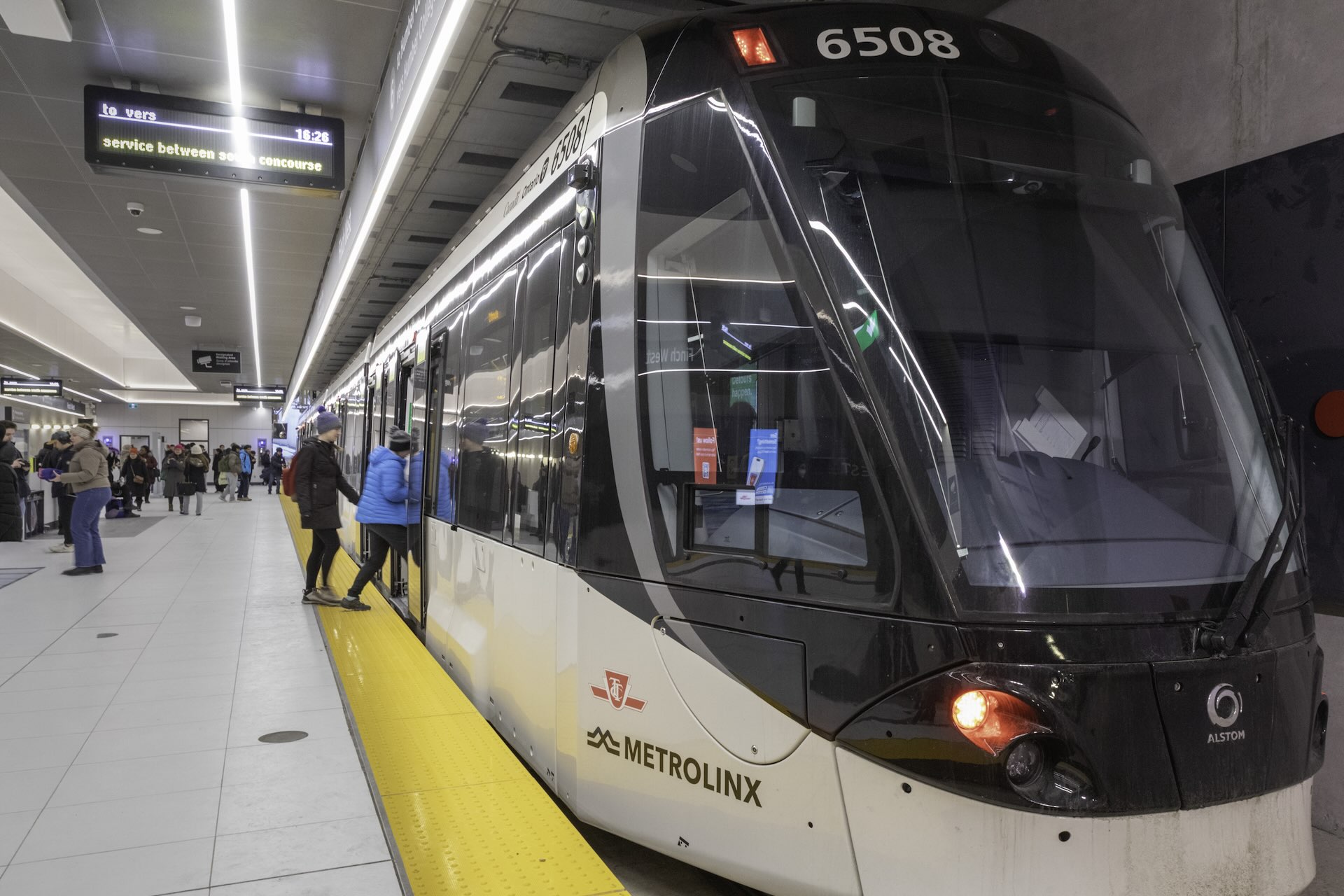
Since opening last December, the $3.7-billion light-rail line between Finch West and Humber College has struggled with reliability problems, slow speeds and service disruptions. Photo: The Canadian Press Images/Colin N. Perkel
TORONTO — The City of Toronto is changing a procurement call for an American company’s traffic sensors to be installed along the Finch West transit line, following accusations it was freezing out Canadian competitors, The Logic has learned.
The work assignment seeks contractors to install traffic-detection and analytics systems at eight intersections along the Finch West commuter route. While the city did not formally label the procurement as sole-sourced, it initially directed contractors to supply and install lidar systems made by Ouster, a San Francisco-based sensor company.
Talking Points
- Toronto is revising a Finch West LRT procurement after backlash that it effectively shut out Canadian tech firms by specifying a single U.S. sensor supplier
- The episode highlights the gap between Buy Canadian policies and how government procurement plays out in practice
That approach seemingly clashed with the chorus of political and business leaders calling on governments across Canada to use public procurement to support domestic companies amid a fractured economic relationship with the U.S.
The project falls under a municipal procurement process, in which pre-qualified contractors submit bids and choose technology partners that meet the city’s requirements. In this case, however, vendors were explicitly directed to install Ouster’s system.
On Tuesday, three days before bids were due, Kitchener, Ont.-based traffic-technology firm Miovision sent a letter to the city expressing concerns about Canadian tech firms being effectively disqualified from the work.
Related Articles

“In the present political and economic climate, there is a significant and growing Buy Canadian sentiment aimed at bolstering our domestic tech ecosystem,” Miovision chief revenue officer Lyne Jacques wrote in the letter to the city, which The Logic has viewed. “Defaulting to high-profile American hardware vendors, particularly when comparable, world-class innovation is being developed right here in Ontario, risks overlooking the economic and security benefits of supporting local industry.”
In recent months, all three levels of government have pointed to procurement as a tool to support domestic companies, amid heightened trade tensions and renewed concern about supply-chain resilience. In March, Toronto City Council passed a motion encouraging the city to source more goods and services locally, and both Ontario and Ottawa implemented policies in December aimed at prioritizing Canadian suppliers in public-sector purchasing.
The Logic contacted the city’s procurement team on Friday after learning of the work assignment. On Tuesday afternoon, spokesperson Kate Lear said the city would update the procurement documents to remove reference to Ouster, however, the city is still intent on specifically using lidar technology. Lear said Ouster was originally named in the assignment because the city had previously used its lidar system and was happy with it. “While Miovision’s video‑based analytics have been used successfully in the city, it does not use lidar so it is outside the scope of this assignment,” Lear added.
The city has since removed reference to Ouster in the work assignment and extended the deadline to February 11.
Jacques said the updated work assignment is still too prescriptive. “Why they need lidar technology when they can do everything with video is not clear to me,” she told The Logic Wednesday morning. In her letter to the city, she said Miovision’s technologies “meet or exceed the functional requirements” the city outlined in the procurement documents, “all developed and supported here in Ontario.”
City Councillor Brad Bradford called it “outrageous” that the city had effectively sole-sourced a contract to an American company originally, “shutting out proven Canadian innovators in the process.” In a statement to The Logic issued before the work assignment was updated to remove the mention of Ouster, Bradford urged Mayor Olivia Chow to “host an open, technology-neutral procurement to ensure we buy the best and give our homegrown innovators a fair shot at fixing Toronto’s traffic problems.”
The traffic-sensor procurement is part of the city’s efforts to improve traffic flow along the Finch West light-rail transit, which started operating in December after years of delays. Since opening, the line has struggled with reliability problems, slow speeds and service disruptions. The train runs through a busy 10.3-kilometre stretch of northwest Toronto, where signal timing and long waits at red lights have been persistent challenges.
The city’s procurement documents show it wants to install lidar sensors that can collect detailed data on vehicle movements, technology that’s typically used to help optimize traffic-light timing and improve the flow of vehicles. It will select a winning contractor from a list of pre-approved vendors, which will be responsible for installing the equipment, ensuring it works and sharing data and analytics with the city for at least five years.
Ian Lee, a financial policy expert and professor at Carleton University’s Sprott School of Business, was surprised the city explicitly named Ouster in its original work assignment, calling it “very unusual” for governments to specify what company vendors ought to subcontract with. However, he said it is common to write a request for proposal in such a way that only one company meets the requirements.
Lee said that the Finch West procurement process shows how prioritizing domestic suppliers can be more complex than Buy Canadian policies suggest. Such policies, he argued, tend to work best for routine purchases of generic products, like military uniforms or office filing cabinets.
Buying Canadian, Lee added, is more difficult when governments are seeking cutting-edge technology that is only made by a handful of companies. In those cases, procurement decisions are more likely to hinge on factors like the technical sophistication, size, revenues and reputation of the company, he said, rather than where it’s headquartered.
Lee said this points to a broader issue for Canada’s tech companies, which tend to be smaller, less established and invest less in research and development than their U.S. competitors. “With innovation, where you’re trying to create something unique, the whole idea of Buy Canadian falls down,” he said, if there’s no Canadian company with that innovation.
Ouster is publicly traded on the Nasdaq, with a market capitalization of about US$1.2 billion. Miovision, which is privately held, was founded in 2005 and has raised at least US$430 million from investors including Export Development Canada and Maverix Private Equity. Its tech has been used in over 70 countries and outside Canada, it has operations in the U.S., Germany and Serbia.
Jaques said the contract would be relatively small for Miovision and that the company is more concerned about being left out of a competitive process. She said Miovision has comparable traffic analytics systems to the ones the city is seeking, and already operates at more than 100 intersections across Toronto.
Update: The reference to Ouster has been removed from the work assignment and the deadline has been extended to February 11. This story has been updated.



Loading...
Thanks for sharing!
You have shared 5 articles this month and reached the maximum amount of shares available.
CloseThis account has reached its share limit.
If you would like to purchase a sharing license please contact The Logic support at [email protected].
CloseGift the full article!
You have gifted 0 article(s) this month and have 5 remaining.
Recipients will be able to read the full text of the article after submitting their email address. They will not have access to other articles or subscriber benefits.
Photo: The Canadian Press Images/Colin N. Perkel
Most Popular This Week




In-depth, agenda-setting reporting
Great journalism delivered straight to your inbox.
News
Canada faces a satellite-launch crunch as SpaceX retires its workhorse rocket
Briefing
Zafin buys U.S. fintech Naehas in nine-figure deal
Violations of money laundering and terrorist financing rules hit new high in Canada
Brookfield Asset Management opens Qatar office as it courts Middle East investments
Best business newsletter in Canada
Get up to speed in minutes with insights and analysis on the most important stories of the day, every weekday.
Exclusive events
See the bigger picture with reporters and industry experts in subscriber-exclusive events.
Membership in The Logic Council
Membership provides access to our popular Slack channel, participation in subscriber surveys and invitations to exclusive events with our journalists and special guests.