The Interview
‘We should not be shy about dreaming big’: Balancing ambition and caution when capital is scarce
Pension funds and corporate investors could fill funding gaps in slow VC market: Industry leaders
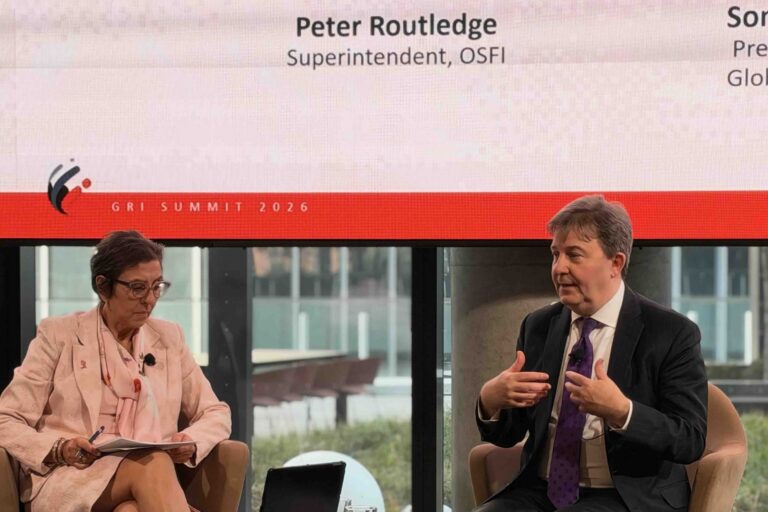
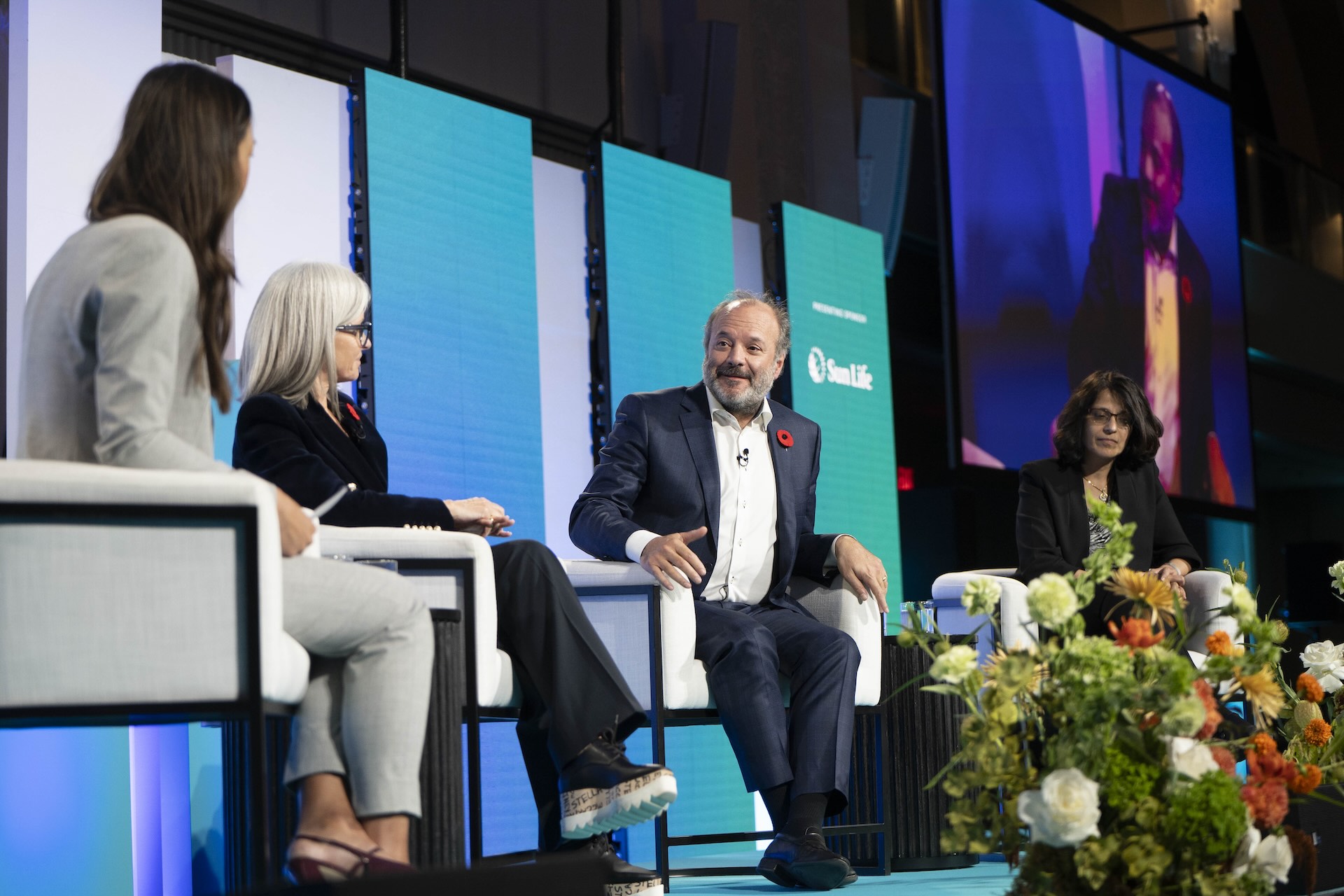
The Logic Summit panel “Navigating an uncertain funding landscape” with executive editor April Fong, BDC’s Isabelle Hudon, Kensington Capital Partners’ Richard Nathan and CPP Investments’ Priti Singh. Photo: Christopher Katsarov Luna for The Logic

Economic shocks over the last few years—from a global health crisis, to wars, and myriad natural disasters—have made it difficult for entrepreneurs and investors to calibrate their risk tolerance. While waiting for a return to stability, many investors have pulled back on deal-making, ebbing the flow of capital. But with instability looking increasingly like the new normal, pressure is mounting on entrepreneurs and investors to be bolder.
At The Logic Summit on Monday, executive editor April Fong sat down with Isabelle Hudon, president and CEO of the Business Development Bank of Canada, Rick Nathan, managing director at Kensington Capital Partners, and Priti Singh, chief risk officer at Canada Pension Plan Investment Board, to discuss balancing ambition and caution in a challenging funding environment. The right sources of capital, tax schemes and mentality, they said, can attract top companies and prevent an exodus of Canada’s best talent. Panelists also highlighted key global risks for investors, obstacles to capital flow, and the importance of adaptability in today’s complex investment landscape.
This interview has been edited for clarity and length.
Related Articles

Investors can’t ignore the global risks and challenges—political tensions, the upcoming U.S. election, for example. Priti, you’re looking at risks all the time. What’s the biggest one that’s keeping you up at night?
Singh: One of the things that’s top of mind is geopolitical risk and the impact it has, not just in the immediate term, but the longer-term horizon. We invest across asset classes, both public and private, ranging from strategies that are a few weeks to over two decades. To navigate that in this kind of environment is a challenge. The other thing that I am looking at quite a lot is what I would call transversal risks. It’s the common risk across multiple investments—whether it is geopolitical, whether it’s climate, whether it’s AI.
Rick, tell us about the pressures limited partners (LPs) are putting on funds for returns.
Nathan: The broader venture capital market has been through a really hard reset, and we’re still working our way through it. The market today is better than it was 12 months ago. But it’s still not at a point where it’s a good, healthy market. The reason that we put pressure on the companies and funds that we invest in is because of the pressure we are feeling [from our LPs].
What’s missing from the recovery efforts is there’s still no big-tech initial public offerings. When you have IPOs in the market, it’s exciting, and you can do pre-IPO financings and growth rounds. All the way down the food chain, from Series A, B, down to Series C, that whole venture-capital funding chain kind of comes alive. To bring back large investors, you need that excitement of the IPOs, and hopefully we’ll see that next year.
BDC is talking to founders and entrepreneurs every day. How do they feel to be inside that storm—to have trouble raising capital?
Hudon: Since 2021 it’s been challenging. We need to have a longer view. If we were to look back 10 years ago, excluding the three years of pandemic, we would see that we’re still on a growth path. We have to recognize that VC is a very new market for Canada. We’re building this sector.
We need to have investors that will invest through the cycle and at different stages. To build champions, we need to be there right at the get-go, and be there, patient, through the cycle.
What do you think is holding us back from building big companies in Canada? Do you agree with the sentiment that we need more ambition?
Hudon: I agree. We should not be shy about dreaming big. We should not be shy about seeing the globe as our market. It’s one thing to build for Canada, but the real ambition is to build global businesses.
Where do we get the capital to grow those businesses?
Hudon: I don’t think the primary challenge is around capital.
Nathan: Capital is one of the main problems. The other is talent. We’ve been chasing capital and ambitious entrepreneurs out of the country in the last couple of years. We don’t have to spend an hour talking about capital gains taxes, but I’ve had conversations with entrepreneurs saying, ‘It feels like my government doesn’t want me to build my company here.’ It’s not just tax policy. Many of the most ambitious people who you’re referring to currently reside in the U.S. and we’ve got to get them to come back.
Read More from The Logic Summit


There’s also been a lot of debate about whether Canadian pension funds should invest more at home. Priti, what would incentivize pension funds to invest more domestically?
Singh: CPP has invested about $75 billion in Canada across all asset classes. That’s 12 per cent of our assets. From a [global] economy perspective, Canada [represents] about 3 per cent. We do that because we think there’s great investment opportunities, because that is our goal, which is to maximize returns. We have engaged with the government on what we look for here: stable, transparent, make it easy to be investable. Good areas would be infrastructure, digital infrastructure, private equity.
Nathan: I think the pension funds should absolutely be investing more in Canada, but I’m opposed to the idea of forcing them to do it. I think the Quebec model is a great model. If we could scale that across the country—where you have leadership at the main financial institutions that believe it’s essential to bake their economy to support the prosperity of their future pensioners—I think we would see a dramatic impact without any sacrifice of financial returns.
Hudon: Pension fund investments are one thing, but also corporate VC. It’s not something in Canada that we see as much as in the U.S. What if our big global companies would decide to massively invest in our entrepreneurs?
Let’s talk about where the money is flowing. Rick, with AI, are we at the top of the hype cycle or is it still a compelling investment?
Nathan: Yes and yes. There’s no question there’s a big hype cycle. As investors, you have to watch out for that. But AI is fundamentally going to change what many of us do everyday, so the hype is justified in many cases. It’s not just AI. Other areas we’ve been investing in: industrial technology, robotics, autonomous systems, manufacturing tech. Another area we like is cyber security. Nobody is cutting their cyber budgets.
Priti, how can companies protect themselves from risks that cut across multiple asset classes?
Singh: It’s about learning an adaptability mindset. We take a very data-driven approach when we’re thinking about things, because it’s hard to challenge belief if you don’t have data behind it. What it leads to is a very good dialogue. As new data becomes available and new emerging risks come in, you may not have all the answers, but just be adaptable.
The other critical part is the preparedness of the team. Ultimately it is the team that is going to make those decisions when uncertainty comes. It’s like a pilot. There’s a lot of things that can go wrong when you’re up there. You’re relying on the pilot’s training to act under difficult conditions.



Loading...
Thanks for sharing!
You have shared 5 articles this month and reached the maximum amount of shares available.
CloseThis account has reached its share limit.
If you would like to purchase a sharing license please contact The Logic support at [email protected].
CloseGift the full article!
You have gifted 0 article(s) this month and have 5 remaining.
Recipients will be able to read the full text of the article after submitting their email address. They will not have access to other articles or subscriber benefits.