MONTREAL — Over the course of a 20-minute conversation, Bryan Murphy, the soon-to-be ex-CEO of flexible-workspace provider Breather, veers from frustration to regret to nostalgia to what-if scenarios and back again. He bats away questions about its recent sale, but otherwise waxes philosophical over the particular cruelty that COVID-19 visited upon the Montreal-based company. “We weren’t selling stationary bikes or video-conferencing software,” he tells The Logic. “We weren’t even like restaurants, which could do takeout. We were selling office space, which could not be used. So it’s just—it’s just one of those things.”
Skip to content

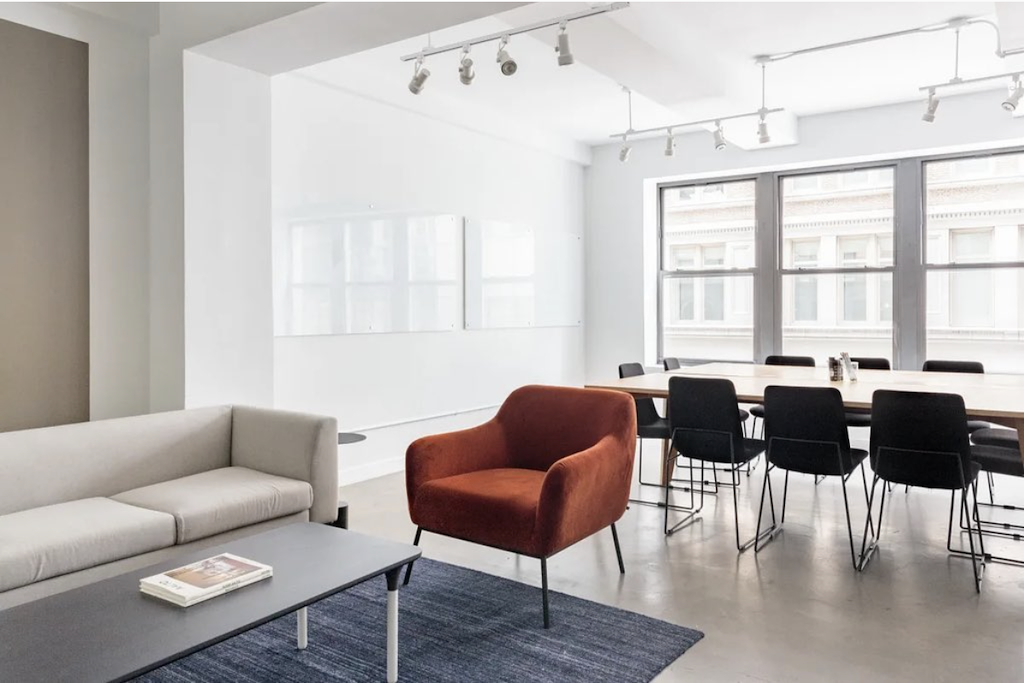 A Breather office in New York. Photo: Breather | Instagram
 Outgoing Breather CEO Bryan Murphy. Photo: Breather | Handout

The Big Read
Out of breath: Inside Breather’s rise and fall
Photo: Illustration by Hanna Lee/The Logic
MONTREAL — Over the course of a 20-minute conversation, Bryan Murphy, the soon-to-be ex-CEO of flexible-workspace provider Breather, veers from frustration to regret to nostalgia to what-if scenarios and back again. He bats away questions about its recent sale, but otherwise waxes philosophical over the particular cruelty that COVID-19 visited upon the Montreal-based company. “We weren’t selling stationary bikes or video-conferencing software,” he tells The Logic. “We weren’t even like restaurants, which could do takeout. We were selling office space, which could not be used. So it’s just—it’s just one of those things.”
Murphy arrived at Breather in 2019, replacing founding CEO Julien Smith. In those pre-COVID-19 days, Murphy boasted about Breather’s massive growth and predicted a path to profitability by 2021. Instead, 2021 saw Murphy overseeing Breather’s sale to Industrious for US$3 million—or about US$124 million less than the company raised during its nine-year existence.
He won’t publicly discuss the seven-figure price for a company that once boasted a nine-figure valuation, except to accentuate what he sees as the inevitability of Breather’s demise. “We’ve gone back over and over and over again: ‘What could we have done differently?’” he says, before answering his own question. “There’s nothing you can do. We did the very best we could to last as long as it could and hopefully get out the other side. And we just couldn’t because we just ran out of time. The clock ran out.”
Talking Point
Once a darling of Canada’s innovation economy with a nine-figure valuation, Breather is being sold to New York-based Industrious for just US$3 million. CEO Bryan Murphy reflects on his regrets, and former Breather staffers tell the story of the company’s rise and struggles to compete with the big U.S. players in the flexible workspace market.
Yet Breather had already become a different beast before it sold for pennies on the dollar to Industrious, a New York-based workspace provider recently backed to the tune of US$200 million by CBRE, the largest commercial real estate service and investment company in the world. Breather’s original pitch—not a workspace provider so much as an app-enabled purveyor of “beautiful, private spaces”—attracted buzz and investment dollars galore. The spaces were meant for work, sure, but also to take naps, practice yoga, charge your phone and otherwise bliss out in a private urban oasis.
By the time Murphy took over, those dollars had already made themselves known, pushing aside Breather’s whimsical raison d’être for the venture capital ethos of growth at all costs. Somewhere along the way, Smith checked out. “Frankly, the company was no longer interesting to him,” said a former Breather executive who spoke to The Logic on the condition of anonymity. The years between Breather’s germination and the influx of venture-backed cash were the stuff of startup trope: ceaseless hope, hubristic optimism and the ensuing reality-bending feeling that the business was not only viable, but near-bulletproof.
And because the sale comes just as people are returning to the very offices Breather peddled, it’s tough not to wonder what would have happened if the company could have hung on just a little bit longer.
***
If Uber sprung from its founders’ inability to get an affordable cab ride when they needed one, then Breather’s origin story involves the tyranny of Starbucks. According to corporate lore, Smith and co-founder Caterina Rizzi found themselves at the mercy of the caffeinated ubiquity whenever they needed places to work when travelling the world. Smith, who didn’t respond to interview requests, was a podcaster and author; Rizzi, a creative director. Smith came up with the name “Breather” after free-associating terms like “lungs,” “space” and “rest.” “Julien and Caterina had a vision of this very frictionless experience, where you would use your phone as a magic wand and have private space nearby that was all yours,” says Evan Prodromou, who served as Breather’s second CTO from 2013 to 2014.
Smith’s idea—“kind of vague and broad,” as Theo Ephraim, one of the company’s first hires, put it—raised many questions. Were the spaces for meetings, work, yoga or all of the above? How would you get the doors open? How would they get cleaned? What about insurance? And what landlord in their right mind would agree to such a thing?
Montreal tech entrepreneur Mitch Joel asked all these questions, and politely demurred Smith’s offer of a board position and entreaties to invest. He came to regret his decision. “I started realizing that Julien was building a powerful infrastructure for how people might work in the future, and he was very passionate about it. I thought it was a really good business model,” Joel says.
The first three Montreal Breather spaces included a pied-à-terre at Notman House, the staple Sherbrooke Street greystone where Real Ventures has its offices. As it happens, Real Ventures was one of Breather’s first backers, leading a US$1.5-million seed funding round in 2013. The company’s employees went about making Breather a frictionless experience. For Séraphin Hochart, its first iOS developer, that meant designing an app that would unlock its proprietary door locks with as few clicks as possible, and make the perfect noise when it did so. It also meant cleaning toilets, painting rooms and answering customer service calls.
“At the beginning, we had to validate the use case,” Hochart says. “People would text Julien, PayPal him some money and get access to the room. And then at the end of the day, every employee would take turns to clean the rooms. And it was the same thing with the 1-800 number. They would rotate through our phones. It started off real scrappy, like every startup. And with that concept, we raised some money and it grew.”
Rizzi, who left the company in 2017, says Breather’s early success came because of this get-it-done attitude, crediting its employees as “the true unsung heroes of this story, [who] deserve all the credit for making the Breather offering as amazing as it was.”
Also key was having a reliable roster of rooms, which Breather secured by leasing them from landlords. According to Prodromou, this was meant to be temporary, a way to coax landlords into seeing the benefits of letting a high volume of short-term renters into their buildings. “I think the idea was always to be more of a marketplace, and less of a long-term commitment,” he says.
Convincing landlords in New York City, home to Breather’s first expansion in 2013, was a unique challenge. Packy McCormick, who helmed the expansion, remembers what he had to do to land his first lease, a room in the 12-storey Townsend Building at 1123 Broadway. “I literally got on my knees,” McCormick says. “I was like, ‘I’m going to get fired if I don’t get this space. Please take a shot. Anything happens, you call me and I’ll come to the building immediately.’ And it’s not like the floodgates opened after we got it, but it became a lot easier.”
New Yorkers certainly took to Breather. The New York Times raved about the yoga mats, high ceilings and “homey, relaxing feel” of the spaces—and tittered at the prospect that they might be ripe for “less wholesome uses than business meetings.” At its height, Breather had 150 spaces in the city. Among their users was Jamie Hodari, co-founder and CEO of Industrious, at the time a nascent office-space provider that didn’t yet have any spaces of its own to use. “We basically hired our initial executive team in different Breather locations around New York,” Hodari says.
At Breather, venture dollars were rolling in: a US$6-million raise led by RRE Ventures in 2014, a US$20-million Series B round led by Peter Thiel’s Valar Ventures in 2015. In 2016, Breather raised another US$40-million round that included California’s Menlo Ventures, which famously bet early on Uber. Menlo partner Venky Ganesan praised Smith—“an iconic founder”—and the “wild experience” of renting a Breather space, before pooh-poohing Canada’s loafer status when it came to nurturing its tech darlings. “If there’s one thing I would say, Canadians—some of the nicest people in the world—I think tend to not be as ambitious as they could be,” Ganesan said on BNN Bloomberg in December 2016. (“Sorry, I have no comment,” Ganesan told The Logic when asked about Menlo’s investment in Breather, following the sale to Industrious.)
Yet taking venture dollars meant adopting the venture ethos of aggressive growth, and somewhere along the way, Smith began to lose interest in what Breather needed to become. “Things started to shift a little bit during the summer of 2017,” says a former senior Breather employee, speaking on the condition of anonymity. “Menlo may have put some expectations on the team from a growth standpoint. I think Julien just checked out at a certain point, unfortunately.”
Smith left the company in September 2018, about three months after the company secured a $60-million financing round, led by Temasek and the Caisse de dépôt et placement du Québec, Quebec’s public pension fund manager. In January 2019, in came former eBay executive Murphy, who laid off about 10 per cent of the staff that December and made clear the company’s future depended on further growth.
By then, Breather was already in a number of cities, including San Francisco, London, Los Angeles and Toronto. But in New York, McCormick saw firsthand the flaws in Breather’s growth strategy, in that it meant competing for bigger office spaces against deeper-pocketed rivals like WeWork and Knotel.
“One of the fun things about Breather was that we were in the third- or fourth-place position, so we had to do things a little differently. We couldn’t just go and spend,” McCormick says. “We’d put the numbers that Knotel and WeWork were willing to pay for a space, and could not in a million years figure out how you’d make money.”
The make-it-rain mantra finally caught up to those bigger players. Investors took a look at WeWork’s money-losing operation and obsessively self-indulgent CEO Adam Neumann, then promptly recoiled at the company’s August 2019 IPO attempt. The story was heaven-sent manna for the financial and tech press, which often covered WeWork’s ensuing downfall with finger-waving glee. And Knotel, which reportedly boasted a US$1.6-billion valuation in March 2020, filed for bankruptcy less than a year later.
While Murphy bragged of more than 300 per cent year-over-year growth in the summer of 2019, the shine had fallen away completely by COVID-19-addled December 2020. As a last-ditch effort, Murphy attempted to turn Breather into an online marketplace for flexible office space, along the lines of what Prodromou had imagined some years before. “The decision I’ve made is that Breather in its current form as an operator doesn’t make sense and, to be frank, I’m not sure it ever made sense,” he told The Globe and Mail at the time. Looking back at that interview, Murphy says, “As long as I live I will regret those words ever coming out of my mouth.”
***
By the time Murphy uttered those words, Industrious CEO Hodari had heard Breather might be up for sale. Like the later iteration of Breather, Industrious rents different-sized workspaces to the officeless. Unlike Breather, it enters into management agreements, not leases, with landlords, meaning the company has neither the overhead nor the commitment to the square footage that it peddles. On April 20, Industrious offered US$3 million for Breather’s assets. A month later, Murphy agreed. The Logic broke the news of the deal on May 26. Several of the 19 common shareholders whom The Logic contacted for this story still hadn’t been made aware of the sale, or that it rendered their shares worthless.
For that price, Industrious gets all of Breather’s digital assets, code and customer profiles, as well as access to the Canadian workspace market—where it doesn’t yet have a footprint. “I’m really excited. I think Breather is going to be a valuable part of Industrious’s platform moving forward, perhaps a very valuable part,” Hodari says. “But I won’t really comment on the sale price.”
Nevertheless, many say Industrious got a hell of a bargain. The company snatched up Breather just as office workers are beginning to creep out of their basements. Amazon and IBM are allowing employees back into their offices in the fall, while Apple and Google are being a tad more forceful in their pitch to workers. In Breather’s stomping grounds of Montreal, both Lightspeed and Novartis are betting big on their workers’ collective desire to return to the brick-and-mortar normalcy of yore.
“If you think about our world, it’s the perfect business model,” says Joel, the entrepreneur who once passed on Breather. “It’s all about slowly going back to work, and you have this business where you can rent places where people can collaborate on the fly, by the hour. I mean, Breather is just built for this moment.”



Loading...
Thanks for sharing!
You have shared 5 articles this month and reached the maximum amount of shares available.
CloseThis account has reached its share limit.
If you would like to purchase a sharing license please contact The Logic support at [email protected].
CloseGift the full article!
You have gifted 0 article(s) this month and have 5 remaining.
Recipients will be able to read the full text of the article after submitting their email address. They will not have access to other articles or subscriber benefits.
Photo: Illustration by Hanna Lee/The Logic
A Breather office in New York.
Outgoing Breather CEO Bryan Murphy.
Most Popular This Week




In-depth, agenda-setting reporting
Great journalism delivered straight to your inbox.
News
Tech firms want AI models to create better versions of themselves
Briefing
Dozens of Canadian researchers join chorus of scientists calling for a global AI oversight
TC Energy strikes deal with Indigenous groups for ownership stake in Coastal GasLink pipeline
Canada’s Tailscale taps Google Moonshot alum to lead sovereign AI push
Best business newsletter in Canada
Get up to speed in minutes with insights and analysis on the most important stories of the day, every weekday.
Exclusive events
See the bigger picture with reporters and industry experts in subscriber-exclusive events.
Membership in The Logic Council
Membership provides access to our popular Slack channel, participation in subscriber surveys and invitations to exclusive events with our journalists and special guests.