VANCOUVER — A cluster of Internet Archive servers scattered across Canada’s West Coast has taken on renewed significance as the U.S. government deletes swathes of online information.
Skip to content

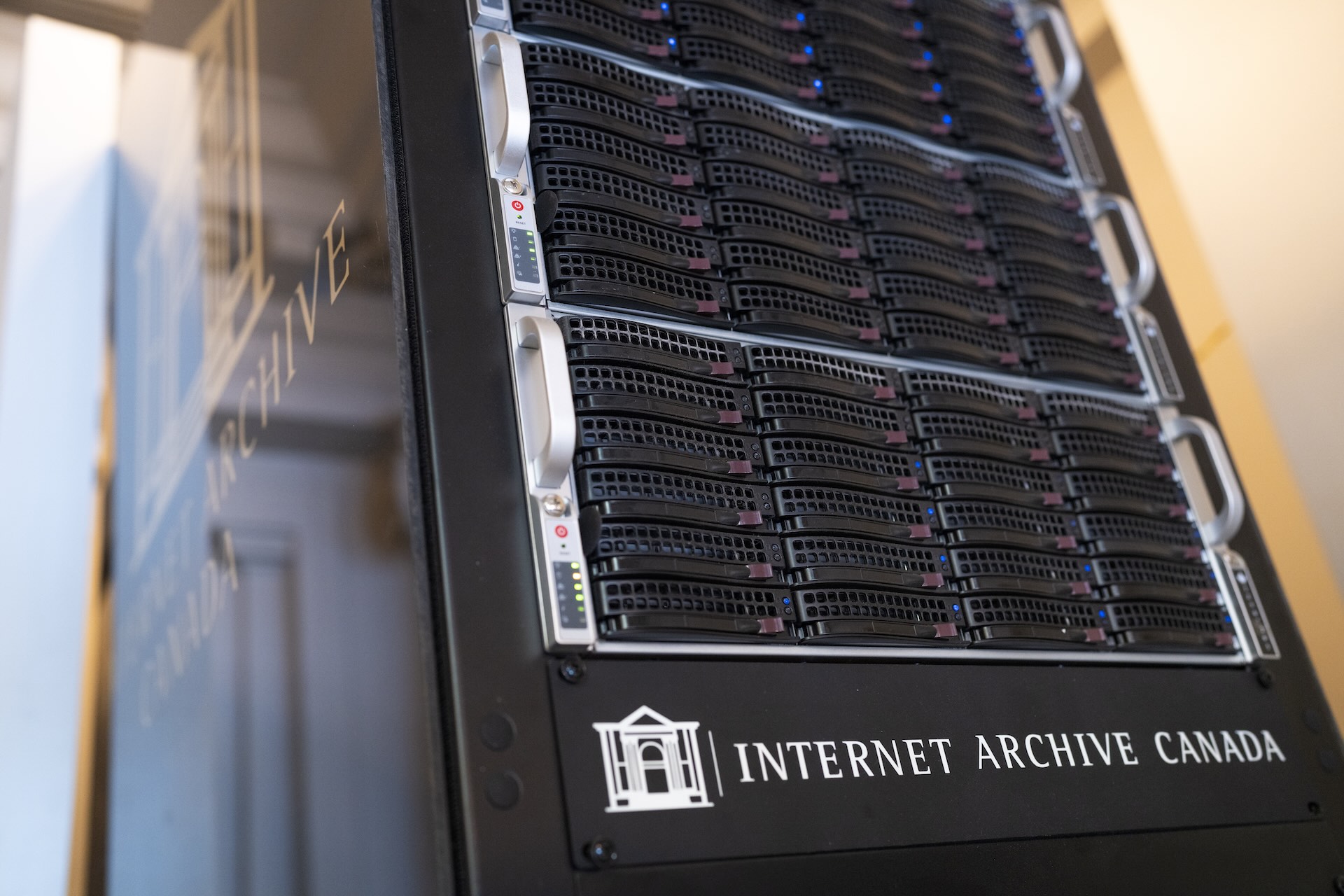 An Internet Archive Canada server. The organization’s Canadian offshoot was founded in 2006 and installed its first servers in Canada in 2022. Photo: Jimmy Jeong for The Logic
 Brewster Kahle, co-founder and director of the Internet Archive, at one of the organization’s server locations in Vancouver, B.C. Photo: Jimmy Jeong for The Logic
 Internet Archive Canada executive director Andrea Mills. She oversees around 30 staff in Canada who work to preserve the country’s internet history. Photo: Jimmy Jeong for The Logic
The Big Read
A crucial Internet Archive backup is hiding in downtown Vancouver
The Internet Archive Canada has been quietly preserving our online history for 20 years. Now, thanks to U.S. President Donald Trump, its importance is clearer than ever.
Brewster Kahle at The Permanent in Vancouver. The building is home to two of the Internet Archive’s servers in Canada. Photo: Jimmy Jeong for The Logic
VANCOUVER — A cluster of Internet Archive servers scattered across Canada’s West Coast has taken on renewed significance as the U.S. government deletes swathes of online information.
Talking Points
- The Trump administration’s moves to erase vast swathes of the internet, including crucial scientific datasets and research, has made the presence of a full Internet Archive backup outside of the U.S. hugely important.
- Internet Archive Canada, which was founded in 2006, now looks after several servers scattered across the country’s West Coast. The organization works to archive the Canadian internet and store backups of global archives.
“Lots of copies keep stuff safe,” says Brewster Kahle, co-founder and director of the Internet Archive. Kahle is sitting in the lobby of The Permanent, a high-end event space in downtown Vancouver, that’s also the unlikely location of two of the Internet Archive’s several Canadian servers. Kahle gestures to the balcony above him, where the lights on the servers are blinking with activity. “People are using those machines right now,” he says.
In fact, people are using them more than ever. Internet Archive Canada may have launched back in 2006, but its importance really became evident shortly after U.S. President Donald Trump’s first election win in 2016. Back then, prompted by fears of the incoming administration’s very real threats to internet freedoms, the organization realized it was crucial to have backups outside of the U.S. This inspired the Internet Archive Canada to open its own data centres, which went online six years later. Now, with Trump’s second term well underway, his administration’s slash-and-burn approach is presenting Kahle and his colleagues with even bigger challenges.
“Red flags go up,” says Kahle of the Trump administration’s proclivity for mass-erasing decades worth of internet history. Over 8,000 U.S. government web pages, approximately 26,000 images, and nearly 3,400 datasets were removed by the Trump administration in late January and early February alone. In April, the National Oceanic and Atmospheric Administration (NOAA) announced that it would be removing a large list of datasets related to weather and climate disasters, oceans and estuary science.
For Kahle and his team, it’s been all hands on deck. “We know that one’s under threat, so we’re mobilizing,” he says of the NOAA removals. “But what other ones that we don’t know about are under threat?”
Kahle founded the Internet Archive in San Francisco in 1996. The online library, best known for the Wayback Machine, works to conserve both the digital and physical works. So far, that’s resulted in the preservation of some 835 billion web pages, 44 million books and 4.8 million images.
Related Articles


Its work in Canada is all about redundancy. Having an archive of the internet in one country is all well and good, but when that country’s government behaves erratically, it’s crucial to have a backup of the backup. Right now, all of the Internet Archive’s Canadian servers are located in B.C.—there are two in downtown Vancouver, along with several more at the University of Victoria on Vancouver Island, as well as at an undisclosed third location elsewhere in the province.
When it launched its Canadian operation nearly decades ago, the Internet Archive worked with Canadian organizations to begin preserving the country’s own internet history. In 2022, the organization installed its first servers on Canadian soil—which, aside from storing Canada’s own archives, also house redundant copies of Internet Archive material from its other international partners. (The organization also has data centres in Amsterdam, Aruba and Egypt.)
Preserving the U.S. federal internet is not new for the Internet Archive, which has been collecting and saving government websites before and after every U.S. presidential election since 2008 as part of a project known as the End of Term Web Archive. Kahle acknowledges that this transition has been very different.
“What’s going on this time is enormous,” he says. “Whole sections of the government web infrastructure are being taken offline: datasets, databases, services, sections of the government. It’s meant that a lot of people have jumped in to help.” Kahle says that this most recent end-of-term crawl is more than two petabytes in size, which is “much larger” than in past years. To achieve such an “enormous task,” as he puts it, the Internet Archive works with many other libraries, archives, museums and heritage organizations to identify, save and organize as much data as possible.
Internet Archive Canada executive director Andrea Mills agrees that it’s a behemoth of a project—largely because, unlike in past years, there’s no end in sight. “Traditionally, you finish the end-of-term crawl, and you do your quality assurance, and you’re like, ‘Yay, success. We’ve successfully archived the change in government,’” she says. “And it just hasn’t ended.”
Aside from the very real need for decentralized storage of digital material outside the U.S., the addition of physical servers in Canada is also a way for the country to have sovereignty over its own archive.
“One of the things that pivoted as the Trump era started was thinking about having our data in Canada repatriated,” says Mills, whose job is to coordinate all of the organization’s Canadian efforts. That means overseeing around 30 staffers, who focus primarily on preserving Canada’s internet history but also jump in to help with international preservation as needed. (“It’s a lot of committed people that will take a call on Saturday morning,” she says of her team.)
Kahle expanded the Internet Archive into Canada, first and foremost, so that the country could begin to preserve its own data—and make that data widely accessible. The addition of servers on Canadian soil has taken that mission to the next level. Today, the archive not only acts as a physical backup for data stored in the U.S. and other partner locations, but also as a way of ensuring that the preservation of Canada’s own internet history doesn’t solely depend on another country.
“There’s cooperation back and forth until there isn’t cooperation,” says Kahle of relations between the U.S. and Canada. “And you want it as such that if there isn’t cooperation, Canada has what it needs to continue to be its own destiny.”



Loading...
Thanks for sharing!
You have shared 5 articles this month and reached the maximum amount of shares available.
CloseThis account has reached its share limit.
If you would like to purchase a sharing license please contact The Logic support at [email protected].
CloseGift the full article!
You have gifted 0 article(s) this month and have 5 remaining.
Recipients will be able to read the full text of the article after submitting their email address. They will not have access to other articles or subscriber benefits.
Photo: Jimmy Jeong for The Logic
An Internet Archive Canada server. The organization’s Canadian offshoot was founded in 2006 and installed its first servers in Canada in 2022.
Brewster Kahle, co-founder and director of the Internet Archive, at one of the organization’s server locations in Vancouver, B.C.
Internet Archive Canada executive director Andrea Mills. She oversees around 30 staff in Canada who work to preserve the country’s internet history.
Most Popular This Week




In-depth, agenda-setting reporting
Great journalism delivered straight to your inbox.
News
National Bank CEO warns AI alone won’t give banks a lasting edge
Briefing
Canada and Ontario commit over $5B to support tariff-hit steel sector
Hackers will see cars as major targets in next 3 years, 83% of car-tech workers say
EA shutting down Edmonton studio BioWare
Best business newsletter in Canada
Get up to speed in minutes with insights and analysis on the most important stories of the day, every weekday.
Exclusive events
See the bigger picture with reporters and industry experts in subscriber-exclusive events.
Membership in The Logic Council
Membership provides access to our popular Slack channel, participation in subscriber surveys and invitations to exclusive events with our journalists and special guests.





