In March, the day he closed all four of his Toronto restaurants and temporarily laid off 97 employees, John Sinopoli began writing his first-ever letter to the government. He addressed “every lawmaker and government official currently considering how to help those most affected by COVID-19.” The executive chef and co-owner of Ascari Hospitality Group feared that the pandemic-induced lockdowns put in place in mid-March would mean “immediate bankruptcy”: no money to pay his landlord or his suppliers or the bank, and no idea when that would change. “When cash flow goes to zero, it gets really scary really fast,” Sinopoli says. “I couldn’t just stand there and do nothing while it crumbled. I had to do something.”
The letter he wrote was a list of the interventions he thought small business owners across the country needed, he says, “to survive this ordeal, to get by.” There were eight things on the list. Near the top: rent relief.
Talking Point
The Logic spoke to more than a dozen people, including federal government, city and provincial government officials in B.C., Ontario and Alberta; small business groups including Save Hospitality and Save Small Business; and representatives of landlord associations. Together they tell a story of an embattled program designed under pressure and produced in record time and yet too late to deliver relief—either for landlords or small businesses.
So on April 24, Sinopoli, like thousands of small-business owners across the country, “exhaled … some relief,” he says, when the federal government delivered the Canada Emergency Commercial Rent Assistance initiative (CECRA). A version of the rent-relief plan he’d proposed in his letter, it would support businesses that had experienced a revenue decline of at least 70 per cent from pre-COVID-19 levels, and their landlords would apply for it. CECRA was different from Ottawa’s other pandemic relief programs: it was much more complicated and required a high level of cooperation by multiple levels of government. It was, according to one federal official, the boldest rent-relief proposal in the world, aiming to deliver way more than similar programs in Australia and France.
For a brief moment, it must have seemed to the country’s 1.2 million small businesses thrust to the brink of collapse that there was a rescue plan. As it turned out, relief was a long, long way away.
The Canadian Federation of Independent Business (CFIB) estimated that some 400,000 to 500,000 firms were eligible for the nearly $3-billion rent-relief program. As of June 29, three months into the pandemic, the government had approved only about $194 million in funding, on behalf of around 25,600 tenants, according to figures Finance Canada provided to The Logic. By July’s end, that number had tripled: still, in its latest estimate, the government said it has delivered a little more than $613 million in rent support to only 63,000 small-business tenants. The program has been extended twice since its launch, most recently to cover rent for August, with only about 20 per cent of allocated funds used at that point. Meanwhile, for businesses, the chances of survival keep getting more dire. According to the CFIB, Canada’s small businesses have accumulated $117 billion in new debt.
The rent relief program should have been one of the main pillars propping up Canada’s economy in an unprecedented time, but, four months after its creation, it still feels like an afterthought. It permits eligible small businesses to pay only 25 per cent of their rent, with government funds covering 50 per cent and landlords covering the remaining 25 per cent. Still, a recent CFIB survey of its 4,600 members found that only 20 per cent believed it was very or somewhat helpful.
In retrospect, CECRA was flawed from the start. Landlords, who would have to forgive a quarter of monthly rent if they wanted to avail of the program, say they weren’t consulted at all; many are themselves struggling small business owners who found themselves pitted against their tenants. Politicians muddled their way through a jurisdictional grey area, pushed along by a nationwide lobby effort, while civil servants worried about the legalities of actions they were being rushed into. All the while, Sinopoli says, restaurant and shop owners were “taking new mortgages out on homes and putting the financial future of our kids [at risk]” to stay afloat.
The Logic spoke to more than a dozen people, including federal government, city and provincial government officials in B.C., Ontario and Alberta; small-business groups including Save Hospitality and Save Small Business; and representatives of landlord associations. Together, they told a story of an embattled program designed under pressure and produced in record time and yet too late to deliver relief—either for landlords or small businesses. Many business owners are still disappointed by the plan, noting that subsequent tweaks to it have not made it easier to get rent relief. And even with gradual reopenings across the country, the stakes remain high. According to Save Small Business’s calculations, Canada could lose 70 to 80 per cent of its small businesses. Sinopoli’s restaurants have now partially reopened, but his worst-case scenario remains grim: one in two restaurants are at risk of closing permanently.
Ottawa didn’t have “a grand plan” for rent relief, both advocates and senior officials say. The issue was discussed in high-level conversations about the economic response to the pandemic, but efforts remained mostly focused on the mechanisms needed to protect people and jobs. The government hoped that the Canadian Emergency Business Account, which provides qualifying businesses with interest-free loans of up to $40,000, would provide companies with emergency liquidity to pay for things like rent, along with other overhead costs. But feedback from business groups suggested it would barely cover one month’s rent.
As early as mid-March, senior federal officials began communicating with businesses in the form of a 30-minute daily call, held at 11 a.m. ET. Initially on those calls, the government heard directly from eighty large businesses and associations, representing business owners across industries. Attendees have since grown into the thousands. One official in finance recalls hearing “just a chorus of businesses and restaurants that were raising the rent issue”; they spoke “very, very passionately,” says another. (The Logic has agreed not to name several of the government officials quoted in this story as they are not authorized to speak publicly.)
Sinopoli was on those calls. He along with two others formed a group called Save Hospitality, a movement to save the hotel and food industry, which has seen the most severe job cuts. For this industry, Sinpoli says, paying rent was equivalent to “unfairly draining our bank account to put into landlords’.”
This group found allies in Michael Smith and Jon Shell, who founded Save Small Business, which in the early days of the pandemic released a petition making similar asks for rent relief; it had 20,000 signatories in a week. (It now has more than 38,000 members.) Together, the two groups learned how to speak with one voice, while pursuing a three-pronged approach: call everybody, try everything, make lots of noise.
“It was a period of throwing hand grenades,” says Shell, managing director and partner at Social Capital Partners. The group didn’t have any prior experience working with provincial or federal governments—a liability in one sense, but also an asset. “Because we didn’t care what our relationships were like with these people afterwards, we were willing to write 10,000 letters to a chief of staff.”
According to one federal official, the noise “just kept getting louder and louder,” eventually forcing Ottawa to do something. But what was that something? The political will to respond was quickly evident, but this was a jurisdictional no-man’s land: rent regulation falls under provincial jurisdiction. Beyond “shaming landlords and trying to get them to the table” to talk about it, Ottawa’s hands were tied.
“It felt like there wasn’t enough creative thinking going into policy creation, and that if we didn’t come up with stuff on our own, maybe it wouldn’t happen,” Sinopoli says of the response. Smith and Shell agreed, and proposed a counter-solution to the government: a grant program for landlords that would cover their rent so tenants didn’t have to pay. “We didn’t think it was the best answer, but it was the best we could come up with,” Smith says.
As an example, they offered Australia, whose government announced a countrywide six-month hold on commercial evictions on March 29, and established a “mandatory code of conduct” for landlords and their small- and medium-sized enterprise tenants. Australian banks also offered mortgage payment deferrals to landlords on the condition they not evict their tenants.
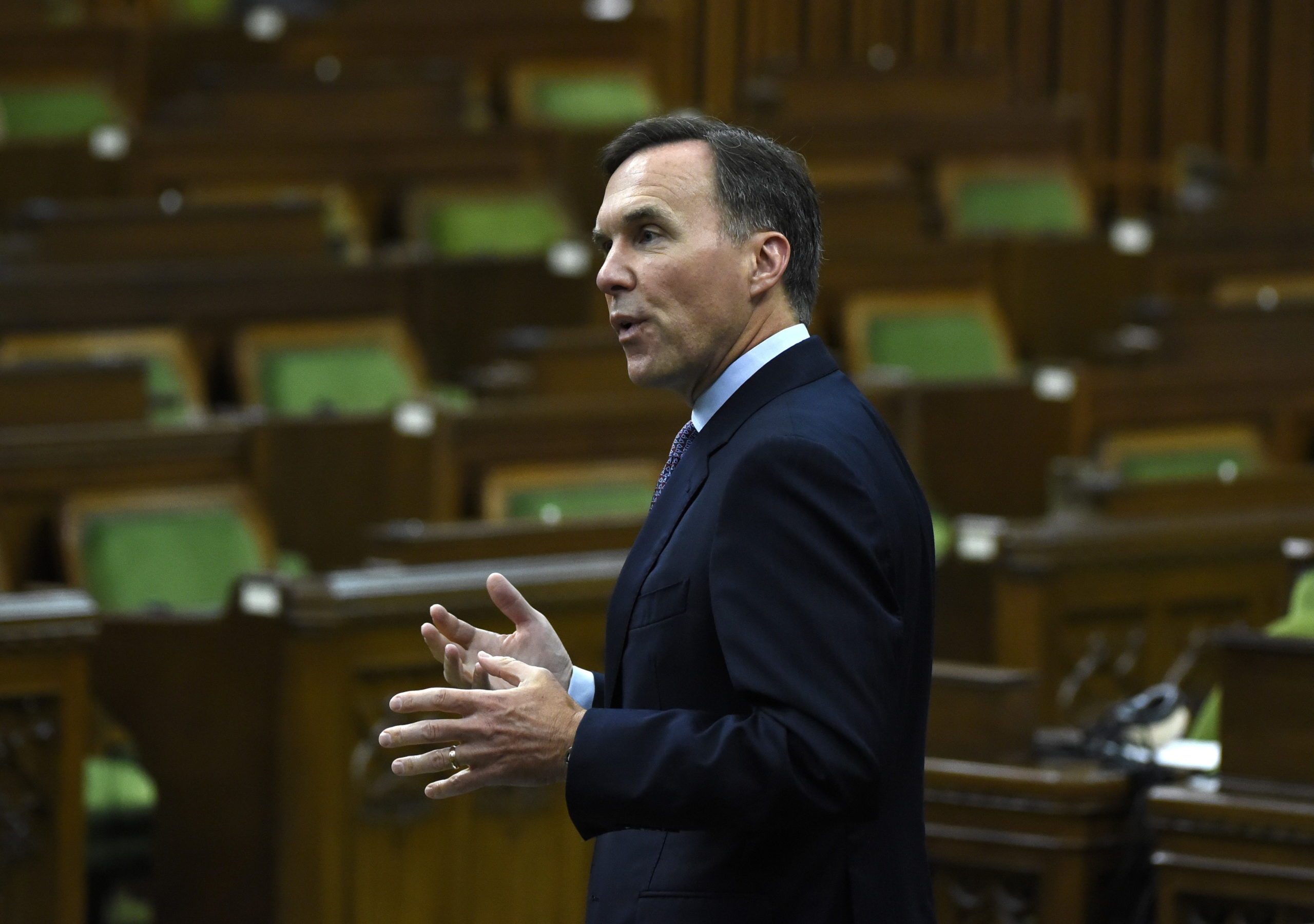
Finance Minister Bill Morneau in Ottawa in June 2020. Photo: The Canadian Press/Justin Tang
Federal officials say the main problem in implementing this proposal was getting buy-in from provinces. For any rent-relief program to be effective, a complementary commercial eviction ban had to be in place, and that was at the discretion of provincial governments. One federal official says that, for the first month of the pandemic, then-finance Minister Bill Morneau was reportedly “continually pressing” premiers across the country in his weekly call. Small-business groups began their own efforts lobbying city and provincial officials for a ban. Many provinces did come through with slightly differing temporary commercial eviction bans—including Nova Scotia, New Brunswick, Manitoba, Saskatchewan, B.C., Ontario and Alberta—though they expire this summer, and extensions have not been announced. Quebec, P.E.I. and Newfoundland and Labrador did not impose a commercial eviction ban.
“We’re a conservative government. We usually prefer a hands-off approach,” Tanya Fir, Alberta’s economic development minister, told The Logic. “We wanted to find that right balance between introducing legislation we have to, but not introducing unnecessary legislation, and in this case, [a commercial eviction ban] was definitely warranted and necessary … because the CECRA program had gaps.”
For one thing, CECRA was voluntary (landlords had to opt in) and had—according to many—very strict criteria: small businesses were eligible only if their revenue had dropped at least 70 per cent in April, May and June; had annual revenue of less than $20 million; and paid up to $50,000 in monthly gross rent. Fir says those requirements excluded many small businesses that were still hurting. Her government looked to what other provinces were doing and introduced “the best Alberta fit”—going further than CECRA in making rent relief accessible: Alberta’s eviction ban applied to commercial tenants who had lost more than 25 per cent decline in revenue; were forced to close due to public health orders; or qualified for rent relief, but their landlords had opted not to apply.
Ontario announced its ban in June, and has since implemented a retroactive ban on evictions to May 1 and through to August 31. Getting to that policy announcement was complicated. Small-business advocates with whom The Logic spoke found that some staffers and ministers chose a cautious, wait-and-see approach behind the scenes, even as Premier Doug Ford pleaded with and at times even threatened landlords in his daily press conferences. The Logic asked several Ontario officials for comment multiple times and was not granted an interview. Small Business Minister Prabmeet Sarkaria sent a statement saying he believes the province and the country’s “rapid response”—which he says were developed after he raised small-business concerns with his federal counterpart Mary Ng—“will prove to have been critical to the recovery of Main Street across our province.”
Some delays were understandable; there were legitimate legal questions to resolve before implementing any ban on commercial evictions. Laura Jones, executive vice-president and chief strategic officer of the CFIB, which boasts 110,00 members countrywide, says provinces feared that a ban would be an illegal intervention in agreements between landlords and tenants. In New York, three landlords sued Governor Andrew Cuomo, arguing the U.S. state’s eviction ban violated their due process and contract and property rights; Cuomo won the challenge.
Two provincial officials told The Logic that attorney generals were consulted, and legislation was amended in some provinces to allow for such bans to be implemented. Fir says concerns about the legality of a ban was “taken into account,” but noted that the legislation, which passed last month, “does become the law.” One Toronto city official says that while the issue was complicated, provinces were reacting too slowly. Premiers “just weren’t responding to what [small businesses] thought was the urgency of the case,” the official says. Fir, for her part, says Alberta “decided to take what we felt was the right amount of time to assess the gaps in the CECRA program to make sure that what we introduced was as effective as possible in addressing the needs of landlords and tenants.”
The senior federal officials who spoke to The Logic stand by the program. One described it as “a model where everyone shares the pain.” Fir says there was “maybe a little bit of tension and negotiating, but there was also a lot of cooperation and listening.” Provinces, the official says, agreed to contribute to the government portion within a week and a half, thanks to “an additional layer of pressure” from small businesses and their advocacy groups.
Michael Wiebe, a Vancouver city councillor and small-business owner who pushed B.C. to implement a commercial eviction ban, says the groups delivered rapid, strong data with “clean and simple asks” that helped elected officials “move mountains compared to what they would normally do in such short periods of time.”
On paper, CECRA should have been a functional program that made an impact. The problem was that a significant party was missing from the room when it was being put together: landlords.
It is easy to think of the big, rich, corporate landlord when considering rent relief, but many who spoke to The Logic point out they are small mom-and-pop businesses themselves, who needed revenue to survive. Most suddenly felt the pressure mount, as the burden to provide relief to other small businesses seemed to rest entirely on them. The pandemic created a stand-off between them and small-business tenants, and some felt they were viewed as an obstacle in achieving rent relief.
Storefronts in Ottawa's Glebe neighbourhood in March 2020. Photo: The Canadian Press/Justin Tang
Things did not get easier after the program was launched. CECRA is “brutally complicated and the criteria is constantly changing,” says Michael Brooks, the CEO of RealPAC, a national industry association that represents the real property sector. For any relief to be given, landlords have to file a massive pile of paperwork: signed attestations from tenants, a legally binding rent reduction agreement with each impacted tenant, a forgivable loan agreement and more. Some amendments to the original requirements, according to landlords, have been minor: the documentation required, for example. Others are more complicated, like how to apply if you own multiple properties.
One landlord, a senior citizen, told The Logic he asked his tenants to help pay for a lawyer to help complete the “insane” amounts of paperwork. Another, a large property owner, said the process was so “onerous” they were looking to find four or five employees to work on it full time for a month, just to help their 400-plus tenants qualify. Both landlords asked not to be identified because they worried about compromising their CECRA applications, and for fear of backlash from tenants.
Brooks says he doesn’t know any property owner who is not applying, but the data shows landlords aren’t participating in the droves government officials expected. One major problem, for example, is how to prove that your tenant has lost 70 per cent of their pre-COVID-19 revenue in the time that they were closed. Brooks wrote to the federal government, proposing an easier alternative: “a commercial rent bank” to support businesses throughout the pandemic, dovetailing off the existing Canada Emergency Business Account program. That would ensure landlords, who were already deferring rent in some cases until spring 2021, weren’t losing income en masse, and small businesses were given a real shot at survival.
“We didn’t get a response to that request,” Brooks says. He and his colleagues were surprised when the rent-relief program was announced, he says. Property owners had “zero input” in its creation, yet Ottawa was asking them to write off part of their revenue stream. In a letter to the government, BOMA Canada, a real estate industry association, urged Ottawa to reconsider its approach, saying that “transferring economic pain from one party to another, without mitigating the pain itself and without providing a principled reason for doing so, only complicates the financial challenge.” Benjamin Shinewald, the group’s CEO, describes CECRA as Ottawa essentially “rewriting the terms of contracts between two private parties, which is fundamentally wrong.” His group has asked for a more balanced approach, and in the meantime, Shinewald says, “We figured we’d hold our nose and do it.”
“There will be landlords and tenants who will make it through because of CECRA. That’s a great, great thing,” he says. “But the question is, you know, how many more could it have helped if it was fairer and more efficient?”
Despite being on the opposite end of the issue, Save Hospitality and Save Small Business agreed with landlords on many of their concerns. Both have been fielding pleas from their industry members to navigate CECRA. A Save Small Business survey in June reported that 41 per cent of their members who believed they qualified for the program said their landlord had not applied. In hindsight, the two groups blame themselves for not doing more to bring landlords to the decision-making table to help streamline CECRA and, according to Sinopoli, rid it of “red tape thicker than you’ve ever seen.”
Even some of the government officials who helped design and execute the mammoth program recognize it is inherently flawed. Saskatchewan Finance Minister Donna Harpauer called it as such in a letter to Morneau, noting it would “be more useful if redirected to directly support small businesses.” Meanwhile, the work continues: Fir, Alberta’s economic development minister, says discussions are still ongoing with ministers across the country on how to improve the program.
“I remember, very clearly, having a moment where I thought we could fight for a different way to deliver rent relief, but then we’d risk not having any relief,” CFIB’s Jones says. “Or we could get behind what was happening and then hope to fix whatever works as it evolves. I’m not entirely sure, given the challenges with the design of the program, that we made the right call.”
The founders of Save Small Business have similar regrets. “Our objective was to, you know, provide real meaningful rent relief, and that didn’t happen,” Shell says. “I wonder about the things we could have done differently: yelled louder, talked to different people, taken a different approach…. I think we failed…. I just don’t know how you can think of this as anything other than in-progress at best.”
A “for rent” sign hangs in the window of a commercial space in Gatineau, Que., in April 2020. Photo: The Canadian Press/Adrian Wyld
Meanwhile, in Ottawa, the rent-relief program has sparked a game of political football. In developing its rent-relief program, Ottawa was leveraging two things: relationships with landlords through the Canada Mortgage and Housing Corporation (CMHC) and their ability to offer money. The end result was the only relief program not managed by the Canada Revenue Agency—a fact that has now made it contentious on Parliament Hill. The CMHC was charged with administering the program, but opted to outsource the work to MCAP, a mortgage financing company that turned out to have ties to senior Liberals; the CMHC told CBC News it “did not have the internal capacity” to deliver the program. The CMHC declined to speak to The Logic and directed all questions to Finance Canada. Morneau, the man at Finance’s helm for CECRA’s launch, has now resigned.
The problem of commercial rent is also beginning to surface in courts. In one of Canada’s first such COVID-19-related lawsuits, a Quebec landlord sued its tenant, a fitness centre, for not paying rent from March to June, during which the gym was forced to shut down. The court decided in July that the landlord was not entitled to payment of the rent, because it had to close its premises by government decree. Though that put the landlord in a force majeure situation, or unforeseen circumstance, it meant the tenant was not provided “peaceful enjoyment of the premises,” an obligation of the landlord. For now, there may not be a better alternative to the rent-relief problem for both landlords and tenants.
While no one is truly happy with it, there are elements of success at the heart of how this policy came to be. CECRA wouldn’t exist without a group of people banding together and demanding change, and governments responding to them. Jones of the CFIB gives business owners “full credit for anything that happened in this space, because it was their voices that gave us even this much.”
“They were instrumental in getting this on our radar, and opening our eyes to the actual impact out there on the ground,” says one federal official. “For those businesses out there, it was two grassroots organizations that did not exist before [COVID-19] that got this program through the system, and that’s a big win. Whether or not it functions 100 per cent perfectly—that’s on us and we’ll fix that. But individuals do have an opportunity to make change.”