Supply chains deliver everything from food and household goods to the raw materials for factories, but until COVID-19 few of us realized how fragile they are.
In this six-part series, The Logic examines the weaknesses in Canada’s supply chains, the solutions some companies are trying to apply, and how a shift from “just in time” to “just in case” thinking brings challenges of its own.
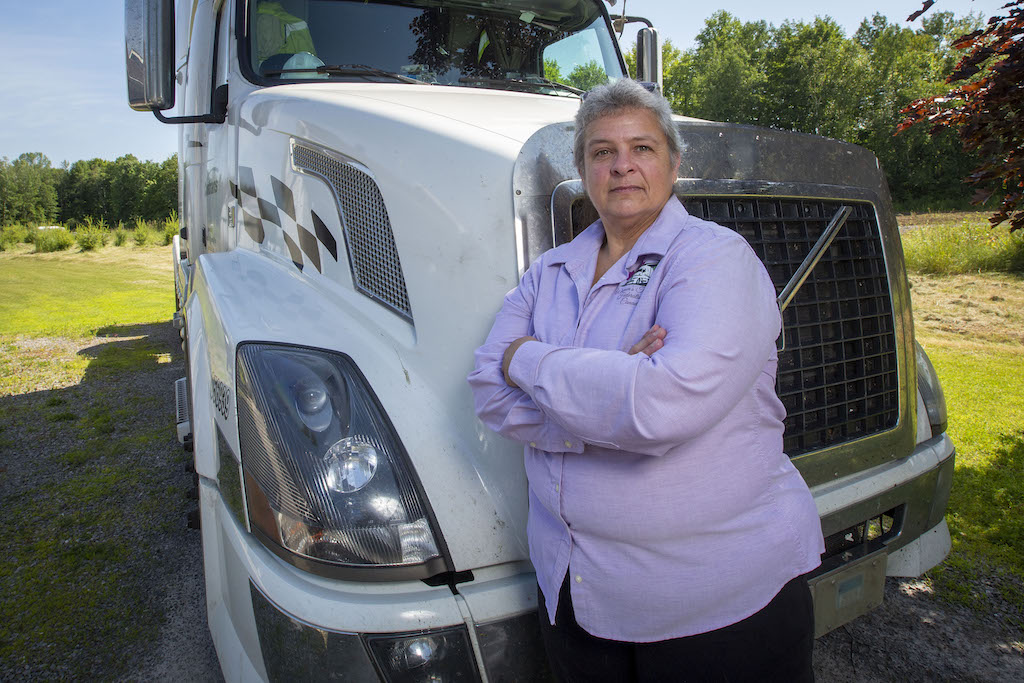
OTTAWA — When Johanne Couture’s husband had a stroke in the depths of the COVID-19 pandemic, and she was on the road in Kentucky, she couldn’t rush to an airport to get home—she would have landed only to start a mandatory hotel quarantine.
Instead, she drove her big rig home to Brockville, in eastern Ontario, and waited to be allowed into the hospital.
Talking Point
Canada had a shortage of truckers before COVID-19 and it’s only worsened—and spread. Employers are taking unprecedented steps to keep workers, but the people who do the jobs say bigger reforms are needed.
“I had to fill out a questionnaire and one of the questions is, ‘Have you travelled?’ Well, now I guess I have travelled, but I’ve been in Canada for the past 14 days. ‘Where in Canada?’ Ontario and Quebec. ‘Oh, well, you’ve been out of province,’” she recounts. Yes, she said, but “I’d been confined to an 80-cubic-foot box.”
For Couture, the pandemic aggravated many of the difficulties of being a long-haul trucker, things that have worsened a severe labour shortage in an occupation critical to the Canadian economy.
There’s a lot she likes about the work. Couture has delivered fuel for Formula One cars in the pits in Indianapolis, hauled Prestone fluid out of storage in caves in Missouri, seen the lights of Las Vegas, crossed the Rockies by “every road you can take going over them.”
“I’ve seen a lot. I’ve been in every state, every province over the years,” she said. “I wanted a job where I could just pack up and leave and travel. I’ve been gone as long as five weeks at a time, and I’ve been home every night, depending on where I’m working.”
But as she waited to offload a concrete-dewatering agent outside Atlanta, four days after leaving her home for a week on the road, she talked over the phone about why so many fellow truckers have soured on the job.
“The industry is essential. But there were parts of the industry that didn’t see it that way,” she said. Dealerships that made truckers wait in freezing metal sheds in January while their vehicles were serviced. Delivery recipients that wouldn’t let them in to use washrooms—“We even had women drivers told, ‘Well, you can go in the bushes over there.’”
Broken Links
Read the rest of the series:
Part 1: The epicentre
Part 2: Labour
Part 3: EVs and ‘glocalization’
Part 4: Scenes from a crisis
Part 5: Solutions
Part 6: The future
People like Couture, along with thousands of other drivers of trucks and trains and ships, and the people who load and unload them, are crucial to the supply chains that drive the Canadian economy. They move logs and grain and gasoline, laptops and coffeemakers, food and fertilizer, the chemicals that become medicines and the metals and microchips that become auto parts, and then cars.
Historically, these were good jobs. Demanding and sometimes dangerous, but very well-paid, often unionized, with reliable employers. Even before COVID-19, though, there were shortages of people willing to work the long hours in all weather, despite the money. The pandemic has made the situation worse.
“Every driver, it was like they had COVID,” said John McCann, the director of Teamsters Canada’s freight and tankhaul division, which represents truckers. “Even though they didn’t—even though they were delivering the products that kept these companies operating.”
Couture said she didn’t support what the truck protest convoy that descended on Ottawa became, but she sympathizes with its original intent—the vaccination mandate for truckers never made sense. She could go a week with less human contact than someone making a single trip to the grocery store. Hard to spread COVID-19 if people won’t even let you in to pee.
The pandemic piled insults and indignities and restrictions on top of the longstanding problems in trucking and worsened a labour shortage that was already serious: according to federal statistics, employers reported 14,900 job vacancies in truck transportation in the first quarter of 2019. In 2022 it was 19,315.
That’s an imperfect measurement in at least three ways: it includes the whole trucking sector, not just drivers; it doesn’t cover other industries where licensed truck drivers might work, such as in logging or mining; and it only covers vacant jobs where workers are on payroll, not independent owner-operators.
Statistics Canada reported the vacancy rate measured this limited way climbed from 6.7 at the start of 2019 per cent to 8.7 per cent last winter. (Across the whole economy, the job-vacancy rate rose from 3.1 per cent to 5.2 per cent.)
Couture isn’t planning to quit. She’s been driving a truck since 1994; she met her husband, who was a dispatcher, on the job. She currently specializes in liquid chemicals under contract to a large company that assigns her runs but she owns and operates her own rig. Pay has increased, especially over the last four years, but with inflation, she said, truck drivers are still catching up to what they were paid in the 1980s. Nevertheless, she’s content.
“I’ve worked for four different carriers,” Couture said. “The one I’ve got now, I’ve been here for 14 years. And it would [take] something really drastic for me to leave here.”
Not everyone is that invested.
“A lot of people, what they thought they were getting into, didn’t work out the way they had planned,” McCann said. “They were like, ‘Shit, I’m away a lot. I’m out of town a lot, I’m missing my family a lot, I have horrible start and finish times. For the wages I’m making, I could do a manufacturing-type job.’”
So drivers just leave, he said. McCann tells of a friend’s son who lasted two days at a driving job where he could be home every night—and the work was so clean he could wear a suit every day if he wanted to. He couldn’t hack shifts that started at 3:30 a.m. and lasted 14 hours. The guy drives a garbage truck now, preferring more normal hours.
Bringing people into the industry to replace them hasn’t been easy.
“For me to get my AZ licence [to drive a heavy truck in Ontario], it’s anywhere between $8,000 to $10,000 out of my pocket, out of my jeans,” McCann said. Even if you do that, these days you still can’t get a Nexus card for easy border crossings.
The need to pay for up-front training has created a predatory business model called “Driver Inc.,” where trucking companies finance a driver’s entry into the industry and tie them to the company’s services with contracts and yet treat them as independent workers with no employee rights—the parallels to gig-economy workforces like Uber drivers are obvious, but worse. Regulators have struggled to take them down.
McCann suggested that treating truck driving as a skilled trade, in keeping with what’s needed to pilot an 80,000-pound piece of machinery on crowded highways and through city streets in all sorts of weather, would help—with paid apprenticeships and a chance to learn the life, not just what it takes to get a driving licence, from experienced drivers.
(Each province manages its own trades system. In Ontario, at least, the job is partly treated that way, with a voluntary apprenticeship program.)
Traffic flows over the Ambassador Bridge in Windsor, Ont., in February 2022. Crossing the U.S.-Canada border during the pandemic made truckers into travellers with restrictions on their movements at home—one of many indignities that contributed to a worsening labour shortage in the freight industries. Photo: The Canadian Press/Nicole Osborne
Even small fixes could make a difference. Both McCann and Couture talked about how hard it is to find a place to stop for the night, or just for a break, when you’re driving a truck. This is especially tough in sparsely populated places like northern Ontario. The previous night, in the U.S., Couture had tried three places to find truck parking, and by the time she did she was 31 minutes past her driving limit for the day, and facing a potential fine of $350 to $700.
“More parking for trucks” isn’t exactly a vote-winning election issue, but both said it’s key for smooth operations in the industry. Especially because, as McCann said, trucking companies are desperately trying to keep up with demand and the maximum legal driving hours are now the standard shift.
Autonomous trucks are in the works but the technology is only in early testing. Transport Canada has funded trials of “co-operative truck platooning,” which uses communication among multiple trucks in a convoy to co-ordinate their movements. That’s about fuel-efficiency and traffic flow, though, not labour: so far, the trials require a licensed driver in each vehicle.
McCann—who represents human truck drivers, of course—said driverless trucks will come eventually. “People have been flying planes forever with their hands off the wheel. And that doesn’t scare us,” he said. But planes on autopilot have pilots aboard, air-traffic controllers on the ground and a lot of room to manoeuvre. The sky is not the Trans-Canada Highway, or Ontario’s 401.
Labour shortages have spread beyond trucking and into rail and ports, and for many of the same reasons. The House of Commons’s transportation committee heard testimony about the scope of the problem at a meeting in April.
“Going forward we are definitely concerned about the availability of labour for the port authority itself, because we are in an environment that offers good working conditions but with very atypical schedules,” said Daniel Dagenais, the vice-president of operations at the Port of Montreal at the time (his title has since changed to vice-president of port performance and sustainable development). “Working weekends, nights and shifts is less and less attractive, so we’re trying to make sure that we are also creating an environment that meets the expectation of new labourers and new workers who are requiring a more stable work-life balance.”
For rail workers, the money can be excellent but the hours are atrocious, said another Teamsters leader, Lyndon Isaak, the president of the union’s rail group.
“For the most part, the railroad [work] is not scheduled. So unless you’re on vacation or on personal rest, let’s say after a shift, you are available to go to work 24/7,” said Isaak, who started working for Canadian National in 1987.
“I used to work Saskatoon to Wainwright, Alta., and there was something like 192 rail miles one-way. So what happens is I get on a train in Saskatoon, I go to Wainwright, I lay there until I get a train to come back east again. That layover can run anywhere from eight hours to 16, 18 hours. All depending on how the traffic’s running,” he said.
That layup can be in a railway bunkhouse with communal showers and negligible privacy, Isaak added.
The scheduling, or lack of it, also makes keeping a job very difficult for a spouse, especially in a family with children. “You’d need a support system for sure, because our lives as railroaders are so unstructured,” Isaak said. “Your spouse would need to have a support structure, have in-laws or friends or cousins or somebody to help you out. Otherwise, it would make it very hard. I’m not going to say impossible, but it would be, virtually.”
A rail worker can expect to be away from home at least 80 hours a week. They can make more than $100,000 for it, in a decent year, but not be present to spend it. Young people just aren’t interested in living that way, Isaak said.
“Unless we find some way to lure the younger generation into wanting to work these jobs, their supply of workers is just going to keep dwindling. They’re going to have to make a way to make this a lot more scheduled or structured,” he said.
Canadian Pacific is struggling with a lack of housing for workers in some places where it needs them, a CP executive told MPs at that meeting in April.
“Because the cost of living can be very high in some of those small communities, we’re taking steps like building accommodations in some small communities to house crews that we would be hiring in the area,” said Joan Hardy, CP’s vice-president of sales and marketing for grain and fertilizer.
Canadian Pacific declined an interview (and a spokesperson rebuffed a specific question about where CP is building housing) but pointed The Logic to public statements by its chief financial officer Nadeem Velani about the railway’s need to hire, hire, hire just to stay even.
“Across the network, we’re adding employees back because you always have attrition, right?” Velani said at a May investor event. “I think that’s something that maybe the naysayers are forgetting, that there’s seven per cent to 10 per cent attrition in our industry. And then, you take a look at what’s happened with the great resignation year with COVID and so forth, that’s accelerated that as well.
“So, you need to hire, you need to train just to get to base level and then for growth. So, we expect to be flat head count for the year.”
Sometimes Couture passes the time on the road thinking about the truck trips that go into goods on store shelves: The tankful of wax delivered to the company that makes the paper label that goes inside the plastic wrapper around a pack of bacon; a jug of milk that needs different trucks to drop off feed for the cattle, raw milk to the dairy, different kinds of plastic for the jug and lid, labels, sanitizers, processed milk to the store. She got to 52 trucks for the milk before she stopped counting.
“Without trucks, everything stops.”