Listen Now
0:00
The night was young at a sprawling banquet hall in Mississauga, Ont., where edtech unicorn ApplyBoard was hosting its 2021 holiday party.
Employees dressed in cocktail attire—a change from their pandemic-time, work-from-home uniforms of pyjamas and sweatsuits—were just starting to trickle in. More would soon arrive aboard buses chartered to ferry workers from the company’s Kitchener, Ont., headquarters. On-again, off-again restrictions aimed at slowing the spread of COVID-19 meant this was the first time many of them were meeting each other in person.
Talking Points
- ApplyBoard developed a system for matching applicants to programs that solved real problems for Canadian colleges and universities—and it came along at exactly the right time to take advantage of extraordinary pressures on those schools amid a global pandemic
- Today, ApplyBoard’s valuation has plunged amid a rollback of immigration policies that massively decreased the number of international students in the country
- The Logic spoke to 17 former ApplyBoard employees, who pointed to failures of leadership judgment ranging from allowing widespread document fraud in student applications to a culture that encouraged excessive drinking and spending lavishly on a social media campaign as workers were being laid off en masse
Wearing a light blue shirt and a dark blue bow tie, CEO Martin Basiri approached the bar and took it upon himself to get the party started.
“Shots! Shots! Shots!” he shouted.
As the tequila flowed, Basiri had a lot to celebrate. ApplyBoard, which operates a software platform connecting Canadian universities and colleges with international students, had six months earlier raised a staggering $375 million from some of Canada’s biggest institutional investors, including the Ontario Teachers’ Pension Plan, La Caisse and the Business Development Bank of Canada. Its valuation for the round was $4 billion.
ApplyBoard’s business was roaring, thanks in large part to new federal policies that made it easier and more attractive for international students to come to Canada. Intended to address labour shortages caused by the pandemic, the changes had triggered a massive inflow of students from around the world. Colleges, in particular, cashed in by offering back doors, via their classrooms, to work in Canada.
At the time, most in power were lauding the policies—and the company that had so successfully leveraged them. During a virtual event the year of ApplyBoard’s big raise, then-Immigration Minister Marco Mendicino hailed ApplyBoard’s sibling team of co-founders—Martin Basiri and his brothers Meti and Massi—as “the Wright brothers of international students,” lavishing them with thanks.
Related Articles


Behind the scenes, however, things were messier. The Logic spoke to 17 former ApplyBoard employees who worked at a variety of levels and in a wide range of roles—from the company’s launch to recent months—to tell the inside story of a startup that played a key role during a pivotal time in Canada’s history. The sources requested anonymity out of fear of professional and legal repercussions.
The former workers talked of pervasive culture problems amid immense pressure to expand as ApplyBoard’s leaders lionized the work-hard, play-hard ethos of Silicon Valley at the expense of workplace boundaries and norms. The results, say the departed staffers, were incidents of recklessness and questionable judgment by senior managers, including sexual harassment and discrimination. They also said managers brushed off well-known problems with document fraud and unscrupulous recruiting agents, prioritizing growth over academic integrity and student well-being.
An emailed statement sent by spokesperson Tony Vlismas on behalf of ApplyBoard said the company’s technology has helped the international education sector combat document fraud and agent misconduct, issues that long predate its launch. The statement said the company has changed and professionalized since its early years.
Nick Rosen-Wachs, a spokesperson for Martin Basiri (who left the company in 2022), did not directly address the 2021 holiday party when asked about it. He said in an emailed statement that Martin doesn’t drink alcohol, and hasn’t for many years.
ApplyBoard and Martin Basiri declined requests for interviews. The Logic then sent them each detailed lists of questions. Rosen-Wachs said the questions for Martin Basiri contained “multiple falsehoods and complete inaccuracies.”
“As education and immigration consultants, we take care of people’s dreams. One mistake can literally screw generations to come. There’s a huge moral and ethical responsibility.”
But “more than anything,” Rosen-Wachs said he was “surprised and confused” about why The Logic was reporting the story. Martin came to Canada penniless, and a full scholarship he received from the University of Waterloo changed his life, Rosen-Wachs said. “ApplyBoard is the Canadian Dream personified. We should be celebrating entrepreneurship in Canada and immigrants, not taking them down.”
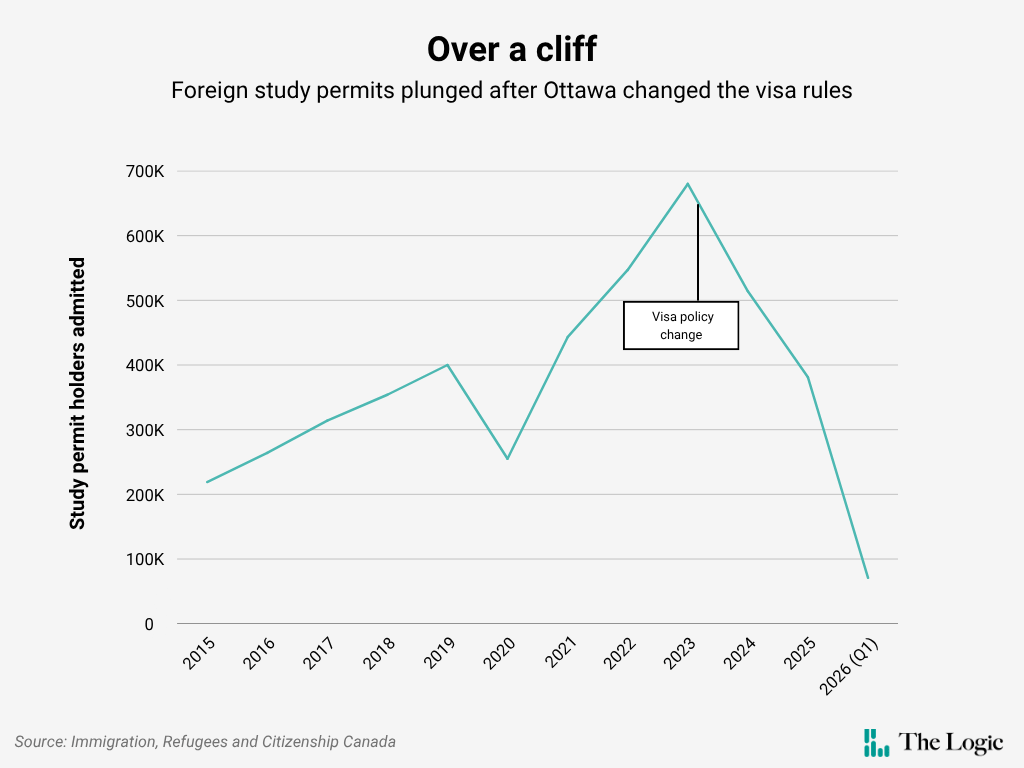
Eventually, the regulatory regime that fuelled ApplyBoard’s explosive growth came to an end. In January 2024, Ottawa started rolling back the policies that had caused Canada’s international student population to grow 68 per cent between Dec. 31, 2021 and the same date in 2023. The federal government announced it would cut new international study permits by 35 per cent.
To some this reckoning was foreseeable. Gautham Kolluri, a Toronto-based immigration consultant with 25 years of experience in international student recruitment, said ApplyBoard “opened Pandora’s box.” The company permanently altered the business of connecting students and schools by putting a faceless software middleman between schools and recruiters who bring them students. In that role, Kolluri said, it impedes accountability in the event this major life decision—one often backed by an entire family’s life savings—doesn’t turn out as advertised.
“As a doctor, we take care of people’s health. As an education and immigration consultant, we take care of people’s dreams. One mistake can literally screw generations to come,” he says. “There’s a huge moral and ethical responsibility.”
ApplyBoard has always maintained that making money for itself and its clients can go hand in hand with social benefit. Its mission, executives say, is “to educate the world” by broadening access and empowering students.
Those were the themes of Martin Basiri’s post-dinner address at the holiday bash in 2021—a night that epitomized the company’s culture of optimism and excess. With the speeches over, a troupe of costumed women in sequins and feathers streamed in and performed a dance sequence. As the night wore on, the DJ periodically interrupted the festivities to plead with attendees to put on their masks and comply with COVID-19 restrictions. One former employee said they witnessed security guards removing an unconscious woman from the bathroom, while two former employees said other partygoers could be heard vomiting in the bathroom stalls.
The hangover hit the next day for the employees who overindulged. In texts viewed by The Logic, they reminisced about drinking whisky on the bus and waking up with lipstick smeared on their faces. They didn’t know it, but it wouldn’t be long before the party came to an end for ApplyBoard as well.
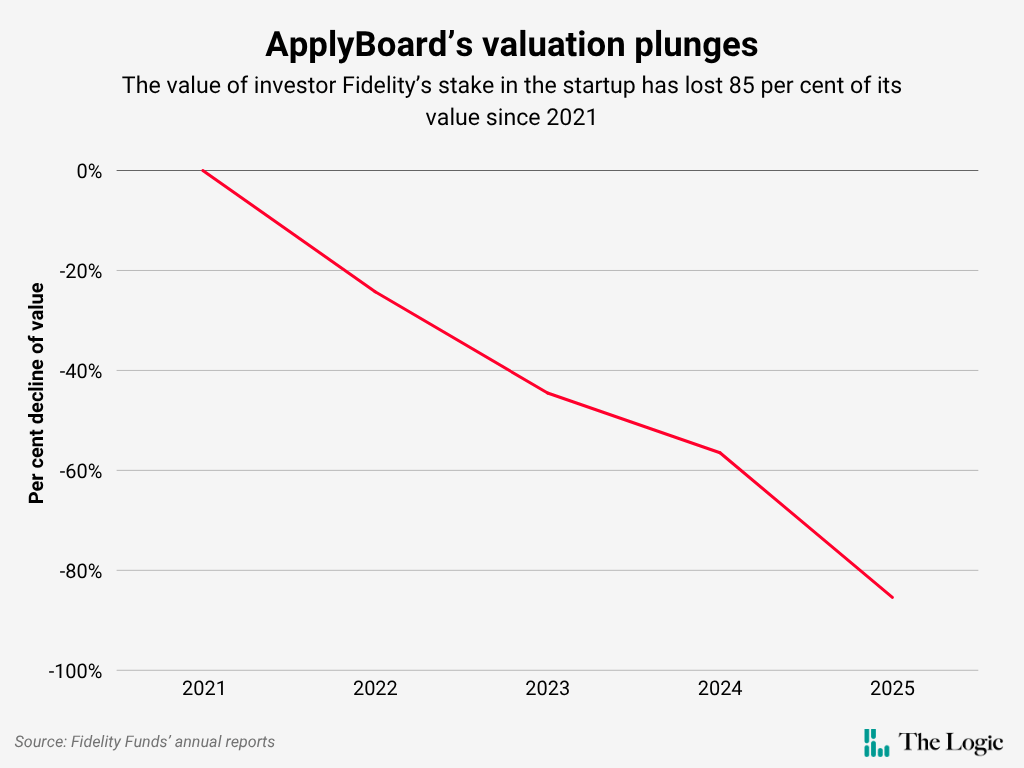
Six months later, shareholder Fidelity would report that its stake in ApplyBoard had already lost about a quarter of its value in the year since the 2021 funding round. Over the next three years, the company’s plans for an IPO would be dashed by a free-falling tech market, and by Ottawa’s decision to pull back its permissive visa regime, which sent international student enrolment plunging.
That hangover is one Canada is still feeling. The spree era is over for ApplyBoard and the colleges and universities it supplied with a seemingly endless stream of new students. Institutions, communities and the young people who chased dreams to come here are still picking up the pieces.
The Basiri brothers came to Canada from Iran, as international students themselves. Martin arrived in 2010 for a master’s degree in mechatronics engineering from the University of Waterloo. Meti and Massi, twins who are five years younger than Martin, followed to pursue diplomas in business marketing and fitness and health promotion at nearby Conestoga College.
In an online interview with venture capital firm 500 Global, an ApplyBoard investor, Martin said he got the idea for the startup from his experience helping friends come to Canada as international students. He was struck by how there was no “single source of truth” about the process, he said. Even lawyers gave conflicting answers. “I was like, ‘Maybe we can automate this.’”
The Basiris launched ApplyBoard in 2015. Martin, with his prestigious degree and a knack for selling bold ideas, took the role of CEO. Meti, who had previously launched a social media startup and was good at connecting with people, took charge of marketing. And Massi, a practical person who seemed more comfortable working behind the scenes, focused on execution as chief operating officer.

Because the three brothers started ApplyBoard more or less straight out of school, they had little work experience, let alone experience running an international juggernaut—a gap that became more problematic as the company grew, five former workers said. “The three of them kind of fell into building this company just by being in the right place at the right time,” one said. “They didn’t really know what they had gotten themselves into, and they seemed to be in over their heads.”
Their timing was undeniably good. In the five years between when they arrived and when they started the company, the number of international students in Canada rose by more than half to over 350,000, and would keep climbing.
By then, the funding model for colleges and universities was in the midst of a historic shift as governments reduced their support. Many provinces also cap tuition for domestic students to keep post-secondary education affordable—Ontario cut and froze domestic tuition in 2019, loosening its cap only this year—making international students an increasingly important part of college and university budgets.
ApplyBoard made it faster, easier and cheaper for universities and colleges to recruit abroad. Traditionally, schools opened their own offices in other countries (if they could afford to) or sent staff on recruiting tours to attract applicants one presentation at a time, said Alex Usher, CEO of Higher Education Strategy Associates, a consulting firm that advises post-secondary institutions.
(Usher has also worked with ApplyBoard and the company’s materials have cited some of his public writing on the education sector. ApplyBoard has sponsored Higher Education Strategy Associates events, but Usher’s firm and ApplyBoard have no ongoing contractual relationship, he said.)
Maintaining recruitment offices abroad or sending staff on frequent tours is very expensive, Usher said. “There are fairs, and you go to 30 or 40 cities in China [alone]. You develop relationships with high schools that you want to go to, and you send your own people there.”
Institutions trying to draw foreign students have also hired local agents on commission. This can be risky, Usher said, with unscrupulous agents “mis-selling” their clients’ programs and opportunities in faraway places.
“Those were the two methods, neither of which are particularly satisfactory,” Usher said.
ApplyBoard forms relationships with independent contractors around the world known as agents, who make money when they successfully place students at universities through the platform.
ApplyBoard lists thousands of participating school programs, and features the logos of eight Canadian schools in a “trusted partners” section on its website. Of the trusted partners, only the University of Saskatchewan answered questions from The Logic about how its relationship with ApplyBoard works.
The company is one of a long list of agents that extend its reach, spokesperson Ashley Trask told The Logic. Those aren’t intermediaries, she said; they’re “key stakeholders who act as trained, in-market representatives of USask.”
The University of Saskatchewan pays its recruitment partners, including ApplyBoard, a percentage of a recruit’s first-year tuition, once the student has registered and paid in full.
Most of the “trusted partner” schools that replied to interview requests did so with short general statements explaining their use of recruitment agents. York University in Toronto asked ApplyBoard to remove it from the partner list after The Logic inquired, spokesperson Yanni Dagonas said. ApplyBoard’s contract is with York’s school of continuing studies, not the main part of the university that grants degrees, he said, “so it wasn’t accurate for ApplyBoard to say York University is a ‘trusted partner.’” Its logo has since been replaced by the University of Manitoba’s.
Besides helping recruit, ApplyBoard gathers and collates applicants’ data for admissions offices, Usher said. When it was founded, that mundane help was revelatory.
“Admissions is a pretty data-intensive process,” Usher said. “I think by 2015 everyone was off Excel for that stuff. But I wouldn’t say they were more than a year or two off Excel in some cases.”
Yet the basic tech behind ApplyBoard’s platform is not particularly sophisticated, four former employees said. One former worker described it as “held together by Google Sheets and dreams.”
The real business was building relationships with post-secondary institutions (to get them to use ApplyBoard’s services) and agents around the world (so that they would send students to those institutions via its portal). That’s time consuming and not easily automated.
ApplyBoard acknowledged that “team members held broad responsibilities” in the company’s early days, but said “it has a more experienced leadership bench” today.
Two former employees who worked at the company in its first four years described staff working long hours for little pay and tensions running high as they tried to recruit clients. Managers hired in the early days often had little experience, those former workers and one other said, with two describing management as “wildly” or “incredibly” incompetent.
One of them learned they were expected to work around the clock, calling agents in different time zones throughout the night, in addition to arriving at the office early and leaving late. “The hours were pretty nonsensical,” the former worker recalled.
ApplyBoard’s statement acknowledged that “team members held broad responsibilities” in the company’s early days, adding that “it has a more experienced leadership bench” today. ApplyBoard did not address a question about long work hours directly, but noted that the company “has always been a high-performance organization” with ambitious goals.
Working around the clock and unseasoned managers aren’t uncommon in startups, but ApplyBoard did some things that shook workers’ trust. Three former employees said that at the height of the pandemic, staff received a company-wide email telling everyone they were getting an extra two weeks of vacation to compensate for COVID-19’s hardships. The note turned out to be a test to teach a lesson about the dangers of “phishing”—cyberattacks that lure people into providing credentials or personal information under false pretenses. When management announced the offer was a ruse, many workers were devastated.
Meanwhile, when it came to its recruiting agents, the firm focused on quantity over quality in those early days, two former employees said. Some of those agents painted an overly rosy picture of life in Canada, according to five former employees. They would tell students who knew little about the country that the schools they were applying to were top-tier when they weren’t, that a diploma would land them a well-paying job and that gaining permanent residency after graduation would be easy. When students arrived and found these promises didn’t match up to reality, many would complain to ApplyBoard, which offered them little remedy, according to one former employee.
Document fraud in applications was also a pervasive problem, according to nine former employees. One former worker said they discovered dozens of students represented by an agent who had submitted reference letters all apparently bearing the same signature: Oprah Winfrey’s.
That employee said they brought the evidence to managers’ attention but they did little about it. “I felt a lot of guilt for working there,” the former worker said. ApplyBoard kept track of agents who had histories of problematic behaviour, two former employees say, but agents with black marks would still be offered incentives by the sales team to get them to keep using the platform.
ApplyBoard’s statement said “any suggestion that ApplyBoard incentivizes unethical conduct is categorically false.” The company delists institutions, rejects applicants and publishes block lists of recruitment partners when it has concerns, the statement said. ApplyBoard has raised standards for document verification and agent behaviour in international education, not lowered them, according to the statement.
“No verification system can eliminate every bad actor, but platform-based controls are stronger than the decentralized, manual processes that historically defined the sector,” the statement said.
Regardless, ApplyBoard stayed on its rocket-ship trajectory. In April 2019, Meti and Martin held a grand opening for a new, bigger office—it had outgrown its previous headquarters after just one year—and met then-prime minister Justin Trudeau during a visit to the Waterloo Region accelerator Communitech. A month later, the company announced a $55-million Series B funding round, led by California’s Anthos Capital.
Then, in 2020, the pandemic hit and that steep trajectory went nearly vertical. Tech companies around the world entered a funding heyday, as every activity that could move online did and central banks lowered interest rates to stimulate the economy. Ottawa scrambled to address a national labour shortage that was paradoxically happening at the same time as mass unemployment, with Canadians reluctant to take in-person jobs that could expose them to COVID-19.
One of the first government measures was removing a 20-hour-per-week cap on the time international students could work, which it said was meant to help health-care facilities and “other workplaces under pressure.” That made Canada an extra-appealing destination, and international students’ ranks grew even faster than before: more than 600,000 in 2021, more than 800,000 in 2022, and breaking the one-million mark in 2023.
Canadian education didn’t necessarily draw them, but it was the way in: In 2024, several international students at the Toronto campuses of Lambton and Cambrian colleges told The Logic the work permits attached to their visas were the primary reason they had chosen to study there.
The immigration measures, particularly the removal of the cap on work hours, sent ApplyBoard’s growth into overdrive, one former employee said: “A perfect storm of all these factors happened.”

Two former employees said ApplyBoard had a significant problem with students arriving in Canada with work and study permits, then disappearing without attending class. Others attended classes at first, then showed up less and less frequently.
ApplyBoard’s statement said the company accounted for less than eight per cent of Canadian study permits at the peak of international student admissions. Monitoring attendance and ensuring compliance with study-permit restrictions is up to schools and the government, it said.
In any case, the funding kept rolling in to ApplyBoard—and the expectations kept growing. By the end of 2021, the company was making more revenue than ever and had plenty of runway thanks to the string of massive funding rounds, including the $375-million raise. At that time, ApplyBoard was projecting it would go on to grow to the scale of tech giants like Shopify and Meta, two former employees told The Logic.
But it was operating a tight-margin business. According to Kolluri, the immigration consultant who also works in international student recruiting, a platform like ApplyBoard would typically keep 20 to 25 per cent of the commission a university or college would pay for a successful enrolment, with the bulk going to agents on the ground. Today, there are many aggregator platforms competing for agents, which has pushed the agents’ cut as high as 90 per cent, he said. That puts further pressure on ApplyBoard—“I’m actually surprised that they are still surviving,” Kolluri said.
ApplyBoard’s statement sent by Vlismas said the company does not comment on financial metrics.
It also confirmed that like many startups, the company’s human resources functions were informal at first, with ApplyBoard developing policies and investing in a dedicated team as it grew. That allowed a stereotypically Silicon Valley culture to flourish, former employees said—flashy events, catered meals and a grind-and-indulge mindset that could lead to people vomiting in the bathrooms at a company party, and worse.
The company said it has zero tolerance for harassment and discrimination, and robust policies to handle any complaints. But former employees said inexperienced management, alcohol-fuelled work events and the high-pressure environment caused problems as the company grew. Four women told The Logic they experienced sexism at work, ranging from belittling comments to being shuffled out of the company after disclosing a pregnancy.
One of them would eventually turn to LinkedIn to tell her story, while another would take to the courts.
Just as she had been doing for a week, Viviane Neves Massaro was sitting in her apartment in São Paulo, Brazil, one morning in July 2022, waiting for an email from ApplyBoard. That day, it finally came. The company was firing her.
Neves Massaro, who was the startup’s sales manager in Brazil, had been locked out of ApplyBoard’s digital systems after the company learned she had told her co-workers about a sexual harassment complaint she made against her manager, Gerardo Carranza. Doing so had violated the company’s confidentiality policy, human resources manager Keara Ramcharitar told her in an email that Neves Massaro shared with The Logic. After deliberating for a week, ApplyBoard had decided to fire her.
Neves Massaro had asked for Carranza to be fired because of his behaviour during a work trip to Toronto and ApplyBoard headquarters in Kitchener, Ont., two months earlier. Emails Neves Massaro provided The Logic show ApplyBoard and Carranza don’t dispute the basic facts of her allegation: Carranza asked for her hotel room number, and repeatedly texted and called her late at night asking to meet up. He invited her to meet him at a bar alone, and after hearing that her husband’s fondness for Jack Daniel’s had endeared him to her, Carranza ordered one.
In an email to human resources later passed on to Neves Massaro that she shared with The Logic, Carranza said he wanted to apologize, stopping short of admitting to sexual harassment but saying “I pushed too hard in my eagerness” to make friends.
Neves Massaro said ApplyBoard took no action against him, offering instead to transfer her to a manager in Africa. In 2024, she posted a video about the experience on LinkedIn, calling out ApplyBoard and Carranza by name. “I am exposing you for who you are to the international education market. ApplyBoard, you are a company unworthy of being worked for. You do not support the causes you claim to support. I want to tell all the agents not to work with you, because if you do not respect your employees, you do not deserve to be in this industry,” she said in Portuguese.
In an interview, Neves Massaro said the way ApplyBoard handled the complaint affected her more than the harassment itself. “The worst part is that I thought that by sharing this, I would have support from the company,” she said. Instead, she ended up out of her job.
The ApplyBoard statement said the company doesn’t comment on individual personnel matters, but that it handles all allegations of harassment in accordance with its policies. The company added it has zero tolerance for retaliation against employees who make allegations in good faith.
“We stand by our processes, policies, investigations and any steps that we may take as a result,” the statement said.
Carranza said in an emailed statement that ApplyBoard “addressed, investigated and resolved” the situation, acknowledging “poor professional judgement” but adding that he doesn’t think the way the events have been characterized since is accurate.
Neves Massaro joins other former ApplyBoard employees who allege the company normalized inappropriate behaviour, including sexual harassment, and punished women who spoke up about it.

One former recruitment manager, Nina Shirkhanloo, would file suit for constructive dismissal against ApplyBoard in November 2024. In her statement of claim, Shirkhanloo alleged that ApplyBoard’s then-chief product officer dragged her and other employees to a strip club after a work event in 2023 and sexually harassed her, including saying she should give him a lap dance.
ApplyBoard never filed a statement of defence, said the company’s statement, because “the claim was discontinued by the plaintiff very shortly after it was filed.”
Shirkhanloo’s lawyer didn’t respond to The Logic’s requests to talk about the case. The case remains on file in court, with just the statement of claim on the record.
The lawsuit alleges that Shirkhanloo’s manager pressured her to lie about the strip-club incident and that Massi and Meti Basiri knew about that attempted coercion. Over the next year, it says, other employees who knew about the strip club either were terminated or resigned from ApplyBoard one by one.
The statement of claim says the executive alleged to have harassed Shirkhanloo was not fired but rather resigned, got a farewell party and stayed on as a consultant for several months. “He was being given a good sendoff despite the company knowing he had sexually harassed [Shirkhanloo], while the company was failing to protect her from her manager and the same events,” the claim says.
Shirkhanloo spent most of the next year being shuffled from job to job within ApplyBoard, the lawsuit says, and ultimately “commenced sick leave due to her toxic, harassing, and poisoned work environment.” She didn’t go back.
The company had once valued Shirkhanloo highly enough to feature her alongside Meti Basiri in a mid-pandemic virtual event that also featured Mendicino, the immigration minister.
A former senior leader with direct knowledge of ApplyBoard’s human resources policies said the way the company allegedly handled Neves Massaro’s and Shirkhanloo’s complaints was “unfortunately, par for the course.” They said it was common for the company to find excuses to terminate complainants and keep high-performing leaders in place following accusations. “It was easier for them to sweep it under the rug than to actually deal with the situation,” they said.
All of this is at odds with the company’s public image. ApplyBoard markets itself as a champion of diversity, both by bringing students from multicultural backgrounds to Canada’s colleges and universities and within the company. It trumpets the results of its diversity surveys, showing how many languages employees speak and what nationalities they represent. La Caisse even invested in the company through its diversity-focused Equity 253 fund, with a press release saying diversity and inclusion “are reflected in the company’s quality management team and workforce, and through its mission to democratize education.”
La Caisse did not respond to a request for an interview on its ApplyBoard investment. Nor did the Ontario Teachers’ Pension Plan.
The Business Development Bank of Canada, ApplyBoard’s third major Canadian institutional investor, referred The Logic to ApplyBoard.
In August 2022, with the international-student market booming, ApplyBoard summoned its staff to a meeting at a downtown Kitchener movie theatre, which had more seating than its nearby office. Workers had grown accustomed to seeing Martin onstage during monthly events called “vision meetings,” during which the themes he hit at the 2021 holiday party—changing the world, empowering students, broadening access to education—came up again and again, according to two former employees who were present.
Martin had a different message this time. Full of emotion, he told the team he would be leaving the company. He said he had been working on a passion project focused on education for women and girls in Afghanistan that he wanted to devote his full attention to. Meti would take over as CEO.
Martin’s passion project turned into Passage, a startup that provides financing to international students studying in Canada.
For ApplyBoard, a new era began. Martin had been the company’s hard-charging visionary, but he also had a tendency to “put his foot in his mouth,” as one former employee put it. He had a reputation for berating staff over perceived mistakes, three former workers said. Rosen-Wachs, Martin’s spokesperson, said that, because Martin is a non-native English speaker and had to work hard to communicate, it would be “extremely out of character” for him to berate anyone.
ApplyBoard professionalized in the years after his departure. Management hires were more qualified and experienced, said one employee who worked there for four years; another said the culture became more formal after Martin left.
ApplyBoard also ramped up its attempts to crack down on document fraud and unethical behaviour by agents. In 2021, it launched courses for agents to help them learn about the countries they were promoting to students and their education systems. It invested heavily in improving agent quality that year, Meti told The PIE Review, a trade publication. More recently, the company has said it rejected 30 per cent of agents who applied to access the platform.

Document fraud and unsavoury agent behaviour continued to be issues, however, according to five former employees.
As the company attempted to straighten up, the broader implications of the international student boom were becoming apparent. A December 2021 report by Ontario’s auditor general found public colleges’ increasing reliance on those students posed risks to their budgets.
The following month, a report by the Smart Prosperity Institute think tank claimed population forecasts were under-projecting the growth in international student numbers, warning this would aggravate the housing shortage.
Stories surfaced about the conditions some international students were living in. Some complained of being packed into poorly maintained rental houses in violation of municipal bylaws, and voiced growing pessimism about their prospects in Canada. In 2023, a Toronto funeral home went public about the spike in requests it was receiving to repatriate the remains of international students to India, some of whom had died of suspected suicides.
In 2024, for the first time in 25 years, a majority of Canadians polled by Environics agreed with the statement, “Overall, there is too much immigration to Canada.”
ApplyBoard’s statement said that social, housing and immigration issues cannot be attributed to one technology platform. “ApplyBoard did not set intake targets, approve visas, determine institutional capacity or plan housing supply. Our contribution has been to make one part of the system more transparent, efficient and secure,” the statement said.
Not long after ApplyBoard’s blockbuster 2021 funding round—the last one it would announce—the mood at the company started to shift. The firm began offshoring jobs to its India office, including a significant portion of the customer service team, four former employees say. In November 2022, the company announced its first major public round of layoffs, cutting six per cent of its staff of 1,500.
Five former employees said there was widespread frustration over the company’s spending priorities following the layoffs.
In May 2024, the marketing department debuted a series of videos featuring “Cappie,” a blue mascot clad in glasses and a graduation cap. “I don’t know how much a mascot costume is, but to me, it wasn’t even the money. I was like, ‘This is what you’re thinking about?’” recalled one former employee.
ApplyBoard’s statement did not directly address these spending decisions, but said the job cuts were “part of the company’s transition from a rapid-growth startup to a more mature global business.”

By the time Cappie debuted, Ottawa was already undoing its pandemic-era immigration policies—cutting study permits, restricting work hours and closing off paths to permanent residency.
Universities and colleges have watched international enrolments collapse, and not just because of the caps on permits; students abroad have heard that Canada doesn’t want them. Federal auditor general Karen Hogan reported in March that by 2025, the Immigration Department wasn’t getting enough applications to take up the visas it was willing to issue.
From a high of 792,200 in 2023, applications fell to 363,007 in 2024. The collapse continued in 2025, with just 134,195 applications in the first nine months of the year.
Worse yet, for reasons the department couldn’t explain and the auditors couldn’t figure out, the approval rate declined, too: In those first nine months of 2025, Immigration approved 50,370 study permit applications and had just 26,000 waiting in its pipeline. Even under the more restrictive regime, Canada had been intending to approve 255,360.
Before Ottawa sent the international student industry into free fall in 2024, ApplyBoard had been planning an IPO for 2026, three former senior staff with knowledge of the company’s high-level decision-making told The Logic. The policy changes scuttled those plans.
In 2023, the company hit a peak of 80,000 students enrolled through its platform, according to two former employees. That was far short of its goal of 250,000, even before federal policy started sucking fuel out of ApplyBoard’s engines.
It launched a major expansion into other markets, such as Germany, Ireland and Australia. It also started aggressively marketing vouchers for standardized tests—such as those used for graduate school admissions, English-language proficiency tests and online high school courses in Ontario—that it bought wholesale and sold at a discount.
In 2025, ApplyBoard posted revenue of about $200 million, flat from the previous year, say two former employees. Rosen-Wachs, Martin’s spokesperson, said ApplyBoard had surpassed that figure back in 2022, under the eldest Basiri brother’s leadership.
Given the collapse of the company’s largest market, holding its revenue steady was no easy feat. But the two sources said that after 10 years in business, the company has never turned a profit.
One senior source said moving into lower-margin test vouchers was part of a pattern of resorting to quick fixes. “What’s the downstream impact of this? Is this sustainable? What are we going to be doing to supplement?” they said. “There was none of that thinking.”
ApplyBoard’s statement said that while an IPO “remains one potential future milestone,” the company does not have anything to announce. It said test vouchers and other products “deepen the company’s relationship with students and partners, improve conversion quality and reduce concentration risk.”
ApplyBoard publicly disclosed a four per cent reduction of its workforce in September 2024 and cut more than 150 employees in June 2025. That same month, investor Fidelity disclosed it had written off more than 80 per cent of the company’s value since 2021.
According to two former employees, there were many small cuts amid the ones that made news. ApplyBoard’s ranks also shrank through attrition, as workers tried to get ahead of layoffs by finding jobs elsewhere, one former employee said.
The pandemic boom in international students made some people rich. It also took a toll—on the families of students who poured their life savings into educations that couldn’t deliver the promised future, on the thousands of faculty and staff who lost their jobs as college and university budgets shrank, on the students who found themselves frequenting food banks and living in slum conditions.
None of this was ApplyBoard’s doing, the company statement said. Canada’s international student population is “shaped by federal immigration policy, provincial education systems, institutional enrolment strategies, labour-market demand, housing supply, global student preferences and competition among destination countries.”
Usher, the college and university consultant who has worked with ApplyBoard, likewise doesn’t pin the consequences of high foreign-student numbers on the company that helped match students to schools that wanted them.
“Business conditions are a function of government regulation,” says Usher. “Did they strike it rich in Canada because of the policy environment? Yeah, they did. Good for them. They didn’t create that policy environment. They took advantage of it. That’s what businesses do.”
“You’re monetizing this value that immigrants have for Canada. Right from the start, as soon as I see that, alarm bells go off in my head.”
Helping Canadian schools get students whose primary motivation was only to get to Canada, however, is what ApplyBoard’s critics point to as a key problem. One such critic is Mikal Skuterud, an economics professor who specializes in immigration at the University of Waterloo—where ApplyBoard was born.
ApplyBoard’s services especially appealed to colleges that don’t have the reputations of major universities or the resources to run wide recruitment operations overseas, and they offered too little in return, Skuterud says.
“If you look at the programs these students were in, overwhelmingly the growth was in these business programs with low cost for the college,” Skuterud says. “You just need one more seat in the classroom.”
That’s not arranging a beautiful intellectual marriage, he says—it’s much grubbier.
The right to move to Canada has been so valuable that migrants from around the world were willing to pay for it, Skuterud says. The federal government effectively outsourced part of the immigration system to colleges and universities, which figured out they could sell access to Canada indirectly by admitting international students and charging them high tuition. For facilitating that business, ApplyBoard got a cut.
“You’re capturing this value,” Skuterud says. “You’re monetizing this value that immigrants have for Canada. Right from the start, as soon as I see that, alarm bells go off in my head.”
ApplyBoard isn’t responsible for its client institutions’ programs or who gets to take them, the statement Vlismas provided said.
One former employee says they believe the Basiri brothers meant it when they said their goal was to democratize education and make the world a better place. “It sounds really great on paper, but they’ve just inserted themselves as a middleman,” they said.
The Basiris “might have been well-intentioned,” the source says, noting that the brothers experienced coming to Canada as international students and achieving wild success. “I think they just got caught up. And I honestly don’t think it really mattered what the business was. They just wanted to be tech moguls.”
In a video posted last May on LinkedIn to mark ApplyBoard’s 10-year anniversary, Massi and Meti talk about their journey building the company and their passion for helping international students navigate the Canadian education and immigration systems.
Executives share recollections about sleeping under their desks in the early days, and coming into the office in the dark hours of the morning to submit applications for students. The camera cuts to a room packed full of ApplyBoard employees in blue, black and red company T-shirts. “Educate. The. World!” they chant, erupting into cheers.
“The traditional way of doing study abroad, it kills hope,” Massi says in the video. “We wanted to solve the problem,” adds Meti. “We didn’t care about anything else.”