
Listen Now
0:00
TORONTO — The last thing Henry wanted to do when he got home from hockey practice, tired and buzzing from the rink, was homework. But with the deadline for his final Grade 9 science project looming, he logged on to his computer and got to work.
He started by tackling the creative component of the assignment. The idea came to him easily: a top-down video game starring a Mars rover on a mission to find aliens while dodging space rocks and floating debris. At first he tried to code the game himself. He had enough experience to sketch out the basics in Scratch, a coding platform geared toward students. But progress was slow. An hour in, it was getting late and the game wasn’t coming together. At this rate, he figured it would take him nearly a full day to finish. So he opened ChatGPT.
Talking Points
- Despite widespread bans on AI in the classroom, students have continued leaning on the technology to help with their school work
- Teachers are slowly warming to generative AI, but without training or clear guidelines, many worry they’re being asked to guide students through a shift they barely understand themselves
Henry described the game, how the rover should move and what should happen when it hits debris. ChatGPT walked him through each step, explaining how to code the game he envisioned. He re-prompted when something felt off—fixing the rover’s diagonal movements, for instance, and correcting how its image flipped as it changed direction. Within a couple hours, the game was playable.
When Henry submitted the assignment later that week, he didn’t think much about the technology behind it, just that it worked, looked good and did what the teacher asked. He got full marks on the game.
Related Articles


Henry, now a tenth grader at an Ottawa public school, is part of the first generation of students who have never experienced high school without generative AI. Since the technology went mainstream in late 2022, ChatGPT and other systems like it have become indispensable for some students. Many use the technology as a tutor, a brainstorming partner and a tool to save time by outsourcing the more tedious aspects of their work. Many others have used it to cheat on assignments.
The arrival of generative AI in high schools sparked widespread panic among teachers who worried it would erode students’ ability to think for themselves and threatened the education system as they knew it. Many reacted with blanket bans. Work suspected of being AI generated was marked with an F.
Despite efforts to resist it, generative AI has become omnipresent in classrooms across Canada. An October 2025 report from KPMG found that 73 per cent of Canadian students relied on the tech for their school work, up from 59 per cent in 2024 and 52 per cent the year before that.
Three years into the frenzy, it’s clear prohibition hasn’t worked. Teachers who spoke to The Logic said they’re now warming up to the idea of AI in the classroom and some see ignoring it as a greater danger to students. Many, however, said they feel ill-equipped to instruct the next generation on how to use tools they themselves aren’t comfortable with.

As teachers fumble their way through the education system’s AI overhaul, Marc-André Girard, a high school teacher on secondment with Quebec’s Education Ministry, says students who don’t learn how to use AI may be falling behind in a world where the technology is being shoehorned into how everything and everyone works. “We need teachers to realise that our kids are being disadvantaged,” he says. “We are not, as of now, preparing our kids for their future.”
Every September since ChatGPT launched, Chloe Pike has started the school year with a speech. Her message to students is part guilt trip, part pep talk, warning against using generative AI. “You’re only cheating yourselves,” she tells them. “You guys are smart, you’re capable. You can do this on your own.”
When ChatGPT hit classrooms in late 2022, Pike, who teaches high school English and drama at a French Catholic school in an Ottawa suburb, hated it. Her students were suddenly turning in bizarrely written essays and research projects full of terms they couldn’t explain. “It was very bad. Very, very bad,” says Pike. Exasperated, she banned the technology from her classroom.
That didn’t work. Despite the ban, Pike says the unmistakable whiff of generative AI never left the classroom.
For a group assignment in her Grade 9 drama class, Pike asked students for a presentation on the history of theatre in a particular country. She stopped one group midway through their talk and asked them to explain some of the words they were using. When they couldn’t answer, their classmates erupted, she says. “The entire class was like, ‘Oh, ChatGPT!’”
Another student showed Pike how they could use ChatGPT to create a scene in French between two characters.“It was actually pretty decent quality,” she says, “which was scary to me.”

While teachers preached abstinence, students were all-in on AI. Gabbi is a twelfth grader at a private school in Mississauga, Ont. She spends her free time learning songs on guitar—Lizzy McAlpine and Phoebe Bridgers are some of her favourites these days—and runs a small nail-tech business.
Academically, Gabbi describes herself as a procrastinator and someone who prioritizes her social life, though she likes the validation of getting good grades. “I’ll stay up the whole night studying and then get a high 90 or whatever, just because I stress myself out so much,” she says.
Those cram sessions often involve help from AI. When she had to comb through academic papers on Google Scholar for a sociology project, she used AI to find and summarize relevant studies. Before a law test, she asked ChatGPT to make practice quizzes to help her study. For the same class, she had to write a legal brief based on a stack of documents about a court case. “It was long and I did not want to go through the whole thing,” she says. Instead, she wrote her brief based on ChatGPT’s summary of the case.
Gabbi, who switches between ChatGPT and Perplexity depending on the task, says she draws the line at getting the chatbots to write her assignments, which is her favourite part of the work. She plans to study English at university next year, and she’s taking an advanced prep course to prepare.
Her careful use of AI hasn’t shielded her from accusations that she’s using the technology to cheat. In one instance, the school’s plagiarism detection system, Turnitin, flagged an essay she wrote as being more than 60 per cent AI generated. She expects it was because she uses em dashes, serial commas and semi-colons—stereotypical markers of AI-generated writing. Gabbi avoided getting a zero on the assignment, however, after her teacher compared the final essay with her hand-written outline and determined it was original work.

Policing students’ use of AI in this way could be misguided, says Ilan Danjoux, an education researcher and lecturer at the University of Toronto. That energy, he says, should instead go into helping young people use the technology responsibly. That means teaching students how to craft good prompts that get at the information they’re looking for and show that they’re engaged with the subject matter. It means showing them how to scrutinize AI responses for incomplete answers, biases, and potential hallucinations where it spits out fabricated information.
Teachers and school boards also need to be cautious of the privacy implications of allowing students to use chatbots, says Danjoux. “There’s a black-box approach to many of the AI systems,” he says. “You don’t know what information they’re storing, or what information they’re keeping about you.”
Many teachers will need to overhaul how they instruct and evaluate students, says Girard, who’s been traveling around Quebec running AI training sessions for other school principals. “If you’re giving them a shitty assignment, they will give you an easy answer,” says Girard, who doesn’t blame students for using ChatGPT on assignments “so obvious and easy that even a robot can do it.”
Danjoux agrees that teaching methods have to change and that AI exposes where assignments were already weak. “Conversation is the key,” says Danjoux, who advocates for what he calls a “triangulation” approach where teachers still look at the final product, but they also observe students working and talk to them about how they arrived at their decisions. If ChatGPT or another similar system is part of the process, teachers should ask students to show their prompts and explain how and why they used the AI-generated information. The method reframes AI as a learning aid, closer to a calculator or textbook.
As kids and teenagers forge ahead inside the AI boom, many are grappling with how to use the technology in all aspects of their lives. Outside of the classroom, Henry uses ChatGPT as an all-purpose assistant. He prompts it for advice on how to handle tricky situations with friends, and for suggestions on what to do for fun on a Friday night. He asks it how to do an oil change, and how to bake cookies. When his family got a pet beta fish, he asked the chatbot for potential names, and landed on Ripple.
Gabbi, a more reluctant AI-adopter in her last semester of high school, is using the technology to weigh in on her future. She recently used ChatGPT to help her choose an English major, asking the chatbot to map her strengths and interests to different university programs. She also got it to outline career pathways she might pursue with those skills, which mostly confirmed what she already had in mind for herself: a lawyer, or teacher, it suggested.
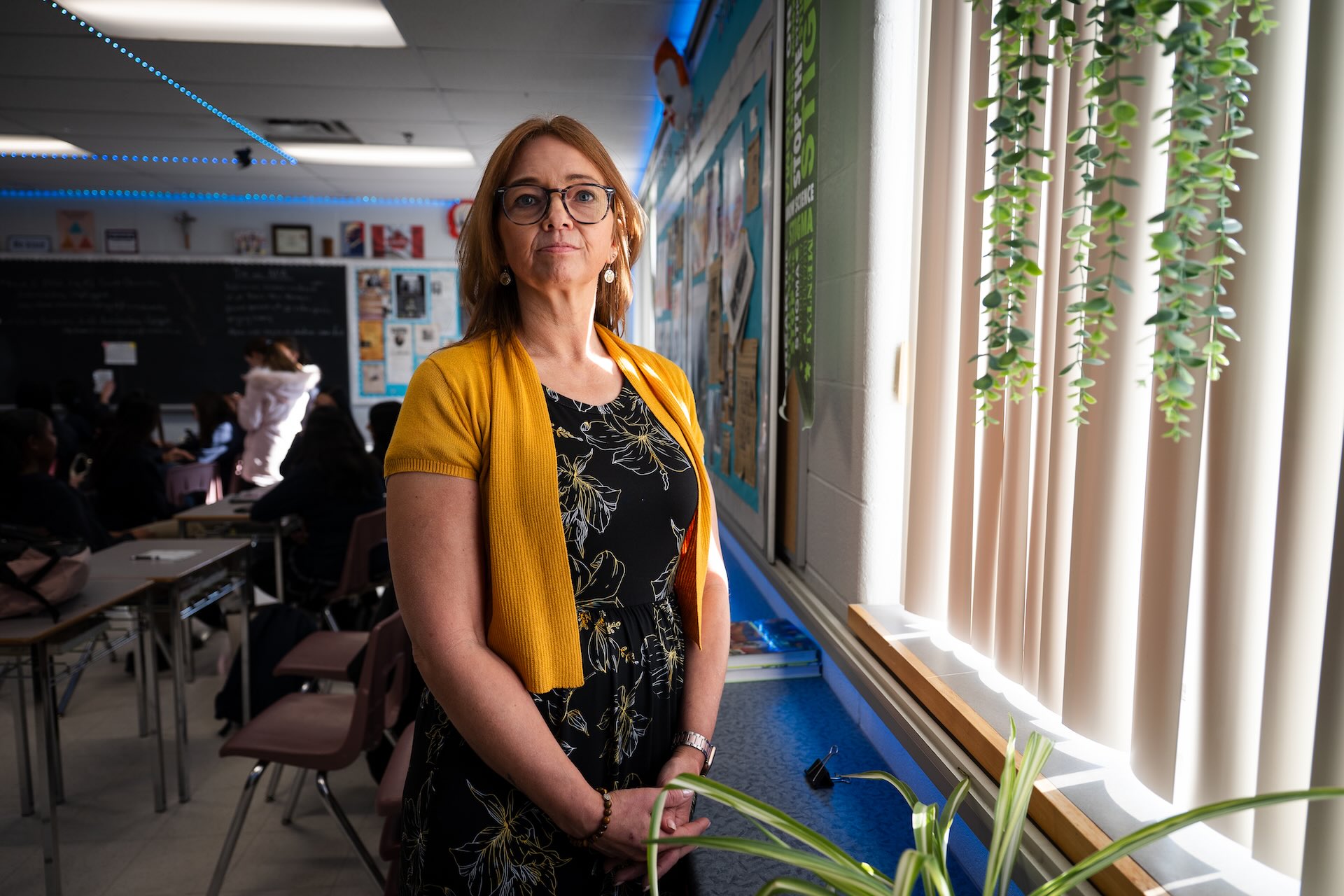
Teachers who spoke to The Logic say they’re now beginning to tinker with the technology—to help make tests or presentations, for example—and they’re starting to soften their stances against students using AI. Pam Garant, an English and history teacher at All Saints Catholic School in Durham, Ont., says she was initially in denial about students using ChatGPT. When it became clear they were submitting AI-generated work, she simply told them, “don’t use it.”
As she began experimenting with AI in her own work, her attitude changed. Garant used Copilot, the Microsoft chatbot, to build exams and suggest class discussion topics and lesson ideas. She says she has no problem now with students using AI as a tutor or study buddy to help brainstorm ideas. To discourage them from overrelying on it, she holds what she calls “research conferences” on big projects, where she tests students on what they submitted by asking them about parts of the assignment.
Beyond that, though, Garant says she’s not sure how to guide them. She’s never been trained on how to use generative AI systems, let alone on instructing students on how to use them. “I’m just coming up with things on the fly,” she says. “I would love to hear ways that we could teach students how to use it responsibly.”
Pike, the teacher in Ottawa, said she, too, is beginning to see the upside of AI in education. Her school board now encourages teachers to use the technology. “My own employer has said to use it in the right context… and that we should move towards getting our students to use it in the right ways, because it’s not going away.” Still, Pike says there are limited resources for how to do that in practice. “I feel like I need a lot more training on it.”
Danjoux says he understands why teachers are being cautious. They’re laying the foundation for how AI will become a legitimate part of the classroom. There are dangers that come with that, he says, and unanswered questions about the right way to preserve the integrity of learning. “You don’t want to mess this up.”














