The Canadian venture capital market is showing signs of cooling down amid the uncertainty of geopolitical tensions and surging inflation, as the number of deals plunged at the start of 2022 while the total capital raised by Canadian companies rose.
Skip to content



Special Report
VC dealmaking in Canada shows ‘signs of a market-wide slowdown’ in Q1
Skyscrapers in downtown Toronto’s Financial District. Photo: Ken Felepchuk/Shutterstock
The Canadian venture capital market is showing signs of cooling down amid the uncertainty of geopolitical tensions and surging inflation, as the number of deals plunged at the start of 2022 while the total capital raised by Canadian companies rose.
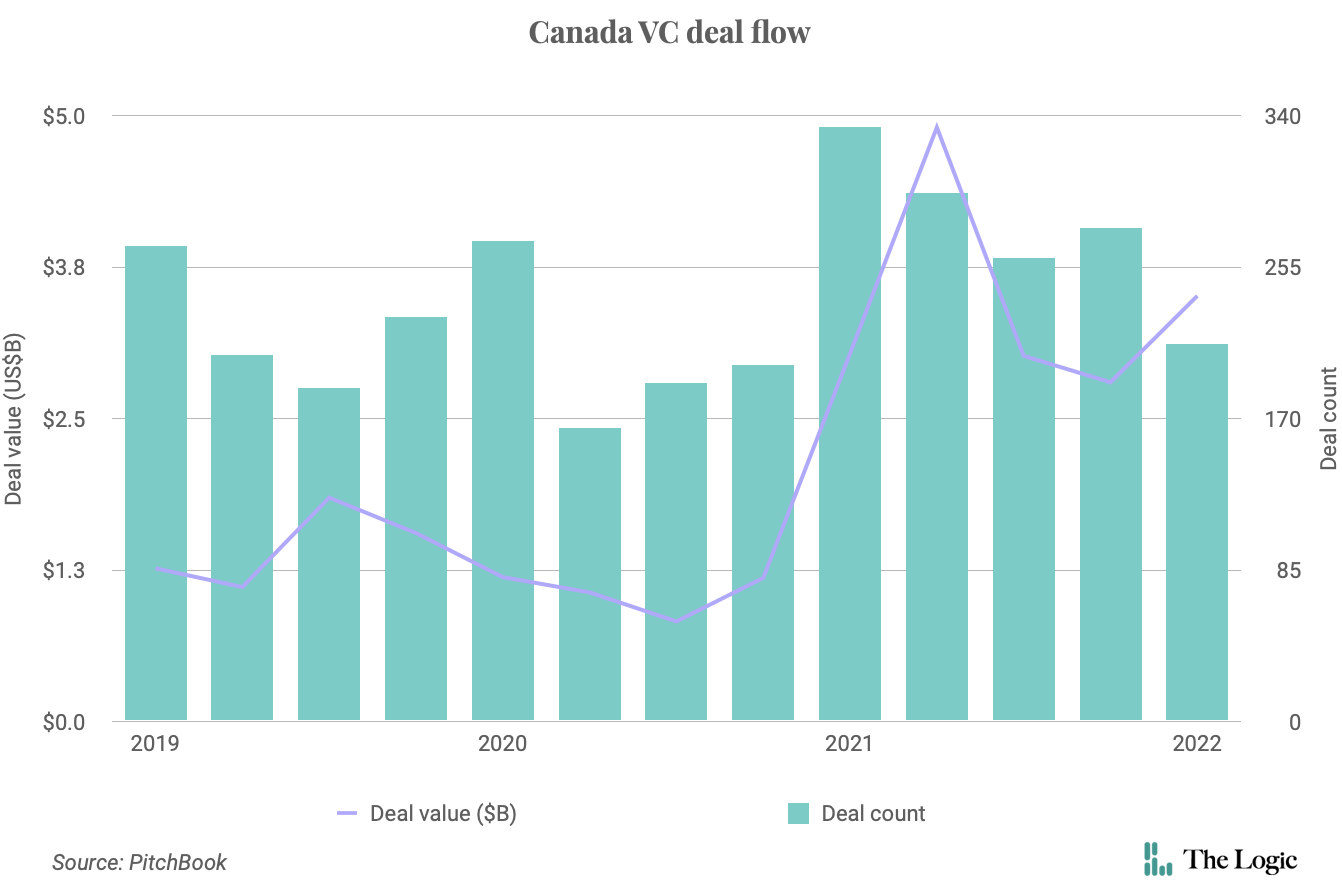
The number of deals fell 36.5 per cent from 334 in the first quarter of 2021 to 212 in the period ending March 31, marking the slowest start since the pandemic hit, according to PitchBook data. Canadian companies raised US$3.5 billion in venture capital in Q1, up 16.7 per cent from the record-breaking US$3 billion in the same period a year ago.
Talking Point
The number of deals in the Canadian venture capital market plunged in the first quarter, while the average deal size and total capital raised by Canadian companies rose as investors doubled down on what they see as winning companies. Experts say the trends highlight uncertainty in the public markets amid geopolitical tensions and inflation concerns.
“There’s a lot of different competing factors with a slowdown in the market. And everyone is just trying to figure [it] out,” said senior PitchBook analyst Kyle Stanford, in an interview with The Logic. “It’s what we saw at the beginning of the pandemic in 2020. There was a two- to three-month period where everyone was just waiting to see where the chips were gonna fall.
“I think that, definitely, for now, is going to be the big story. And even though it hasn’t turned into a massive story yet, there are signs of a market-wide slowdown or pause,” said Stanford.
Stanford said a pullback is probably healthy for the market as it will allow companies to grow at a sustainable pace moving forward.
Aside from the ongoing Ukraine-Russia war, economic sanctions and other major market uncertainties, the drop in the number of venture-capital deals may also reflect what’s happening on the stock market.
“I think that the main reason why investment is down from 2021 is because of the decrease in the multiples in the public markets. In general, they’re reverting back to historical averages and that’s now starting to be reflected in [venture capital and private equity],” said Patrick Lor, managing partner at Panache Ventures.
Still, Lor said he’s “optimistic about the world,” and believes venture capital investment for the next five years is still trending in a positive direction.
Though the number of deals fell, the average deal size increased year over year, up 45.6 per cent, from US$15.6 million to US$22.7 million, according to Pitchbook data.
The uncertainty in investment is also reflected in a slowdown in global M&A, where dealmaking has fallen to its lowest level in value since the start of the pandemic. Meanwhile, the average deal size globally also soared from US$67 million to US$100 million, the highest level since 2013.
A few large deals have contributed to the increase in average Canadian deal size. Toronto-based 1Password’s US$620-million Series C funding round is this year’s biggest deal so far, followed by the Montreal-headquartered education-software company Paper’s US$270-million Series D round led by Sapphire and SoftBank’s Vision Fund 2.
“I think what some VCs have figured out is, ‘Wait a second; what if I give one of these companies $10 million? What if I give one of these companies $20 million because I think this team is extra talented; I like the product better than the other products?’” said Lor.
He said more venture capitalists are using this money to “supercharge the company” they really like.
“So what you’re seeing, as a result, is that the winning companies aren’t necessarily bigger or have more revenue traction. They’re being identified as somehow being more talented. And they’re being given a leg up; they’re being given an advantage,” said Lor.
Across a three-year period, Panache is the second most active VC in the Canadian market, behind only BDC Capital, according to PitchBook. Other top investors for the same time period include the MaRS Investment Accelerator Fund, Real Ventures and Desjardins Capital.
Canadian venture capitalists are also slowing down their investments globally. Both the number and the value of global deals involving at least one Canadian participant in the first quarter decreased compared to the same period last year. The number of deals fell from 380 to 276, down 27 per cent. The total deal value also dropped from US$12.5 billion to US$11.6 billion. However, that’s still $7.2 billion more than the first quarter of 2020 when the pandemic first started.



Loading...
Thanks for sharing!
You have shared 5 articles this month and reached the maximum amount of shares available.
CloseThis account has reached its share limit.
If you would like to purchase a sharing license please contact The Logic support at [email protected].
CloseGift the full article!
You have gifted 0 article(s) this month and have 5 remaining.
Recipients will be able to read the full text of the article after submitting their email address. They will not have access to other articles or subscriber benefits.
Photo: Ken Felepchuk/Shutterstock
Most Popular This Week




In-depth, agenda-setting reporting
Great journalism delivered straight to your inbox.
The Big Read
Alberta’s referendum is just the start of the turmoil
Briefing
EverWind plans $10B data centre and wind development in Nova Scotia
Canada ready to force Stelco to sell its Canadian operations, Joly says
Feds plan a 60 MW defence-oriented data centre for Ottawa
Best business newsletter in Canada
Get up to speed in minutes with insights and analysis on the most important stories of the day, every weekday.
Exclusive events
See the bigger picture with reporters and industry experts in subscriber-exclusive events.
Membership in The Logic Council
Membership provides access to our popular Slack channel, participation in subscriber surveys and invitations to exclusive events with our journalists and special guests.






