OTTAWA — The future of Canada’s mining industry depends on extracting valuable minerals from increasingly difficult sources, according to a briefing note prepared last fall for Natural Resources Minister Jonathan Wilkinson, and miners—especially in the critical-minerals sector—ought to be looking to space for help.
Skip to content


News
Space technology could help Canada mine critical minerals, feds think
Declining mining outputs and rising costs beset industry that could use a boost, briefing says
NASA's Perseverance Mars rover collects a rock sample from an outcrop using a coring bit on the end of its robotic arm, in March 2023. Photo: NASA/JPL-Caltech
OTTAWA — The future of Canada’s mining industry depends on extracting valuable minerals from increasingly difficult sources, according to a briefing note prepared last fall for Natural Resources Minister Jonathan Wilkinson, and miners—especially in the critical-minerals sector—ought to be looking to space for help.
Its investments in the effort are dwarfed by those of other countries, though, including tiny Luxembourg.
Talking Points
- Lessons from mining in space could help Canadian miners extract increasingly challenging deposits of critical minerals, the federal government believes
- Like big established mining companies, smaller miners focused on critical minerals seem uninterested in looking to the sky instead of the ground
The country’s mining outputs have been declining and discovery costs have increased, and long-term success depends on “using innovative technologies for improved operational and environmental performance,” says the briefing note, obtained by The Logic through an access-to-information request.
“As the minerals sector looks to capitalize on emerging opportunities, there is a convergence with the growing international space-resources industry,” it continues. “There is potential to generate solutions to shared operational challenges (e.g., eliminating waste, addressing energy needs and advancing automation and next-generation robotics).”
Natural Resources Canada has been trying to interest mining companies in that potential for years, the note said, with symposiums, summits and workshops. It’s sent people to panels at Prospectors & Developers Association of Canada conventions. It has also shared expertise on mining with fledgling space companies that are keen on extraterrestrial opportunities but aren’t miners on Earth.
Related Articles

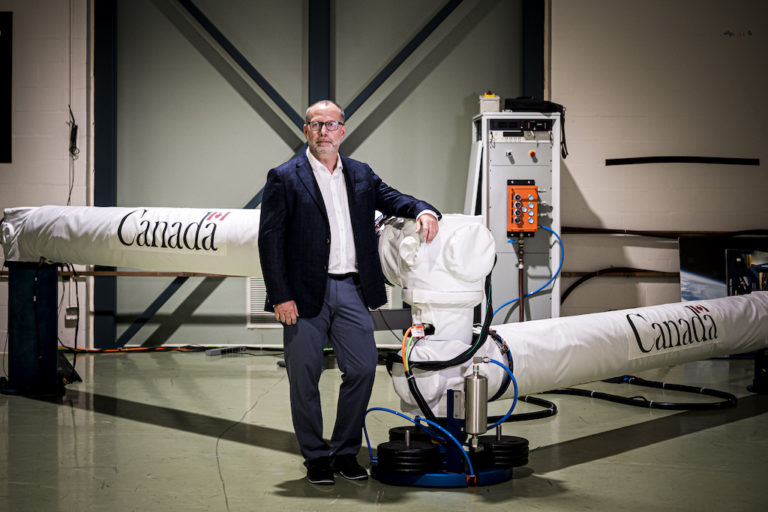
A 2021 consultants’ report prepared for the Canadian Space Agency argued that Canadian mining companies, accustomed to working in harsh conditions, are well positioned to help develop mining capabilities in space. Solutions invented for “space resources utilization,” as it’s called, might be useful for terrestrial mining innovation, the report said.
Major mining companies in Canada just weren’t interested—they had “difficulties understanding the added value that collaborating with the space industry for technology transfers could bring to their organization[s],” according to that report.
The October briefing suggests that miners of critical minerals, seeking to exploit smaller deposits from even tougher terrain, might see more value in technology crossovers from space exploration than established producers do.
Critical-mineral companies The Logic contacted appear only marginally more interested than the big players.
“At the moment we are focused on developing what we have in the ground,” wrote Tyrone Docherty, CEO of First Tellurium, in an email to The Logic. The company is hoping to develop a mine for gold, silver and tellurium (and is prospecting for tungsten) in the remote coastal mountains of B.C. southeast of Kitimat. Both tellurium and tungsten are on the federal government’s list of critical minerals. “From a corporate view,” wrote Docherty, “I would think that mining the oceans would make more sense than heading to outer space.”
“While mining in space is incredibly interesting, it is not something we are contemplating in the foreseeable future,” wrote Emily Robb, a spokesperson for Impala Canada. Impala currently mines palladium, another critical mineral, in northwestern Ontario.
Cost, distance, environmental concerns and lack of infrastructure have impeded dreams of mining vast reserves of critical minerals believed to be in the ground in Northern Ontario’s “Ring of Fire.”
“It’s not something we’re currently considering,” wrote Leanne Franco of Wyloo Metals, whose Canadian subsidiary Ring of Fire Metals aims to mine a site with nickel, copper, platinum and palladium.
The Logic asked Wilkinson’s office whether the minister has raised the potential crossover benefits of space mining with terrestrial critical-minerals companies.
“Leveraging Canada’s strengths and potential for cross-collaboration between industries will position both the mining and space industries to lead in the development of the high-tech, digital and cleaner mines of tomorrow,” wrote his spokesperson Michael MacDonald in an emailed response, not answering the question about whether Wilkinson has pushed the issue personally.
Other countries are well ahead, the briefing note says.
“International space partners (e.g., U.S. and Japan) are early movers on space resources, developing policy and regulatory frameworks, and investing in private industry to take advantage of an estimated $200-billion space resources market by 2050,” the note states.
Luxembourg, which wants to be a space power, passed a law in 2017 allowing space mining, and has allocated €200 million to position itself as Europe’s space-mining hub.
Canada, in contrast, has allocated $1.75 million for concept studies on moon infrastructure and $10.3 million “to support the development of technologies targeting the lunar economy and participation in lunar-mission supply chains by 2024,” the note says.
Natural Resources Canada works with the CSA on space policy, and is looking forward to the results of a broad consultation the space agency ran on space-related regulations, MacDonald wrote. That closed April 4.
“Any potential future development of space resources (including policy, legislation, and regulations to enable industry involvement) is a strategic opportunity to demonstrate Canadian leadership in space exploration and mining, including pooling resources and know-how to make mining on Earth and in space more efficient, cost-effective and sustainable,” he wrote.



Loading...
Thanks for sharing!
You have shared 5 articles this month and reached the maximum amount of shares available.
CloseThis account has reached its share limit.
If you would like to purchase a sharing license please contact The Logic support at [email protected].
CloseGift the full article!
You have gifted 0 article(s) this month and have 5 remaining.
Recipients will be able to read the full text of the article after submitting their email address. They will not have access to other articles or subscriber benefits.
Photo: NASA/JPL-Caltech
Most Popular This Week




In-depth, agenda-setting reporting
Great journalism delivered straight to your inbox.
News
Tech firms want AI models to create better versions of themselves
Briefing
Lightspeed cuts 250 jobs through layoffs and attrition
Oil tycoon Adam Waterous aims to build new Canadian energy player with US$1B fund
Data centre infrastructure firms 3C and Datalec merge, plan Calgary expansion
Best business newsletter in Canada
Get up to speed in minutes with insights and analysis on the most important stories of the day, every weekday.
Exclusive events
See the bigger picture with reporters and industry experts in subscriber-exclusive events.
Membership in The Logic Council
Membership provides access to our popular Slack channel, participation in subscriber surveys and invitations to exclusive events with our journalists and special guests.