Toyota is charming critics with a “technological breakthrough.”
Under pressure to speed up its transition to EVs, the company unveiled plans to release a solid-state battery as soon as 2027, shortening charging times to 10 minutes or less with over 1,200 kilometres of range.
The high-performance batteries are also more eco-friendly and could assuage Toyota Canada’s concerns about a global battery-metal shortage.
It will be a big change from the hybrid-focused approach the world’s—and Canada’s—highest-volume auto manufacturer has pursued to date. It’s also the strongest signal yet in favour of a technology for which the industry has high hopes.
“We’re looking at the next iteration of batteries being solid-state,” said Honda Canada CEO Jean Marc Leclerc in an interview with The Logic earlier this year.
“We are being very bullish on that technology for the future, to increase the adoption or to lead the mass adoption of electric vehicles.”
Most of today’s lithium-ion batteries have limitations because of their design, said Richard Bouveret, CEO of Bolloré’s e-mobility and smart-grid division, which includes Blue Solutions’s solid-state batteries made in Boucherville, Que.
They contain a liquid electrolyte between two electrodes, which is flammable if the battery is damaged, said University of Waterloo professor Linda Nazar, the Canada Research chair in solid-state energy materials. In cold temperatures, it gets viscous like honey, making it harder for ions to move smoothly and discharge power.
Solid-state batteries are instead filled with materials like polymers or ceramic, which Nazar said allows for smaller, stackable batteries. They also last longer and are easier to recycle. “Safety improves drastically” in batteries that don’t contain the liquid electrolyte, said Kunal Phalpher, president of Ontario-based Li-Metal, which develops lithium metal and anode-production technologies.
But making them requires nanometre- and micron-level precision, so they’re hard to manufacture in a way that makes commercial sense.
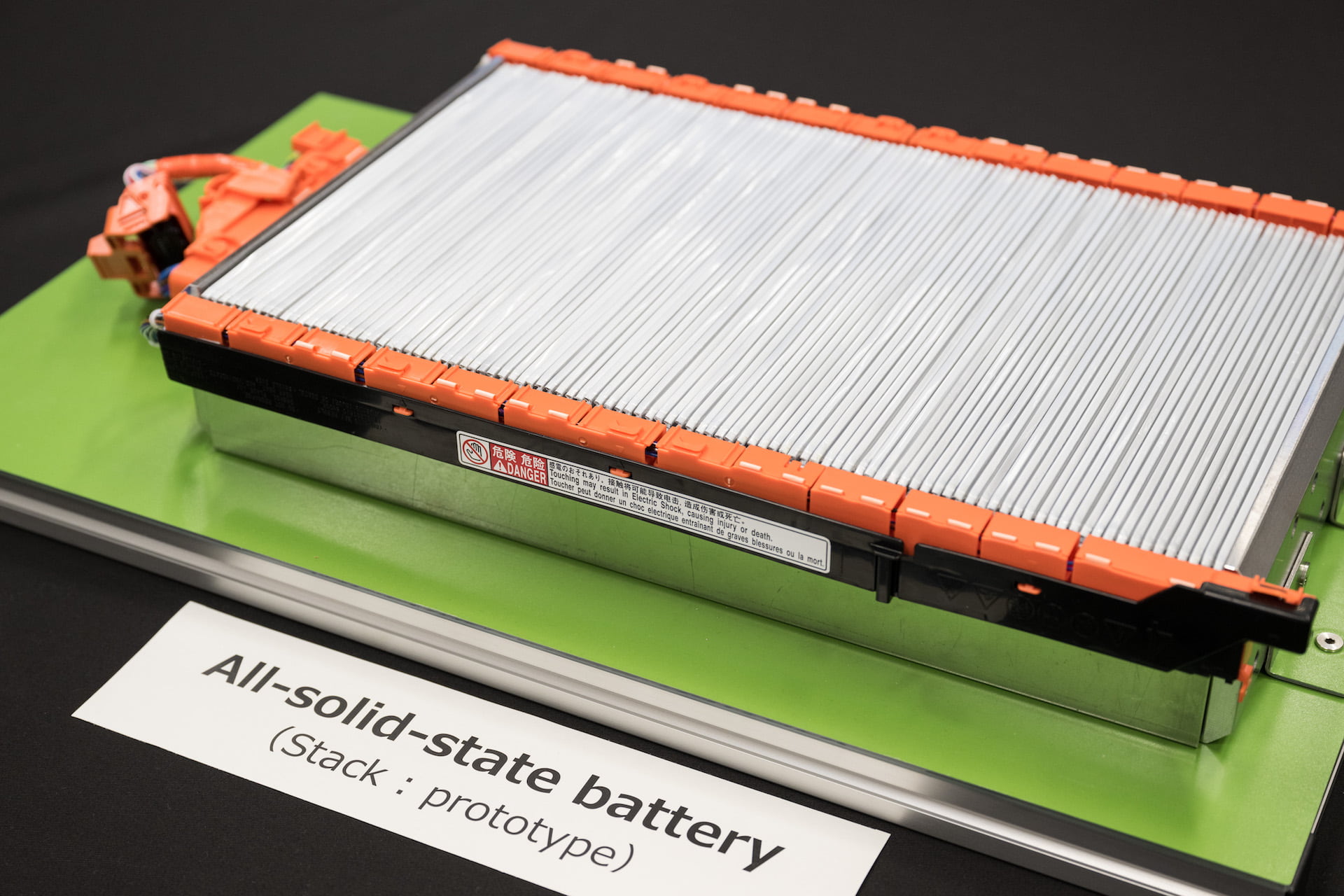
Toyota’s solid-state battery unveiled in June 2023. Photo: Toyota/Handout
“If you are trying to get a liquid into a sponge, it will be really easy,” said Nazar. “If somebody tries to get you to stick chewing gum in the sponge, now you’ve got a real problem. … It’s difficult to mix solids at that level.”
Li-Metal is working with Blue Solutions, which says after decades of research it’s the only firm that mass produces solid-state batteries in North America and Europe. Bouveret expects it will take until at least 2026 to validate its latest iteration. It aims to release some research to rivals to speed up the industry’s transition to solid-state batteries.
The International Monetary Fund warned this week that Canada should be cautious with its strong focus on subsidizing EV batteries, given the race for better technologies. Nazar said the global transition to electrify vehicles, power grids and other devices will likely mean there will be more demand than supply of all types of lithium-ion batteries in the years to come.
“The standard liquid-electrolyte, rechargeable lithium-ion batteries that we have now are going to be around for some time,” she said.
Read Shift—The Logic’s authoritative weekly newsletter on automotive technology industry news—for more; and if you know someone who should be reading it, they can sign up here.