EV true believers are “gnashing” their teeth as they await news on the future of Tesla’s charging business.
According to a memo The Information obtained last week, CEO Elon Musk sent a message to its executive staff to take their cost-cutting more seriously, laying off about 500 workers—including nearly all the staff on the Supercharger team. Tesla plans to grow its charging network at a slower pace, Musk tweeted, and is focused on improving and expanding existing locations as it reportedly looks for new leadership for the unit.
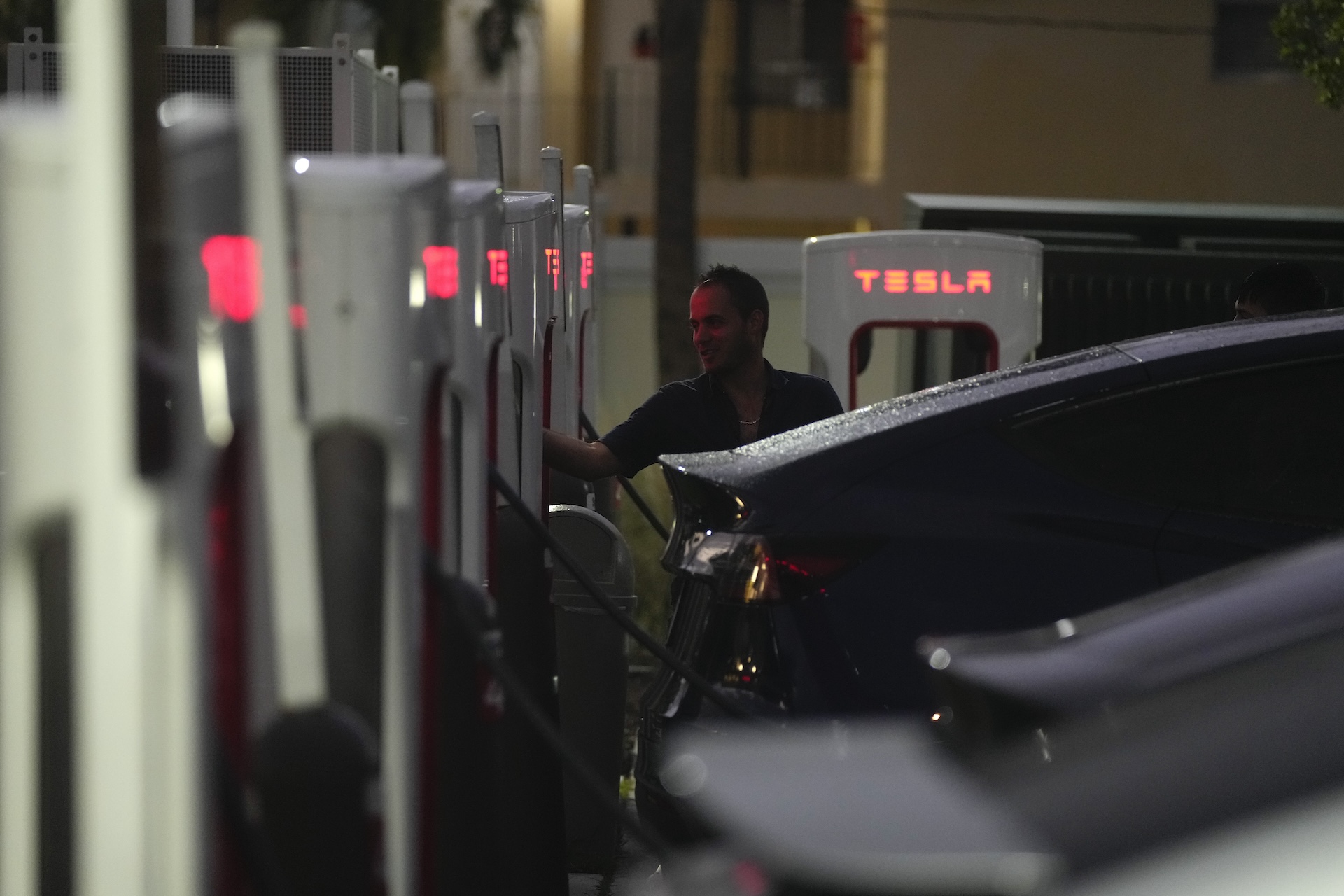
It may be a wakeup call for policymakers and others in the industry who have taken for granted Tesla’s willingness to underwrite what is essentially a massive public infrastructure investment to speed along the EV transition. With Tesla providing more than 2,000 out of Canada’s 5,113 public fast-charger ports, other companies may have to step up if the country is to meet its EV goals.
Some Tesla drivers—typically pretty “ecstatic” about the industry-leading Supercharger network—were left confused and wanting assurances this week that the automaker is still committed to its mission to accelerate the shift to sustainable energy, said Glenn Garry, president of Victoria Electric Vehicle Association.
At an EV and charging expo in Toronto last week, Scott Sharabura, vice president of EV charging at the Calgary-based gas station company Parkland, worried that the shocking headlines might stick in the heads of car buyers who would avoid EV purchases altogether rather than researching the state of the charging network, or waiting around for Tesla’s next move.
The big picture: The incentives in the EV-charging industry are shifting as technology changes. While Tesla’s charging network was primarily a perk of buying a Tesla, other businesses have begun to benefit as EV adoption grows. Saskatoon mayor Charlie Clark previously credited them with attracting new visitors to the city.
Meanwhile, with most EV charging happening in homes, nearly 70 per cent of Tesla drivers in Canada polled by CAA in late 2022 said they were already confident they can always find a public fast charger, a much higher satisfaction level than other EV owners. With Tesla’s charging standard specifications widely available online, charging is increasingly commoditized.
Though some companies, like China’s Huawei, have had to build the infrastructure to power their consumer products at the early stage, there would be little incentive nowadays for Ford to build gas stations, or Apple to build its own cell towers, when there’s already enough density to support their buyers.
Travis Allen, public affairs officer at Flo, said at the expo that real estate companies and other firms that had been merely dipping their toes into the EV charging waters are now starting to get serious about investments.
While he’s never happy when “something like this” happens, he said, “it does create new opportunities.”
The fallout: Laid-off workers, of course, took the brunt of the bad news, and that included those at Tesla’s Canadian operations.
“What the @#$% just happened? If you’re trying to apply logic or rationality to understand why Tesla’s entire charging team was vaporized, don’t waste your time,” wrote Steven Hitchinson on LinkedIn, who as regional manager for Tesla’s Canadian charging business was hiring for a “long-term planning” position just two months ago. Hitchinson issued an apology to confused vendors in Canada, adding, “The biggest benefactor of this will inevitably be the rest of the industry who will scoop up the talent.”
The caveat: Musk tends to make bold pronouncements far ahead of their implementation, making adjustments as he goes. Rather than a broad abandonment of its charging business, the Supercharger cuts could be a prelude to something new. Garry, of the Victoria EV group, wondered whether the next shoe to drop might not be all bad. For example, as Tesla focuses more on robotaxis, it could be investing instead in wireless induction charging pads, he noted.
“It’s like dogs barking in the dark,” he said. “We don’t [yet] know what it is.”
Read Shift—The Logic’s authoritative weekly newsletter on automotive technology industry news—for more; and if you know someone who should be reading it, they can sign up here.