Can big EV investments juice up a slowing economy?
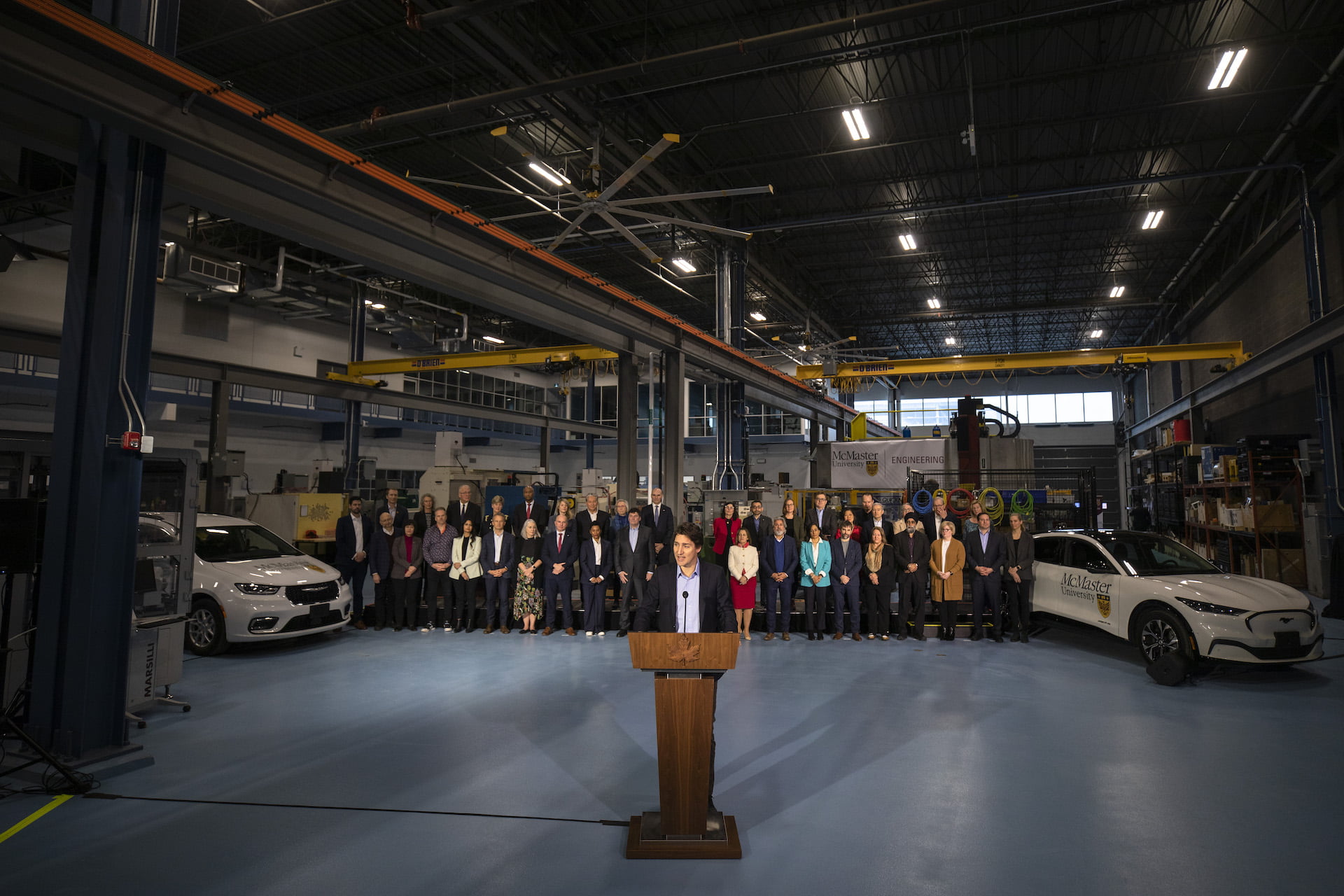
HAMILTON, ONT. — Against a backdrop of electric SUVs and a forecast of rising unemployment, Prime Minister Justin Trudeau painted electric vehicles as an engine of growth while at McMaster University’s Automotive Resource Centre (MARC) on Wednesday.
“Our government is committed to building an economy that works for all Canadians,” he told reporters. “We’re also investing to create new opportunities for resource workers across the country, like the workers I met in Saskatoon last week who are mining the critical minerals and rare-earth elements used to make the batteries our … electric vehicles rely on.”
While Trudeau was speaking, the Bank of Canada predicted that spending on consumer services and business investment would slow after its new rate hikes.
Despite the potential for a weakening job market, Ali Emadi, a McMaster professor and Canada Research Chair in transportation electrification and smart mobility, as well as McMaster advanced-manufacturing professor Stephen Veldhuis, said demand for their graduates is not slowing down.
“The car companies and other companies are telling students, ‘Do you have a pulse? Have you been at MARC for a week or a month? You’re hired.’ And they are paying really good salaries,” said Emadi, who is also CEO of EV startup Enedym.
The EV sector has not been immune to economic turmoil. Last week, the battery giant LG reportedly pulled out of one of its U.S. gigafactory plants, despite federal support, citing an uncertain macroeconomic outlook.
Asked by The Logic at a press briefing whether LG has since confirmed its battery plant in Windsor, Ont., Innovation Minister François-Philippe Champagne said he’s been speaking with colleagues globally, and that Canada “remains one of the most attractive places” for a battery plant.
UBC economics professor Kevin Milligan, who helped brief cabinet members on economic issues this week, told The Logic that building the supply chain for electric-car batteries could still be a sensible government investment.
“The kind of industry I would look for, if the government is going to be putting out spending-side measures and trying to grow our productive capacity, [are] ones that have growth potential—a future-looking industry,” said Milligan in an interview. “Whether it’s the critical minerals, whether it’s the actual construction of the batteries.”
Emadi said that there has been a lot of focus on battery manufacturing, a good sign. However, he told Trudeau that there are other areas of EV manufacturing where Canada could excel, but that politicians are overlooking.
For one, Emadi said, rather than compete with the U.S. CHIPS Act on semiconductor manufacturing, Canada should focus on power electronics, advanced manufacturing, thermal management and chip-related software.
“They do the chips, we do everything else beyond that. … We are good at those things.”
Emadi said that software can be used to design better EV motors that don’t need rare-earth magnets, which are difficult to manufacture cleanly and often must be imported from China.
“This is the thing we are awesome at in Ontario and Canada—our universities are training amazing software engineers.”
“Having good jobs and having security in your life. … That’s part of what we are looking to build here and support,” Veldhuis added in response to Trudeau’s speech. “As we convert over to EVs, we need to make sure that we retain the manufacturing activity, and that’s what we focus on.”
Read Shift—The Logic’s authoritative weekly newsletter on automotive technology industry news—for more; and if you know someone who should be reading it, they can sign up here.