North America is within grasp of being a “clean-energy powerhouse”—if the three countries can work together on zero-emissions vehicles.
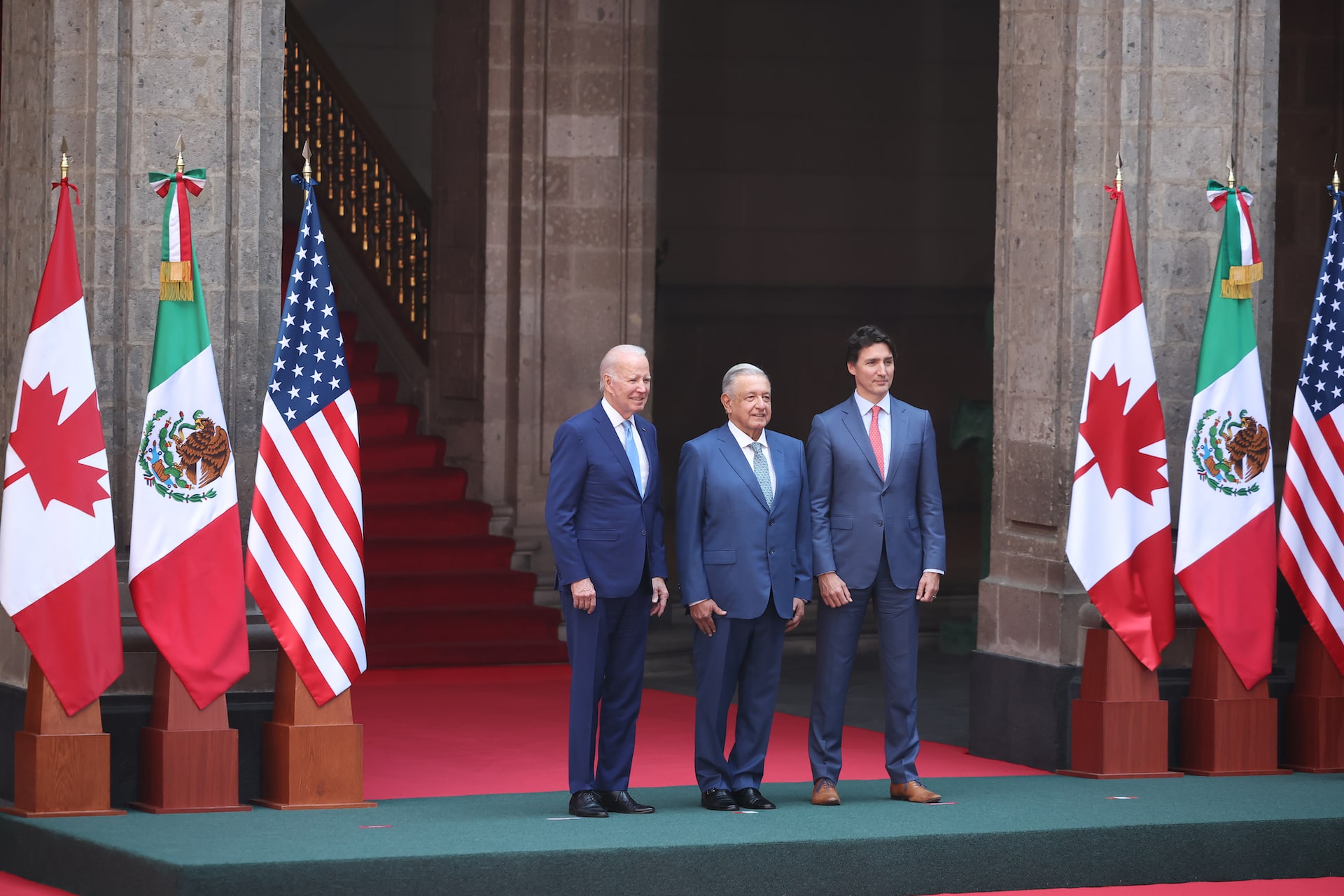
That’s one message that U.S. President Joe Biden took away from the North American Leaders’ Summit in Mexico City this week.
Biden, along with Prime Minister Justin Trudeau and Mexican President Andrés Manuel López Obrador, discussed “reliable value chains” for everything from EVs to critical minerals to electric vehicles to semiconductors.
Despite the seemingly positive relations coming out of the summit, conversations with industry experts suggest thorny issues remain ahead of Biden’s trip to Canada in March, his first as president.
The Canadian Manufacturers & Exporters warned that unless Canada pushes for more cooperation between the three nations, there remains a risk of “increasing government protectionism.”
Canadian American Business Council CEO Scotty Greenwood said Canada will need to “continue to advocate strongly for every inch of preference it gets” from the U.S., starting with how the U.S. reacts to the trade challenge it lost on the implementation of the USMCA in the auto sector. Canada and Mexico argued that the U.S. interpretation of stricter regional content rules goes beyond what was negotiated during USMCA. The ruling that favoured the two countries’ interpretation of the rules was made public on Wednesday.
Meanwhile, Mexico’s move to create a state-owned lithium industry last year, which may block attempts for private investment in lithium, could stifle investment in the key mineral, said Rachel Samson, the Institute for Research on Public Policy’s vice-president of research.
Canadian Manufacturers & Exporters CEO Dennis Darby told The Logic that one of his concerns stems from the Inflation Reduction Act, which is one of several U.S. programs that tries to incentivize manufacturing within its borders, alongside semiconductor and infrastructure bills.
“Under the IRA, the U.S. has put a whole pile of production and manufacturing incentives on the table—a lot of carrots—to get companies to locate in the U.S.,” Darby said.
“This is an opportunity to make sure that we North American countries can work together to maintain this incredibly important industry. How do we work together to coordinate so that we don’t have protectionist elements in one jurisdiction or another?”
The IRA was considered a major improvement for Canada compared with previous versions of the bill that favoured U.S. assembly. It extends tax credits to EVs assembled in North America and vehicles manufactured using critical minerals extracted or processed by U.S. free-trade-agreement partners, or recycled in North America.
But the fact that the U.S. considered excluding Canada and Mexico in the previous bill was a “wake-up call,” said Samson.
“That would have devastated our automotive sector,” Samson said. “Certainly, the risk is still there, if the U.S. moves toward the protectionist side of things.”
Now, reports suggest that the U.S. is considering opening the incentives to mineral-rich countries like Argentina, Indonesia and the Democratic Republic of the Congo, as well as companies like Hyundai that don’t build EVs in North America yet.
Greenwood said such reports have also raised concerns that Canada could lose the edge it got from the IRA.
“It’s clear that the leaders talked about critical minerals in Mexico City. … So the question now becomes, ‘What meaningful steps is Canada prepared to take to back up the very good rhetoric?’ What meaningful steps is Canada prepared to take to advance the development, processing and recycling of critical minerals?” Greenwood said.
“The shot clock, to use a sports term, really started in Mexico City.”
Read Shift—The Logic’s authoritative weekly newsletter on automotive technology industry news—for more; and if you know someone who should be reading it, they can sign up here.