Does the internal combustion engine still have gas in the tank?
Paul Woodward thinks so. The president of Burnaby-based Aether Catalyst Solutions is looking to make gas-powered automobiles more cost efficient at a time when electric vehicles are all the rage, with governments dumping billions of dollars into developing EV and battery supply chains.
Aether, a small research-oriented company, is betting it can drastically reduce the cost of catalytic converters, the flattened cylinders that fit onto a vehicle’s exhaust system and filter out harmful pollutants.
Such a breakthrough could put a sizable dent in the cost of traditional combustion engine vehicles. Catalytic converters are pricey. Thieves increasingly pilfer them from cars, trucks and tractors to make an easy profit. The part was initially expensive enough that Detroit automakers lobbied with uncommon fierceness in the 1970s against regulations that eventually forced them to install catalytic converters on their vehicles. (The plots of recent Hollywood movies including Steven Soderbergh’s No Sudden Move and The Nice Guys, a detective comedy starring Ryan Gosling and Russell Crowe, centred around allegations that Detroit’s Big Three knowingly downplayed the need for catalytic converters.)
Today, the part is expensive largely due to the soaring cost of the precious metals they are made out of: namely platinum, palladium and rhodium. Last year, global demand for precious metals used in converters totalled nearly US$40 billion.
“It’s a massive market,” Woodward said in an interview with The Logic.
Woodward said Aether could eventually let automakers cut the cost of catalytic converters tenfold, largely by using a unique chemical compound that uses cheaper base metals rather than precious ones.
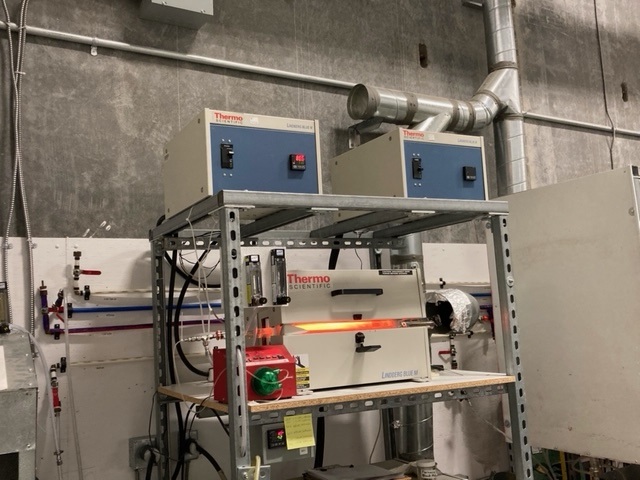
Aging ovens at the Aether Catalyst Solutions Lab. Photo: The Canadian Press/Chris Young
“For us it’s not necessarily a ‘green’ thing,” Woodward said. “We have something that’s one-tenth the cost, and we’re very close to making it work.”
Aether still has a lot of ground to cover. The company employs just four people. For the last 10 years it has focused strictly on research. But Aether has more recently signed partnerships with several large original equipment manufacturers (OEMs), including a joint development agreement with a multinational material sciences company to test and potentially eventually scale up its chemical catalyst technology.
With EVs and gas-powered vehicles locked in a battle to bring down costs, consumers have continued to shy away from electric due largely to higher up-front costs. Still, EV manufacturers led by Tesla significantly drove down sticker prices in the last year—down to US$50,000, cut by roughly US$15,000—and EVs could soon reach parity with gasoline. A matter less often discussed is whether the traditional gas model still has room to get a bit more lean.
Read Shift—The Logic’s authoritative weekly newsletter on automotive technology industry news—for more; and if you know someone who should be reading it, they can sign up here.