OTTAWA — Scale-ups play an outsized role in productivity growth and investment in research and development in Canada, but policymakers need to take a more tailored approach to supporting them, according to a study from two innovation think tanks to be released Friday. Here’s a breakdown of its key findings:
Skip to content


News
Scale-ups drive productivity growth and R&D spending in Canada, study finds
The Canada pavilion at the Offshore Technology Conference In Houston in August 2021. Photo: F. Carter Smith/Bloomberg via Getty Images
OTTAWA — Scale-ups play an outsized role in productivity growth and investment in research and development in Canada, but policymakers need to take a more tailored approach to supporting them, according to a study from two innovation think tanks to be released Friday. Here’s a breakdown of its key findings:
The backstory: Helping startups get bigger has been a major focus of the Liberal federal government’s innovation policy. The 2017 federal budget promised to double the number of high-growth companies in Canada by 2025, while the following year’s budget ordered the regional-development agencies, which distribute federal funding to businesses in different parts of the country, to “place greater emphasis in helping firms scale up.” In August 2018, Prime Minister Justin Trudeau instructed newly installed Small Business Minister Mary Ng via her mandate letter to “to help scale Canadian SMEs seeking to grow, scale up, and become more productive [and] innovative.”
Talking Point
Firms that are rapidly growing their headcount or revenues have a “disproportionate economic impact” in Canada, according to a new study from Ryerson University’s Brookfield Institute for Innovation + Entrepreneurship and the Innovation Policy Lab at the University of Toronto’s Munk School of Global Affairs and Public Policy. Tech scale-ups in particular are leading contributors to productivity growth and R&D investment.
Provincial governments have followed suit. This year, Ontario put $100 million into a venture capital fund-of-funds to back “high-potential” firms, while Alberta allocated $25 million for incubators and accelerators to close the “scale-up gap.”
The report: Titled “Into the scale-up-verse,” the study is an ambitious attempt to count the number of scale-ups in Canada and understand their economic impact. A co-production between researchers at Ryerson University’s Brookfield Institute for Innovation + Entrepreneurship and the Innovation Policy Lab at the University of Toronto’s Munk School of Global Affairs and Public Policy, it used data from the Canadian Centre for Data Development and Economic Research’s National Accounts Longitudinal Microdata File, which covers almost all tax-filing firms in the country, between 2000 and 2016.
The firms: Scale-ups are companies with rapidly growing headcount or revenues, with the typical threshold being an average annual rate of 20 per cent or more. About one in a hundred Canadian firms make the cut, the report says. That level dipped shortly after the global financial crisis beginning in 2008, but stayed steady from 2012 through 2016, the study’s data endpoint.
They’re not geographically concentrated. “Scale-ups do really exist everywhere in Canada,” said study author Viet Vu, senior economist at the Brookfield Institute. “It’s not just in that Toronto-Waterloo corridor or [other] urban tech centres.” For example, the report finds concentrations of fast-hiring firms in B.C.’s Okanagan Valley and Vancouver Island, as well as in Northwestern Ontario, and revenue-spinning companies in Alberta’s Wood Buffalo municipality, which encompasses Fort McMurray and much of Alberta’s oil sands.
The scale-up dividend: Politicians of all partisan hues periodically proclaim small businesses “the backbone” of Canada’s economy. But companies that are trying to get bigger provide its vitality, the study suggests. Scale-ups “have an extraordinarily disproportionate economic impact,” said co-author Steven Denney, associate at the Innovation Policy Lab. “They are not prone to fail. Future prosperity really is tied to these firms.”
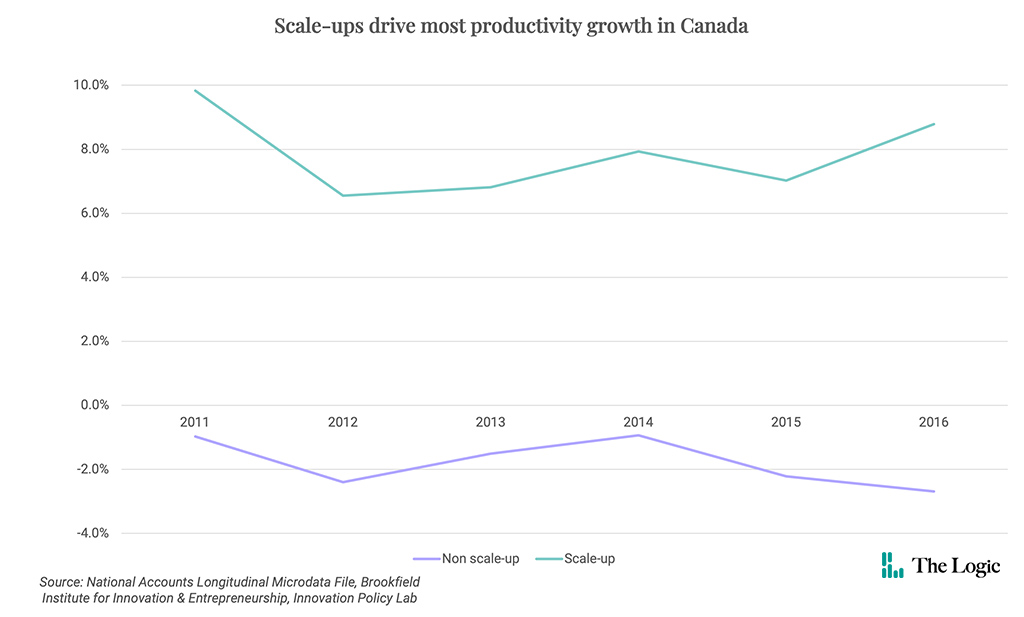
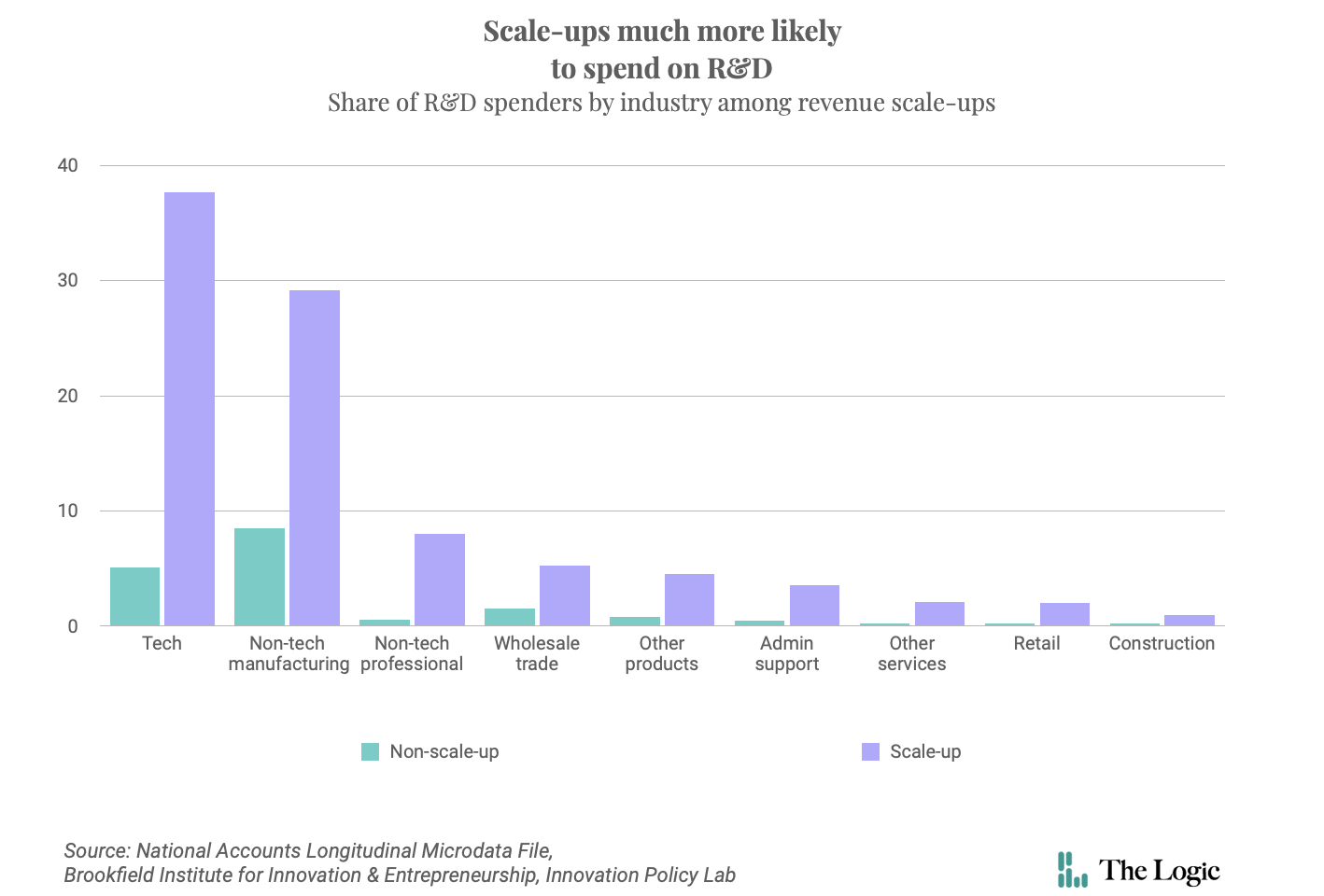
Canadian scale-ups buck economic trend lines that have long worried policy experts. The study found that companies that earn the label on the basis of rapid revenue increases had average productivity growth of 8.78 per cent in 2016, compared to a 2.69 per cent decline for all other firms; tech scale-ups did even better, at 17.3 per cent. Revenue scale-ups were also “significantly more likely to invest in R&D,” with tech again leading the charge. Companies that earned the scale-up label based on their rate of hiring, meanwhile, were 1.3 times more likely to file for patents.
Economy-wide, Canada lags the U.S. and other OECD countries in expanding the amount of output it gets from labour and capital, while business expenditures on R&D have been flat or declining for much of the last two decades.
The challenge of creating “good middle-class jobs”: The authors note that few companies can provide every kind of economic benefit at once. Tech scale-ups, tops for productivity growth and R&D spending, “also create fewer jobs,” the report says.
“The superstar firms of today compared to the superstar firms of yore employ way less people,” said Denney. “We’re way past the model of company towns.” At a time when most government funding announcements come with new-job counts, politicians betting on scale-up policy and programs to meet employment objectives may be disappointed.
A note of caution: “Productivity growth [is] free lunch,” said Vu. Based on the study there’s “little doubt that scale-ups drive most of productivity growth in Canada.” But continued productivity growth depends on companies continuing to increase R&D investment. And even among the dynamic firms the authors studied, that’s not happening. (Tech scale-ups were the exception). “Businesses are not being induced to spend on R&D, which is a huge red flag,” said Denney.
The one-size-fits-all problem: At an industry event in October 2018, then-innovation minister Navdeep Bains told a crowd of tech executives that Ottawa was prepared to spend “billions of dollars” on “innovation that benefits Canadian companies, with the primary focus of scale-up.” And how would he gauge the success of that support? “Ten Shopifys wouldn’t be so bad.”
But the study suggests that’s the wrong objective, in both number and model. Companies need different support depending on whether they’re growing headcount, revenues, productivity, R&D or exports. Very few firms, like Shopify, are likely to be doing it all. “We need an entire ecosystem of all of these different scale-ups growing,” says Vu. “There’s only so much one company or [a few] can do for Canada’s economy. But what if you have tens of thousands? Then you actually see that outsized impact.”



Loading...
Thanks for sharing!
You have shared 5 articles this month and reached the maximum amount of shares available.
CloseThis account has reached its share limit.
If you would like to purchase a sharing license please contact The Logic support at [email protected].
CloseGift the full article!
You have gifted 0 article(s) this month and have 5 remaining.
Recipients will be able to read the full text of the article after submitting their email address. They will not have access to other articles or subscriber benefits.
Photo: F. Carter Smith/Bloomberg via Getty Images
Most Popular This Week




In-depth, agenda-setting reporting
Great journalism delivered straight to your inbox.
News
Coinbase wants to put bots on the blockchain
Briefing
Canadian businesses want Ottawa to hold out for a better U.S. trade deal: KPMG survey
Online banks are attracting younger Canadians, report shows
Lightspeed cuts 250 jobs through layoffs and attrition
Best business newsletter in Canada
Get up to speed in minutes with insights and analysis on the most important stories of the day, every weekday.
Exclusive events
See the bigger picture with reporters and industry experts in subscriber-exclusive events.
Membership in The Logic Council
Membership provides access to our popular Slack channel, participation in subscriber surveys and invitations to exclusive events with our journalists and special guests.