For Paul Vallée, founder of Ottawa-based remote work platform Tehama, returning to his company’s office headquarters after the pandemic felt like “visiting your grandmother’s house after she passed away.” The office was very poorly attended—with a daily average of fewer than two in-office employees for his 20-person startup—and Vallée recalls feeling a sense of “dusty decay” in the space, like “all of the things that happened there will never happen again.”
Skip to content

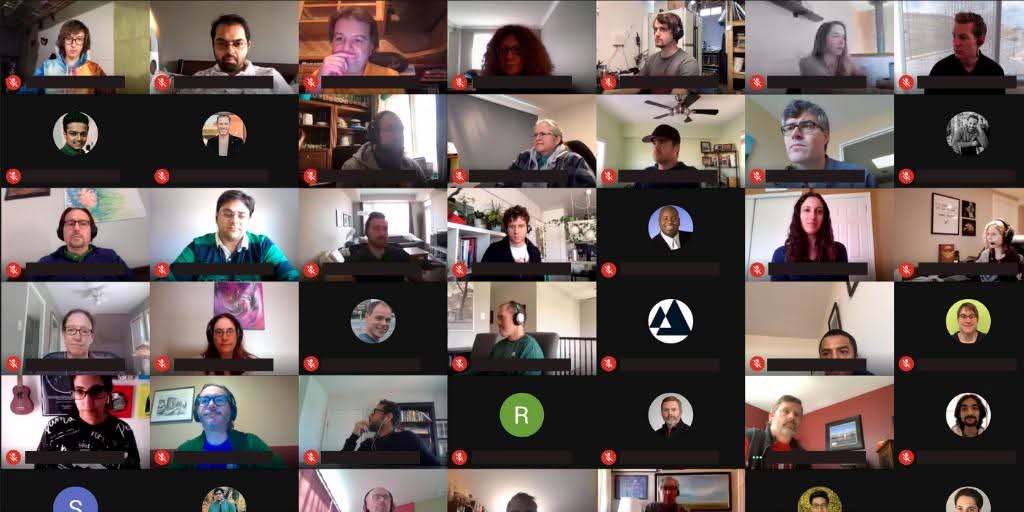 The fully remote Tehama team on a video call. The company offers a travel budget to let them meet in person when they can. Photo: Tehama/Handout
 Architech employees at a co-working space, where the company gathers monthly. Photo: Architech/Handout

News
These Canadian founders are never going back to the office
Fed up with sky-high rents and on the hunt for talent, some Canadian companies have left Canada not for another country, but for nowhere
Photo: Illustration by Paul Kim for The Logic
For Paul Vallée, founder of Ottawa-based remote work platform Tehama, returning to his company’s office headquarters after the pandemic felt like “visiting your grandmother’s house after she passed away.” The office was very poorly attended—with a daily average of fewer than two in-office employees for his 20-person startup—and Vallée recalls feeling a sense of “dusty decay” in the space, like “all of the things that happened there will never happen again.”
Talking Points
- Slashing real estate costs was the biggest win for companies that went fully remote during or after the pandemic
- Remote-only companies that succeed often establish policies to combat the social isolation that can come with remote work, from regular get-togethers to digital avatars
As many companies mandated return-to-office policies, Vallée went a different route. As a provider of remote work software, and given the low attendance, he decided to take Tehama fully remote. Giving up his 17,000-square-foot floor also translated into tremendous savings for the company, which was paying about $34,000 in monthly rent at the time. “It allowed us to make Tehama an independent going concern, as opposed to a business that would need to raise capital to survive,” says Vallée.
Beyond the savings on real estate and operations, Vallée also found that advertising openings only by time zones—not location—let him access a much larger talent pool. Today, Tehama operates as a remote-only firm with fewer than 25 employees across North America.
Tehama is an outlier in a post-pandemic climate of rigorous return-to-office and hybrid work policies. After peaking at approximately 40 per cent in April 2020, the proportion of Canadians who worked the majority of their hours from home during a typical week declined to around 20 per cent by November 2023, according to Statistics Canada. A 2025 survey by Canadian Federation of Independent Business reveals that only three per cent of its surveyed members plan to expand remote work, seven per cent intend to reduce it, and 56 per cent either do not offer it or have no plans to do so. Meanwhile, in September 2024, Amazon mandated a full return to the office, declaring a return to pre-pandemic norms.
Related Articles


But a crop of companies like Tehama held onto the financial relief that real estate downsizing offered, and doubled down on remote work. Overcoming social isolation remains one of their biggest hurdles, and one that often requires creative solutions.
Vallée has been fine-tuning his approach for years. He made his first long-distance hire halfway across the world in Sydney, Australia, in 2002, almost two decades before remote work entered the workplace zeitgeist. At the time, Vallée was running Pythian, an Ottawa-based data analytics firm he founded five years earlier. He needed someone to cover evening and midnight shifts, but it was too expensive to hire someone locally.
Since it was his first remote hire, Vallée decided to bring the new employee to Ottawa for a three-week, in-person orientation to immerse him in the company’s culture, workload and team dynamics. “It worked phenomenally well,” recalls Vallée.
Encouraged by the success, Vallée continued to hire remotely, albeit with shorter, week-long orientation periods for employees. But as the company grew into a 300-person, globally distributed team, new hires began quitting within months, struggling with disengagement and low productivity, or failing to make it past probation.
Digging into the data, Vallée realized that the prolonged face-to-face onboarding had been the glue holding the company together.
To bridge that gap, he and his management team began launching social initiatives to counter the isolating effects of remote work: they encouraged team members to meet at industry conferences and allocated an annual $5,000 budget per employee for travel and accommodations. Vallée says the initiatives reduced the attrition rate dramatically, and he’s implemented a similar travel and accommodation budget for Tehama employees.
The pandemic also propelled TFK Renovations—a company specializing in home, kitchen and bathroom renovations—to go remote. Pre-pandemic, the Edmonton-based general contracting business had invested in a physical showroom for clients after securing an IKEA contract. Once COVID-19 hit, the showroom transformed into “a giant storage space,” says founder Cheryl Fuller-Kiziak, who now works from home in a rural area near Edmonton.
Realizing the financial drain, TFK eliminated its showroom and office, cutting approximately $5,000 per month in rent, utilities, insurance and overhead costs. Instead, it downsized to two heated self-storage facilities for stocking tools, supplies and materials—cutting real estate costs by 90 per cent and lowering business insurance expenses to just $100 a month. To offset social isolation, the team often meets up for lunches in the city; Fuller-Kiziak also makes it a point to have her camera on as much as possible during calls.
Vallée recalls feeling a sense of “dusty decay” in the space, like “all of the things that happened there will never happen again.”
At software development service Architech, the shift to a remote-first workplace was driven by employee consensus.
Before the pandemic, the 100-person tech firm operated out of two floors of a building in downtown Toronto, with some employees already working remotely from Poland and Vancouver. Towards the end of 2021, the company needed to make a decision to renew or let go of its office lease, and conducted an employee satisfaction survey. The poll revealed that 88 per cent of employees were satisfied with the remote setup, while 83 per cent preferred working remotely or spending less than one day per week in the office.
Given the results and the already seamless remote operations, Architech went fully remote. Marima Van Walsh, the head of business operations and remote work at Architech, recalls the brick-and-mortar space fondly—including exposed brick walls, plentiful meeting spaces, snacks and a foosball table—but said she feels positively about the social culture the company has built remotely.
Van Walsh organizes regular virtual socials for Architech’s employees, including Friday hangouts and cookie-decorating parties. The team also gets together in person about once a month at a co-working space, and sometimes for recreational activities like axe-throwing and bowling. Architech employees—currently spread out through Canada, Poland, India and South America—also receive a $600 annual work-from-home budget, which they can use to cover remote work expenses or invest in health and wellness services such as gym memberships or fitness classes.
The company’s most recent internal survey found high employee morale and engagement, Walsh says.
Like Architech’s employees, many Canadians want remote and flexible work—but opportunities grow scarce. A 2025 report by HR firm Robert Half found that nearly half of Canadian job seekers prefer hybrid roles, at 49 percent, while 26 per cent want fully remote positions and just 24 per cent favour a fully in-office setup. As of late 2024, only 11 per cent of job postings were fully remote, the firm found.
Bradley Forney, an Ottawa-based senior engineer at Tehama, joined the company in 2020—right before it went remote. He recalls having beers at the end of the work week with his colleagues and a strong sense of camaraderie that was abruptly interrupted. “It was a very hard transition for sure,” says Forney, who found it difficult to get to know his new team online.
As pandemic guidelines relaxed, Tehama employees started organizing outdoor patio hangouts—bringing chairs, sitting apart, but speaking face-to-face. While these gatherings happened organically, HR also introduced initiatives like group Slack channels where employees would often vent and commiserate about work-related challenges. One team member even recreated Tehama’s office digitally—each employee had an avatar that could “walk” to different desks and start video chats.
Forney says working from home has improved his productivity and health, and he can better take care of his two kids, who he sometimes walks to school in Ottawa. He also takes occasional working vacations logging in from the mountains of Panama or dialling in from a road trip through Spain.
Forney occasionally reminisces about seeing his colleagues in person, but says he has little to complain about with his current work setup. “I don’t really miss much.”



Loading...
Thanks for sharing!
You have shared 5 articles this month and reached the maximum amount of shares available.
CloseThis account has reached its share limit.
If you would like to purchase a sharing license please contact The Logic support at [email protected].
CloseGift the full article!
You have gifted 0 article(s) this month and have 5 remaining.
Recipients will be able to read the full text of the article after submitting their email address. They will not have access to other articles or subscriber benefits.
Photo: Illustration by Paul Kim for The Logic
The fully remote Tehama team on a video call. The company offers a travel budget to let them meet in person when they can.
Architech employees at a co-working space, where the company gathers monthly.
Most Popular This Week




In-depth, agenda-setting reporting
Great journalism delivered straight to your inbox.
News
Canada faces a satellite-launch crunch as SpaceX retires its workhorse rocket
Briefing
North Vector Dynamics raises over US$20M for anti-drone missile development
Rio Tinto gets nearly $165M in additional federal funds for Quebec aluminum
U.S. to lift tariffs on some Canadian products crucial to Maine: Collins
Best business newsletter in Canada
Get up to speed in minutes with insights and analysis on the most important stories of the day, every weekday.
Exclusive events
See the bigger picture with reporters and industry experts in subscriber-exclusive events.
Membership in The Logic Council
Membership provides access to our popular Slack channel, participation in subscriber surveys and invitations to exclusive events with our journalists and special guests.