Frances Haugen will be coming to Montreal a lot in the next year.
Skip to content

Commentary: Quebec Ink
Facebook whistleblower Frances Haugen takes a post at McGill University
‘We all live on the same planet; we all have to use the same information environment’
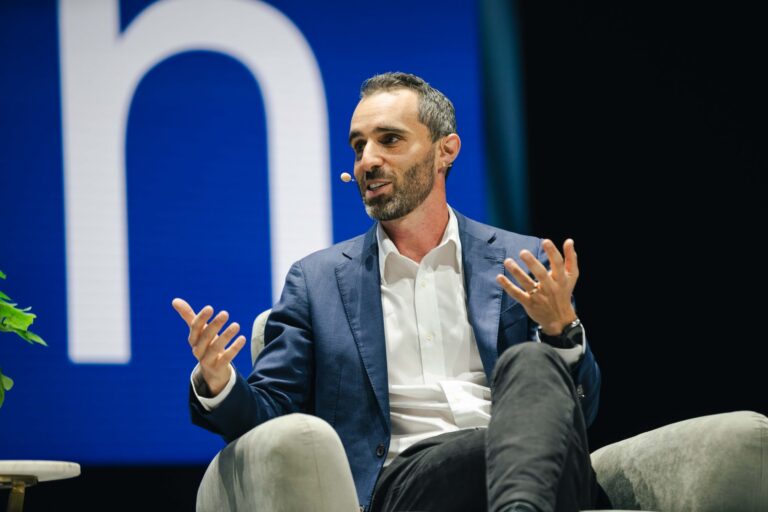
Frances Haugen in Ottawa in October 2022. Photo: Blair Gable for The Logic
Frances Haugen will be coming to Montreal a lot in the next year.
As of today, the former Facebook product manager and famed Facebook whistleblower is a senior fellow-in-residence at McGill University’s Centre for Media, Technology and Democracy (MTD), where she will collaborate on a Canada-wide, youth-focused digital-literacy campaign. She also has the decidedly more daunting task of depoliticizing the debate over Big Tech regulation in this country. It’s a one-year gig, though MTD director Taylor Owen, who was instrumental in her appointment, hopes it will go well beyond that.
That’s the news. Now, the context. In 2021, The Wall Street Journal published a devastating 17-part series about Meta, largely based on internal documents Haugen had meticulously copied and spirited out of the company. These documents spelled out, in cold if unguarded corpo-speak, the extent to which Meta knew users on its social media platforms were spreading misinformation, fomenting anger, enabling drug cartels and human trafficking, ruining the lives of many teenage girls and otherwise turning the platforms into efficient worldwide vectors of hate speech and excessive violence. More damning still, the documents showed that Meta largely ignored the problems it created in the name of engagement. Haugen has since become a symbol of resistance in the face of Big Tech’s overwhelming power to influence governments and shape lives.
She is coming here because she sees Canada as a counterpoint to the zero-sum, hyperpartisan exercise that is U.S. politics—and McGill as a counterpoint to America’s increasingly politicized academia. “They’re non-trivial parts of the United States that have very strong beliefs about the trustworthiness of X University versus Y University,” Haugen told me recently. “I believe all these issues are bipartisan. We all live on the same planet; we all have to use the same information environment. And it’s really hard, because it means that if I chose to work with many American universities, it’d be seen as choosing a side.”
Related Articles



Among her first tasks at MTD: building out a series of explainer videos about social media, with the goal of making one million people in the world fluent in how these platforms, and the algorithms driving them, actually work. She and Owen will also host town halls about Big Tech, the first on June 27, targeted toward the under-18 crowd.
This might sound a bit hokey to cynical ears, if not downright quaint. But like a number of U.S. senators, I have heard Haugen speak, and she is emphatic that connecting with people on a personal level—not via the vortex of social media—is crucial to pushing polarized politics out of the conversation about internet regulation. “The way we break this from being a partisan issue is we connect with people, because that’s how democracy works. And the Big Tech companies want it to be partisan,” she told me.
The federal government’s first attempts at curbing the internet’s hateful and dangerous excesses was, in three words, a blessed disaster, with critics saying the proposed changes could lead to censorship and a “surveillance state.” The government tacitly acknowledged the criticism, and promised to do better, though it has yet to produce any legislation. Haugen, Owen told me, will be crucial to bringing an international perspective to the debate by showing the good (and bad) aspects of existing legislation in countries like Belgium and France. The U.K., for example, largely skirted the “internet censorship” criticism in part by compelling Big Tech firms to enforce their own terms of service—something Meta, in particular, seems loath to do.
It’s a daunting task, and not only because the Conservative opposition seems to regard every legislative move on the part of the Liberal government as an attack on freedom of expression, online and otherwise. Google’s YouTube, in particular, was vociferous in its opposition to the government’s Online Streaming Act, which compels platforms to prioritize Canadian content as a condition of operating here. And both Google and Meta have threatened to pull their news services out of the country should the federal government adopt a law forcing them to pay for news content posted on their platforms.
Legislating against online harms will be exponentially more difficult, Haugen told me, in large part because Big Tech is keenly aware of Canada’s proximity to the U.S. market. “They’re going to fight a lot harder. And the stakes are higher. Americans view Canada as a lot less foreign than they view Europe. So Facebook and Google and all these companies know that if Canada passes a reasonable law, it’s gonna be a lot harder for that to seem like a foreign thing in the United States,” she said.
It makes Haugen’s appointment to McGill interesting for another reason. The MTD is housed at the Max Bell School of Public Policy, where Owen serves as an associate professor. Kevin Chan, Meta’s senior director of global policy campaign strategies, is on Max Bell’s advisory board. Chan, I found out in 2021, has been a frequent vocal critic of Owen, in large part because Owen is a frequent critic of Meta. Now, thanks to Owen, one of the world’s most recognizable and effective Meta critics will be roaming the halls, too.
I emailed Chan to ask about the appointment. He hadn’t heard about it; he thanked me for the information and said nothing else—yet.
Clarification: This story has been updated to reflect the correct date of the first MTD meeting on the influence of Big Tech.
Martin Patriquin is The Logic’s Quebec correspondent. He joined in 2019 after 10 years as Quebec bureau chief for Maclean’s. A National Magazine Award and SABEW winner, he has written for The New York Times, The Guardian, The Walrus, Vice, BuzzFeed and The Globe and Mail, among others. He is also a panelist on CBC’s “Power & Politics.” @MartinPatriquin



Loading...
Thanks for sharing!
You have shared 5 articles this month and reached the maximum amount of shares available.
CloseThis account has reached its share limit.
If you would like to purchase a sharing license please contact The Logic support at [email protected].
CloseGift the full article!
You have gifted 0 article(s) this month and have 5 remaining.
Recipients will be able to read the full text of the article after submitting their email address. They will not have access to other articles or subscriber benefits.
Photo: Blair Gable for The Logic
Most Popular This Week



In-depth, agenda-setting reporting
Great journalism delivered straight to your inbox.
News
Coinbase wants to put bots on the blockchain
Briefing
Canadian businesses want Ottawa to hold out for a better U.S. trade deal: KPMG survey
Online banks are attracting younger Canadians, report shows
Lightspeed cuts 250 jobs through layoffs and attrition
Best business newsletter in Canada
Get up to speed in minutes with insights and analysis on the most important stories of the day, every weekday.
Exclusive events
See the bigger picture with reporters and industry experts in subscriber-exclusive events.
Membership in The Logic Council
Membership provides access to our popular Slack channel, participation in subscriber surveys and invitations to exclusive events with our journalists and special guests.