Skip to content

Canada's Business and Tech Newsroom

  • Professional Subscription
  • Partnerships & Advertising
  • Licensing & Syndication
Log In Subscribe
Welcome,
  • My Account
  • Log Out
  • Business
  • Tech
  • National
  • The Big Read
  • Briefings
  • Commentary
Search
Log In Subscribe
Welcome,
  • My Account
  • Log Out
News

OpenAI adds to parental controls as it positions ChatGPT as a learning tool for teens

Listen Now
0:00
News

OpenAI adds to parental controls as it positions ChatGPT as a learning tool for teens

Policymakers around the world are considering curbs on how children use chatbots, amid mental health and educational concerns

By Murad Hemmadi
A silhouette shot of a teenaged boy looking at his phone.
OpenAI says most teens are using ChatGPT to learn, access information and develop skills. Photo: Getty Images/Matt Cardy
Jul 16, 2026
A A
A Small A Medium A Large
Share

Gift

Share

Listen Now
0:00

TORONTO — OpenAI is slightly expanding parental controls in ChatGPT and touting it as an educational tool for teens, as policymakers around the world grapple with how and when kids should be allowed to use AI.

The new features build on the San Francisco-based firm’s September launch of a system that lets parents link their accounts to those of their children to set time limits, turn off image-generation functionality and alert them if “something may be seriously wrong.” Now, they’ll get those notifications in cases where OpenAI deactivates their child’s account for making violent threats. Parents still won’t be able to see the actual contents of the chats, which the firm says is to preserve user privacy. 

Talking Points

  • As policymakers consider chatbot bans and other measures to protect kids using AI, OpenAI is arguing that teens need access to ChatGPT for education
  • The San Francisco-based firm has added new features to its parental controls, and is emphasizing study-focused use of its applications

OpenAI is also adding more education features. Starting in January, the firm’s technology began trying to assess whether users are minors, and if so, to prevent them from seeing sensitive content that contains or promotes graphic violence, self-harm or sexual role-playing. 

For accounts tagged as belonging to teens, ChatGPT will now by default suggest learning-focused prompts for tasks it can help with, like making edits on an essay or drafting study materials like flashcards. And it will remind heavy users to take breaks more often.

The firm says most teens are using the tools to learn, access information, develop skills or make themselves more productive.

Related Articles

A close-up of Marc Miller in which he appears on the far right side of the frame against a black background.

Online harms bill isn’t the last word on child social media safety, says Miller

By Laura Osman
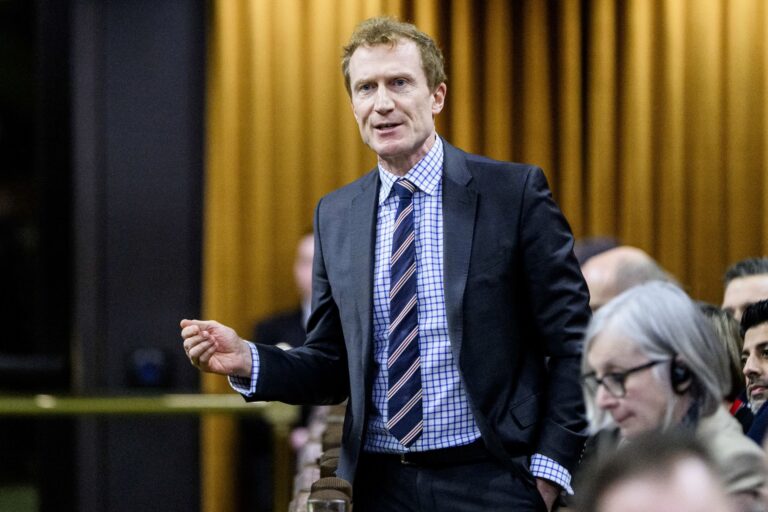
Minister Marc Miller wears a blue suit and tie. He stands while speaking and gesturing.

Online harms bill would give new regulator power to slap massive fines on AI, social media giants

By Laura Osman and Martin Patriquin

Parents can also now remotely turn on the tool’s “study mode,” which walks users through problems step by step rather than simply generating the answers. OpenAI said it used input from educators and learning experts to design the system. Teachers have expressed concern that students’ use of AI may prevent them from learning critical thinking, and make them reliant on the technology.

Policymakers in Canada and other countries have been applying more scrutiny and rules to AI developers following a series of incidents involving young people’s interactions with chatbots. 

In February, the firm promised to update its policies around alerting authorities of potential risks of harm, after The Wall Street Journal reported that it had not told police about disturbing conversations last year between ChatGPT and the teenage perpetrator of the Tumbler Ridge mass shooting. 

OpenAI is also facing lawsuits from parents alleging ChatGPT contributed to their children’s suicides, including a New Brunswick woman who’s suing in California court over the death of her 24-year-old daughter.

The company’s education-focused message comes as it faces the prospect of child chatbot bans. In a blog post published Wednesday, the firm claimed keeping teens from using AI would leave them “less prepared to use one of the defining technologies of their time.”

Manitoba Premier Wab Kinew was the first to move on a chatbot ban, in April. The province’s measure would apply to under-16s. Kinew cited the risk of mental health impacts, although he acknowledged the technology may have educational benefits.

Last month, the federal government proposed a new Digital Safety Act that would ban social media—but not chatbots—for children under 16. The law would impose on AI companies the duty to act responsibly and protect children. It requires developers that offer “public-facing conversational chatbots that can mimic human-like relationships” to ensure their products don’t communicate harmful content, and to have protocols for intervening in crisis situations. Firms that break the law, if it passes, would face audits and fines from a new regulator of up to $10 million or three per cent of global revenues from a new regulator.

Ottawa’s proposed Protecting Privacy and Consumer Data Act, meanwhile, requires companies to take extra care with the private information of children. 

OpenAI spokesperson Jamie Radice said the firm supports “Canada’s goal of protecting young people online,” and is tracking the Digital Safety Act. But she said the updates announced Thursday are part of its broader approach to safety, and expand on “ongoing work to provide age-appropriate experiences, stronger safeguards and practical tools that help families guide how teens use AI.” 

The company said it could not provide data on what share of minor-tagged accounts are linked to parent accounts.

Gift the full article

Governments in Australia, the U.K. and the U.S. have launched or proposed partial chatbot ban or limits for minors.

Lawyers representing the families of affected teens criticized the original parental controls as insufficient, noting they require that families already know their kids are using ChatGPT.


#artificial intelligence #ChatGPT #economy #online harms #OpenAI #Tech

Sponsored Content

The real-world economic offshoots of sovereign AI

By Deborah Aarts
Illustration of a plane flying above a mailbox

Increasing healthcare access across Canada

By Deborah Aarts

What it takes to lead a frontier firm

By Deborah Aarts
Paid promotional content

Loading...

Thanks for sharing!

You have shared 5 articles this month and reached the maximum amount of shares available.

Close
This account has reached its share limit.

If you would like to purchase a sharing license please contact The Logic support at [email protected].

Close
Want to share this article?

Upgrade to all-access now

Close
Gift the full article!

You have gifted 0 article(s) this month and have 5 remaining.

Copy link and gift
Copy Link
Email to a friend
Send Email
Gift on Social Media

Recipients will be able to read the full text of the article after submitting their email address. They will not have access to other articles or subscriber benefits.

A silhouette shot of a teenaged boy looking at his phone.

Photo: Getty Images/Matt Cardy

Most Popular This Week

A screen displays a TSXV and Emerge banner in front of several skyscrapers in Toronto’s downtown financial district.
News

Nasdaq’s crackdown tests Canada’s bet on small public companies

By Catherine McIntyre and Anita Balakrishnan
The Big Read

The $20B risk at the heart of Carney and Smith’s grand pipeline bargain

By Meghan Potkins
A multimedia illustration showing images of six smiling individuals, on a dark background with blue shapes.
Special Report

Meet Canada’s leading innovators from the Class of 2026

By Sara Harowitz
An image of a man wearing a white collared shirt. He is standing against a brown background with the word HOOPP written on it. He is slightly smiling and looking directly at the camera.
Exclusive

What the Maple 8’s first chief AI officer is up to

By Murad Hemmadi

In-depth, agenda-setting reporting

Great journalism delivered straight to your inbox.

Shivam Mahajan and Zaaheda Islam pose in front of their company offices.
Analysis

These AI startups are making millions with tiny teams

By Catherine McIntyre

Briefing

Supply-chain management vendor Kinaxis reports revenue jump and higher profit

By David Reevely   |   Aug 5, 2026 | 5:00 PM ET

Flush with cash, Suncor Energy boosts share buybacks—but doesn’t rule out production growth

By Meghan Potkins   |   Aug 5, 2026 | 3:57 PM ET

Goodfood seeks creditor protection as it tries to sell itself

By Anita Balakrishnan   |   Aug 5, 2026 | 3:43 PM ET

Best business newsletter in Canada

Get up to speed in minutes with insights and analysis on the most important stories of the day, every weekday.

Exclusive events

See the bigger picture with reporters and industry experts in subscriber-exclusive events.

Membership in The Logic Council

Membership provides access to our popular Slack channel, participation in subscriber surveys and invitations to exclusive events with our journalists and special guests.

Recent Popular Stories

Special Report

Meet Canada’s leading innovators from the Class of 2026

By Sara Harowitz   |   Jul 29, 2026
A multimedia illustration showing images of six smiling individuals, on a dark background with blue shapes.
The Big Read

The $20B risk at the heart of Carney and Smith’s grand pipeline bargain

By Meghan Potkins   |   Jul 30, 2026
Exclusive

What the Maple 8’s first chief AI officer is up to

By Murad Hemmadi   |   Jul 28, 2026
An image of a man wearing a white collared shirt. He is standing against a brown background with the word HOOPP written on it. He is slightly smiling and looking directly at the camera.
Commentary

Carmichael: The hard work of breaking down internal trade barriers is starting to pay off

By Kevin Carmichael   |   Jul 25, 2026
News

Canada’s cyberspy agency exempts itself from Buy Canadian rules

By David Reevely   |   Jul 27, 2026
A shot of the sign outside Communications Security Establishment headquarters in Ottawa.
News

Canada Goose shrugs off Trump’s 50% tariff threat

By David Reevely   |   Jul 30, 2026
A rack of winter jackets with the Canada Goose arm patch logo visible on each one

Canada's most influential executives and policymakers are reading The Logic

  • CPP Investments
  • Sun Life Financial
  • C100
  • Amazon
  • Telus
  • Mastercard
  • bdc
  • Shopify
  • Rogers
  • RBC
  • General Motors
  • MaRS
  • Government of Canada
  • Uber
  • Loblaw Companies Limited
logic-logo

Canada's Business and Tech Newsroom

100% human-crafted journalism

Newsroom

  • News Tips
  • AI Policy
  • Editorial Disclosures
  • Story Pitches

Company

  • About Us
  • Terms of Service
  • Privacy Statement
  • Corporate Information

Contact

  • Contact Us
  • Advertise
  • FAQs
  • Work at The Logic

© 2026 The Logic Inc. All Rights Reserved.

Trusted by leaders

Error

Account creation failed.

Please email us at [email protected].

Create Account

[wppb-register form_name=”cozmo-registration-form-for-modal”]

I do have an account
Login
or

[wppb-login]

I don’t have an account