Skip to content

Canada's Business and Tech Newsroom

  • Professional Subscription
  • Partnerships & Advertising
  • Licensing & Syndication
Log In Subscribe
Welcome,
  • My Account
  • Log Out
  • Business
  • Tech
  • National
  • The Big Read
  • Briefings
  • Commentary
Search
Log In Subscribe
Welcome,
  • My Account
  • Log Out
News

Online harms bill isn’t the last word on child social media safety, says Miller

Listen Now
0:00
A close-up of Marc Miller in which he appears on the far right side of the frame against a black background.
News

Online harms bill isn’t the last word on child social media safety, says Miller

The roles that platforms, app stores and government play in the ban is an “ongoing conversation,” Culture Minister Marc Miller told The Logic

By Laura Osman
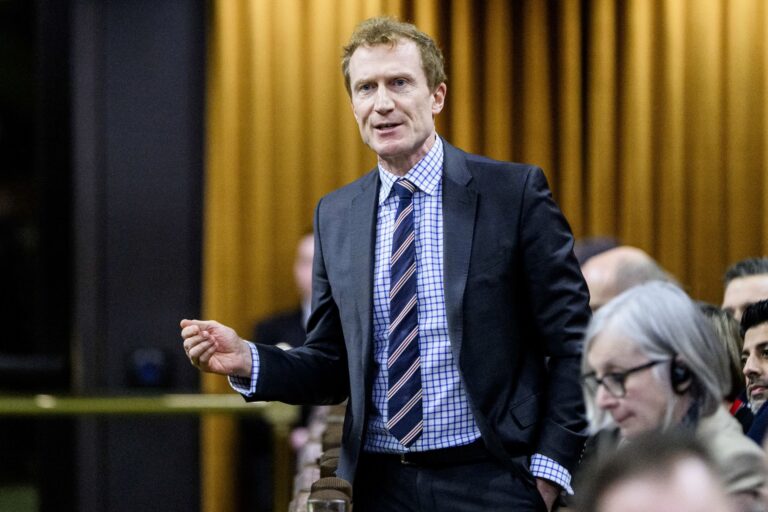
Culture Minister Marc Miller tabled social media safety legislation in Parliament earlier this week. Photo: The Canadian Press/Adrian Wyld
Jun 12, 2026
A A
A Small A Medium A Large
Share

Gift

Share

Listen Now
0:00

OTTAWA — The federal government made social media companies accountable for safeguarding the sensitive personal information gathered to keep kids off their platforms because they’re the ones that profit from Canadian users, Culture Minister Marc Miller told The Logic.

Those firms will shoulder the responsibility for now, but Miller said the legislation won’t be the final word on whether platforms, app stores or governments are best placed to collect and handle sensitive data without creating new hazards.

Talking Points

  • Culture Minister Marc Miller wants social media platforms—not app stores or governments—to bear initial responsibility for verifying users’ ages as part of a new bill that would bar children from social media sites until they are 16 years old, he said in an interview with The Logic
  • Ottawa is also exploring a government-led age-verification option, according to a federal official, though the option would not be mandatory 

“We have made platforms responsible because they are the ones doing business,” he said in an interview Thursday. 

Earlier this week, Miller tabled Bill C-34, titled the Safe Social Media Act, which would ban children under the age of 16 from social media and create a new regulator with the power to impose binding orders and heavy fines on platforms and AI chatbot companies. 

Related Articles

A close-up of the TikTok logo on the side of a concrete structure.

Big Tech says it will work with Ottawa on plan to ban kids from social media

By Martin Patriquin and Laura Osman
Minister Marc Miller wears a blue suit and tie. He stands while speaking and gesturing.

Online harms bill would give new regulator power to slap massive fines on AI, social media giants

By Laura Osman and Martin Patriquin

Once established, the Digital Safety Commission will be able to exempt social media platforms from the ban, as long as they meet certain safety standards, but creating the regulator will take at least 18 months. In the meantime, experts have raised concerns about the privacy implications of the age-verification methods needed to make the bans work, which could include collecting government identification or biometric data from users. 

The approach marks a shift from the outlook of the previous Liberal government, which banned TikTok from operating in Canada amid concerns that its parent company, ByteDance, might pass users’ sensitive data to the Chinese government. Earlier this year, Ottawa reversed the decision in exchange for a commitment from the company to enforce stronger data protections.

Meta, one of the companies targeted by the legislation, has argued for months it doesn’t want to collect users’ identification, and that app stores should be responsible for verifying ages. Companies like Google and Apple already receive information about users when they set up their devices and could relay to platforms how old the user is, Meta Canada’s director of public policy Rachel Curran told a parliamentary committee last year. 

Ottawa is also considering a government-run age-verification service, similar to the “mini wallet” tool developed by the European Union, according to a Heritage Department official who briefed reporters on the bill on the condition they not be named. The official stressed that a government-led option wouldn’t be mandatory. 

None of those options offer perfect solutions to secure Canadians’ personal information, Miller said. “All [are] fraught with challenges about who protects and who is seen to protect people’s privacy the best,” the minister said, adding: “This is an ongoing conversation. It’s not something that is solved by the legislation.”

The bill leaves it to platforms to decide how they will keep kids off their sites, but requires them to destroy the personal information they collect to do it, after performing any verifications. The government has also announced plans to soon introduce separate legislation to update Canada’s privacy laws.

Canada’s privacy commissioner has found several instances of social media platforms mining Canadians’ personal information without consent, including children’s.

“The sad reality in all this, and I think the more important issue in and around privacy, is these platforms already have a tremendous amount of information with respect to our kids,” Miller said.

Prime Minister Mark Carney arrived in France on Friday on his way to a G7 summit, where he plans to discuss a common approach to age verification technologies with other leaders. Miller said the goal isn’t to create identical international rules, but to try to solve a common problem. 

“To the extent that kids are getting harmed in much the same ways in countries, it stands to reason that you would have some laws and regulations and structures that are similar,” he said. 

Miller said the government took a close look at regulators in the EU, U.K. and Australia to design a Digital Safety Commission for Canada. “There have been deep policy analyses of the good, the bad and the ugly of some of these attempts at making sure that platforms actually behave in a responsible fashion,” he said. The government’s previous failed attempts to regulate social media and feedback from parents also informed the design.

Canada’s regulator won’t wield as large a stick as its international counterparts, however. The government proposes to let the commission impose a maximum fine of $10 million or three per cent of a company’s global revenue–whichever is more. By comparison, the EU can impose penalties of up to six per cent of global revenue under its Digital Services Act, and the U.K.’s Online Safety Act allows fines of up to 10 per cent. 

“There’s a bit of art, there’s a bit of science,” Miller said of setting the maximum fines. “We did look at what potential growth revenue turnover was for a number of companies.” 

Gift the full article

The government also considered what would be reasonable in a market the size of Canada, and the fact that firms could face additional fines if provinces impose their own penalties for online safety or privacy violations. 

Ideally, he said, the new rules will get ahead of serious online safety issues and make platforms safe and secure, so the fine won’t be necessary. “This is really about keeping kids safe,” he said. 

#economy #Marc Miller #online harms #social media #Tech

Loading...

Thanks for sharing!

You have shared 5 articles this month and reached the maximum amount of shares available.

Close
This account has reached its share limit.

If you would like to purchase a sharing license please contact The Logic support at [email protected].

Close
Want to share this article?

Upgrade to all-access now

Close
Gift the full article!

You have gifted 0 article(s) this month and have 5 remaining.

Copy link and gift
Copy Link
Email to a friend
Send Email
Gift on Social Media

Recipients will be able to read the full text of the article after submitting their email address. They will not have access to other articles or subscriber benefits.

A close-up of Marc Miller in which he appears on the far right side of the frame against a black background.

Photo: The Canadian Press/Adrian Wyld

Most Popular This Week

A person in glasses and a blue top is sitting and typing on a laptop in an office. A desktop screen next to the laptop displays some blurred-out coding work.
News

A niche white-collar role is becoming the AI industry’s hot new job

By Anita Balakrishnan
A logo that reads AI in blue lettering against a light yellow background.
News

What happened when a VC firm let AI do almost everything

By Catherine McIntyre
News

Canada joins the movement to make AI more open source

By Murad Hemmadi
A close-up of a made-in-Canada stamp on the end of a cylindrical piece of raw aluminum.
Analysis

It turns out Trump does need something from Canada—aluminum

By Joanna Smith

In-depth, agenda-setting reporting

Great journalism delivered straight to your inbox.

A shot of a placard on a table reading "Let Alberta Decide." There is a person out of focus in the foreground wearing a cowboy hat.
The Big Read

What Alberta’s corporate heavyweights really think about separation

By Meghan Potkins

Briefing

Radical Ventures backs TwelveLabs in US$100M Series B for video AI tools

By Murad Hemmadi   |   Jul 2, 2026 | 3:14 PM ET

OMERS revamps leadership after investment chief’s departure

By Chaimae Chouiekh   |   Jul 2, 2026 | 3:10 PM ET

Robinhood launches crypto trading in Canada

By Claire Brownell   |   Jul 2, 2026 | 1:15 PM ET

Best business newsletter in Canada

Get up to speed in minutes with insights and analysis on the most important stories of the day, every weekday.

Exclusive events

See the bigger picture with reporters and industry experts in subscriber-exclusive events.

Membership in The Logic Council

Membership provides access to our popular Slack channel, participation in subscriber surveys and invitations to exclusive events with our journalists and special guests.

Recent Popular Stories

Analysis

It turns out Trump does need something from Canada—aluminum

By Joanna Smith   |   Jun 25, 2026
A close-up of a made-in-Canada stamp on the end of a cylindrical piece of raw aluminum.
News

What happened when a VC firm let AI do almost everything

By Catherine McIntyre   |   Jun 29, 2026
A logo that reads AI in blue lettering against a light yellow background.
News

Alberta to free up a huge amount of power to attract Big Tech and its data centres

By Meghan Potkins   |   Jun 24, 2026
A wide landscape shot of high-tension power lines over green and golden fields in rolling countryside.
Exclusive

Ssense has laid off photo and make-up teams and says AI will do much of their work

By Catherine McIntyre   |   Jun 22, 2026
News

A niche white-collar role is becoming the AI industry’s hot new job

By Anita Balakrishnan   |   Jun 30, 2026
A person in glasses and a blue top is sitting and typing on a laptop in an office. A desktop screen next to the laptop displays some blurred-out coding work.
News

Canada joins the movement to make AI more open source

By Murad Hemmadi   |   Jun 26, 2026

Canada's most influential executives and policymakers are reading The Logic

  • CPP Investments
  • Sun Life Financial
  • C100
  • Amazon
  • Telus
  • Mastercard
  • bdc
  • Shopify
  • Rogers
  • RBC
  • General Motors
  • MaRS
  • Government of Canada
  • Uber
  • Loblaw Companies Limited
logic-logo

Canada's Business and Tech Newsroom

100% human-crafted journalism

Newsroom

  • News Tips
  • AI Policy
  • Editorial Disclosures
  • Story Pitches

Company

  • About Us
  • Terms of Service
  • Privacy Statement
  • Corporate Information

Contact

  • Contact Us
  • Advertise
  • FAQs
  • Work at The Logic

© 2026 The Logic Inc. All Rights Reserved.

Trusted by leaders

Error

Account creation failed.

Please email us at [email protected].

Create Account

[wppb-register form_name=”cozmo-registration-form-for-modal”]

I do have an account
Login
or

[wppb-login]

I don’t have an account