OTTAWA — The federal government is providing $5.5 million to fund a new network anchored at McGill University and the University of Toronto to study what information people in the country are taking in, and how it spreads through communities and across online platforms.
The money for the Canadian Digital Media Research Network is part of Ottawa’s plan to tackle foreign interference, following reports that the Liberals failed to address Beijing’s attempted meddling.
Talking Points
- Ottawa is spending $5.5 million to back a digital media research network that will study what information Canadians are consuming online and how it spreads
- The funding is part of the Liberal government’s plan to tackle foreign interference and the spread of disinformation
- The network will be based out of McGill University’s Centre for Media, Technology and Democracy and the University of Toronto’s Munk School of Global Affairs and Public Policy
“Platforms are changing, the nature of journalism is changing [and] the issues in the world are changing,” said Peter Loewen, director of U of T’s Munk School of Global Affairs & Public Policy. He’s one of the co-leads of the new network, along with Taylor Owen, director of McGill’s Centre for Media, Technology and Democracy. Loewen cited growing awareness of foreign actors trying to shape the country’s information ecosystem, and forthcoming legislative changes to how it is subsidized and run, as other reasons for the initiative.
The network is meant to help policymakers, media members, researchers and the general public understand how people are consuming and sharing information across increasingly fragmented fora. The federal funding, to be disbursed over three fiscal years, will pay for graduate-student research teams and data collection at McGill and U of T, along with partner institutes.
The initiative will offer participants access to information pulled from social platforms as well as the ability to conduct surveys and tools to aid in their projects. It will support pop-up studies of events like elections but also longer-term analyses of the information landscape, producing reports and multimedia laying out researchers’ findings.
“A lot of Canadians—on all sides of our various political divides—are concerned that we believe different things from each other,” said Owen. Following the information journeys that take people to those diverging end points could help get more of them to “some common facts we can all agree to.”
The network expands on the existing Media Ecosystem Observatory, a project Loewen, Owen and another researcher launched in 2019. One early-pandemic project tied misinformation on social media to people’s misperceptions about COVID-19 and reduced adherence to social distancing.
Other jurisdictions have backed similar approaches. The European Digital Media Observatory (EDMO) is based in Florence, Italy, and has 14 hubs at universities and research centres across the continent; the European Commission provides funding as part of its December 2018 anti-disinformation strategy.
The launch of the network comes as the Liberal government faces scrutiny and criticism for its handling of alleged attempts by the Chinese state to meddle with Canada’s democratic processes and pressure diaspora communities here. In March, Prime Minister Justin Trudeau announced measures to combat foreign interference, including $5.5 million to “strengthen the capacity of civil society partners to counter disinformation.”
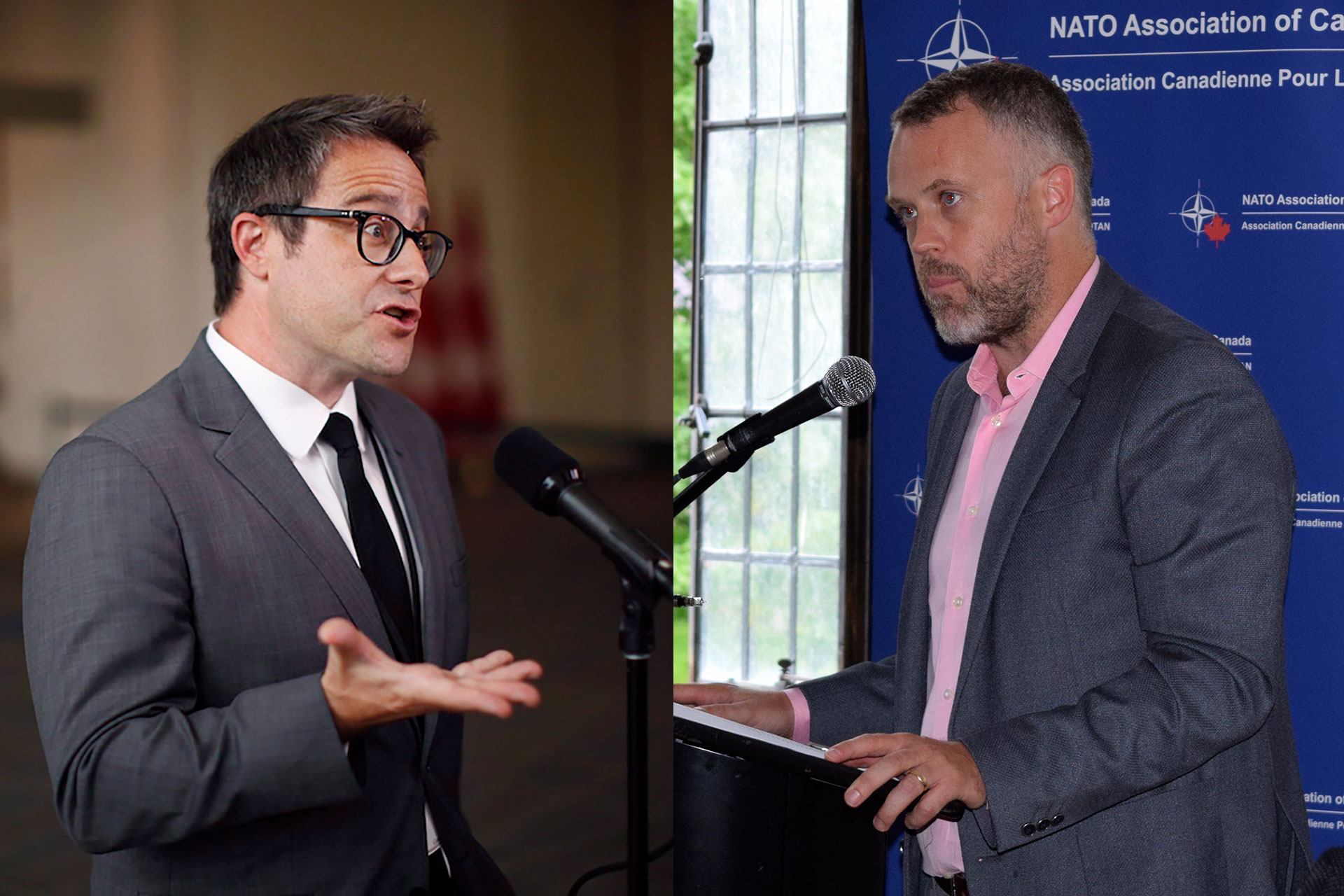
From left to right: Taylor Owen, director of McGill's Centre for Media, Technology and Democracy, in Nanaimo, B.C., in August 2018; and Peter Loewen, director of U of T’s Munk School of Global Affairs & Public Policy, in August 2016. Photo: The Canadian Press/Chad Hipolito; NATO Association of Canada via Flickr/Lira Loloci
That’s the money that’s going to the network, although Owen said discussions about the initiative began more than a year ago. The federal measures aren’t specifically targeted at Beijing, and Loewen said the initiative’s projects won’t be either. Instead, the network will consider whether people more broadly have the information to understand what’s true in their political worlds and hold governments to account. “This is not simply one government trying to plant one set of lies on one channel of social media,” he said.
The initiative will undertake case studies that dig into media sources and channels from diaspora communities. Loewen said lack of appreciation for the importance and scope of content in languages other than English and French is a “major point of weakness, not only in Canadian academia, but in our media.”
Owen noted that social platforms have made it more difficult for academics to track public-facing posts and other activity they host. Those quantitative findings will be supplemented with more qualitative ones, drawn from behavioural surveys and sociological or ethnographic work. The network has already launched studies of the federal byelections currently underway.
Both leads say the network’s approach will not be to correct specific claims made on, or amplified by, digital media. “This is not a fact-checking exercise. In fact, I don’t think those work,” Owen said, adding that governments and institutions that partner with them should not be “picking and choosing true and false information and pushing back against it.” (The EDMO’s hubs, by contrast, do conduct fact-checking.)
This isn’t the first time Ottawa has spent to fight disinformation. In January 2019, it allocated $7 million for public-awareness campaigns it said would help citizens grapple with “online deceptive practices” in the lead-up to that year’s election. But there’s no one-and-done way to inoculate the country’s information ecosystem from such threats, said Loewen. “We need to really keep going and figuring out what’s going to work.”