MONTREAL — The head of one of Canada’s senior stock exchanges is calling for greater oversight of retail trading, even as market data shows the trend is, for now, on the decline.
Skip to content


News
Neo Exchange CEO calls for more oversight of retail trading
Neo Exchange CEO Jos Schmitt at the alternative stock exchange’s launch in Toronto in March 2015. Photo: The Canadian Press/Darren Calabrese
MONTREAL — The head of one of Canada’s senior stock exchanges is calling for greater oversight of retail trading, even as market data shows the trend is, for now, on the decline.
“To be honest, I think it’s an issue,” Jos Schmitt, CEO of the Neo Exchange, said in an interview with The Logic. “Regulators need to create more transparency and also ensure proper education, and then seek to identify if there is some fraudulent behaviour there also. I would not be surprised that in certain cases it’s fraudulent and that someone is sitting on a position, talking it up, pushing people to bring the price up, and then [making] a solid gain on it while others are generating losses.”
Talking Point
Jos Schmitt said regulators should be examining conflicts of interest for people who boost stocks online, as fintech startups look to capitalize on retail trading and regulators in some parts of Canada push for broader oversight powers.
Schmitt’s comments come as regulators weigh a response to the market turbulence that has sent so-called meme stocks whipsawing over the last few months. Market watchdogs like the Ontario Securities Commission have recently adopted a harsher tone toward coordinated trading and the platforms that enable it, even as Canadian startups like Mogo and Wealthsimple have taken steps to get a piece of the action.
The heads of other Canadian exchanges were less concerned about the need for heightened scrutiny of social-media driven trading, which has funnelled additional volumes to trading venues since the trend began. John McKenzie, CEO of TMX Group, which operates the Toronto Stock Exchange, said regulators already have all the tools they need to ensure asset prices aren’t being manipulated. “I don’t see any evidence of any misses” by regulators, he said.
Richard Carleton, the head of the Canadian Securities Exchange, said he has seen an increased focus from regulators on the use of social media to distribute information on stocks, though he questioned whether they had the capability to monitor the amount of activity on those platforms.
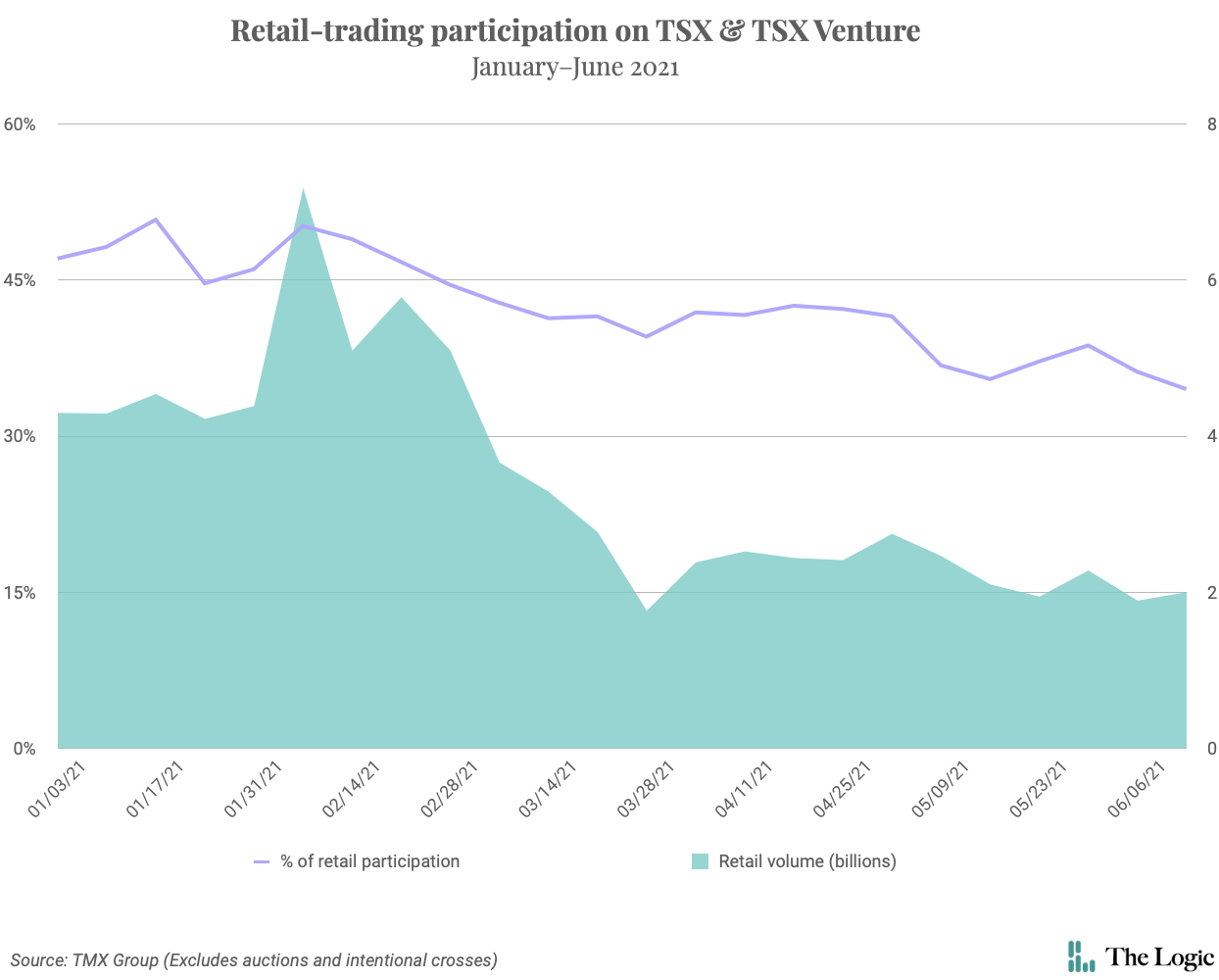
After months of ups and downs in meme stocks—often heavily shorted companies with outdated business models, whose shares are promoted on Reddit and other social media platforms—the retail-trading frenzy seems to be losing steam. On the TSX and TSX Venture Exchange, retail-trading volumes are down to roughly 36 per cent this month from their peak of 48 per cent of all trades in February. By comparison, the share of retail trading on the two exchanges was about 35 per cent in 2019, according to TMX data.
According to Schmitt, however, the surge in retail investing could be bad for markets in the long run. “Some people may find it funny that [short sellers] are being negatively impacted by it,” he said. “But I also see a lot of the retail investors who are following that movement getting harmed, because they are buying the stock at a price which is far beyond what its fundamental value is, and then the stock goes down and they lose money, and there’s no way out.”
The share of retail trades on the TSX has declined every month since February, with overall trading volume down by roughly half, according to data from the exchange’s parent company, TMX. The Neo has seen a similar drop since the start of the year, Schmitt said. The decline in participation is less pronounced on the TSX Venture Exchange, composed mainly of smaller companies.
Despite the decline, the industry and regulators alike remain on guard. Schmitt said regulators should probe whether some of the stock promotion on social media platforms is fraudulent, with some people potentially making misleading statements to artificially inflate a stock’s price—or what’s known as a pump and dump. Regulators should also take steps to boost transparency in the market and give investors more educational resources so they can make informed trades, he said.
In a speech last month at Canadian Club Toronto, Grant Vingoe, the chair and CEO of the OSC, said online brokers need to do more to combat irresponsible trading, saying there is a “fine line between being easy to use and encouraging reckless behaviour.” Vingoe also vowed to pursue enforcement actions against bad actors in the market.
“We will not be shy about enforcing against those who feed misstatements into the market, either to denigrate stocks to profit from short selling or as part of pump-and-dump schemes,” Vingoe said. A review into regulation of Ontario’s capital markets by a provincial task force recommended giving the commission more tools to fight market manipulation, Vingoe added.
British Columbia’s securities regulator has proposed new rules that would require anyone promoting stocks on social media or other online media to disclose whether they hold a position in that stock or are otherwise profiting from the promotion. The sweeping regulations would allow provincial authorities to pursue enforcement actions against stock boosters, if they are adopted once the 60-day comment period for the proposal ends on July 26.
McKenzie said a similar framework would be useful to adopt elsewhere in Canada. “If you’ve got folks that are manipulating the market to their own benefit, then we should see the regulators go after them,” he said.
Still, it isn’t clear what, if anything, regulators can do to prevent retail traders from crowding into particular trades, which can be destabilizing for markets, said Jeff MacIntosh, a law professor at the University of Toronto who specializes in securities regulation. It would be extremely resource-intensive to parse through individual trades for meme stocks to find instances of illicit behaviour, and it’s difficult to separate naive trading from intentional manipulation, he said.
In response to the retail-trading trend, major online brokers in Canada have rolled out new offerings that they say will increase the amount of information available to investors. Questrade, for example, announced a partnership last week with TipRanks, integrating the company’s data on analysts’ stock recommendations into Questrade’s trading platform.
Newer companies are also expanding into retail stock trading as the market heats up. This year, Vancouver-based lender Mogo acquired investing app Moka and Canadian broker-dealer Fortification Capital in a bid to build a full platform for retail trading. Wealthsimple, which has offered a no-free stock-trading product since 2019, has bolstered its offerings through the addition of more cryptocurrencies to its trading platform.
With the rise in retail trading, the OSC has seen a corresponding rise in complaints to firms and regulators about service interruptions and delays in answering service-related calls by some online brokers, Vingoe said in May. Questrade had to triple the size of its customer support team to manage the influx of customers, who have signed up at roughly double Questrade’s typical pace since the start of the pandemic, according to COO Stephen Graham.
Interactive Brokers, another online brokerage, has increased its investment in hiring employees to help with customer onboarding, education and support, said Steve Sosnick, the company’s chief strategist. “We want our customers to be with us for the long term, and to have a long-term relationship with us,” Sosnick said. “The best way to ensure that is to make sure that people are making prudent investment decisions rather than uninformed decisions.”
As for the risks retail traders pose, they could resolve themselves once stocks pull back, as they often do when individual investors become too active in the markets, or when traders fail to match the incredible returns they have seen from others on social media, MacIntosh said.
“I kind of think it’s a self-correcting phenomenon,” MacIntosh said. “A lot of retail investors got into investing with stars in their eyes. Eventually, things are going to come crashing back to Earth.”
With files from Claire Brownell



Loading...
Thanks for sharing!
You have shared 5 articles this month and reached the maximum amount of shares available.
CloseThis account has reached its share limit.
If you would like to purchase a sharing license please contact The Logic support at [email protected].
CloseGift the full article!
You have gifted 0 article(s) this month and have 5 remaining.
Recipients will be able to read the full text of the article after submitting their email address. They will not have access to other articles or subscriber benefits.
Photo: The Canadian Press/Darren Calabrese
Most Popular This Week




In-depth, agenda-setting reporting
Great journalism delivered straight to your inbox.
News
Panel decries Canada’s chaotic way of funding world-class science
Briefing
AI is pushing insurers to become asset managers, Canadian CEOs say
Trump administration faces lawsuit over 50% tariffs on Canadian goods
Canada-U.S. trade war to reduce real GDP by 1.4% over 2024 levels after five years: PBO
Best business newsletter in Canada
Get up to speed in minutes with insights and analysis on the most important stories of the day, every weekday.
Exclusive events
See the bigger picture with reporters and industry experts in subscriber-exclusive events.
Membership in The Logic Council
Membership provides access to our popular Slack channel, participation in subscriber surveys and invitations to exclusive events with our journalists and special guests.