Skip to content

Canada's Business and Tech Newsroom

  • Professional Subscription
  • Partnerships & Advertising
  • Licensing & Syndication
Log In Subscribe
Welcome,
  • My Account
  • Log Out
  • Business
  • Tech
  • National
  • The Big Read
  • Briefings
  • Commentary
Search
Log In Subscribe
Welcome,
  • My Account
  • Log Out
News

Nations Royalty was Canada’s first majority-Indigenous-owned public company. It doesn’t want to be the exception

Listen Now
0:00
News

Nations Royalty was Canada’s first majority-Indigenous-owned public company. It doesn’t want to be the exception

The company is working with TMX Group to encourage Indigenous communities to use public markets to build long-term wealth

By Anita Balakrishnan
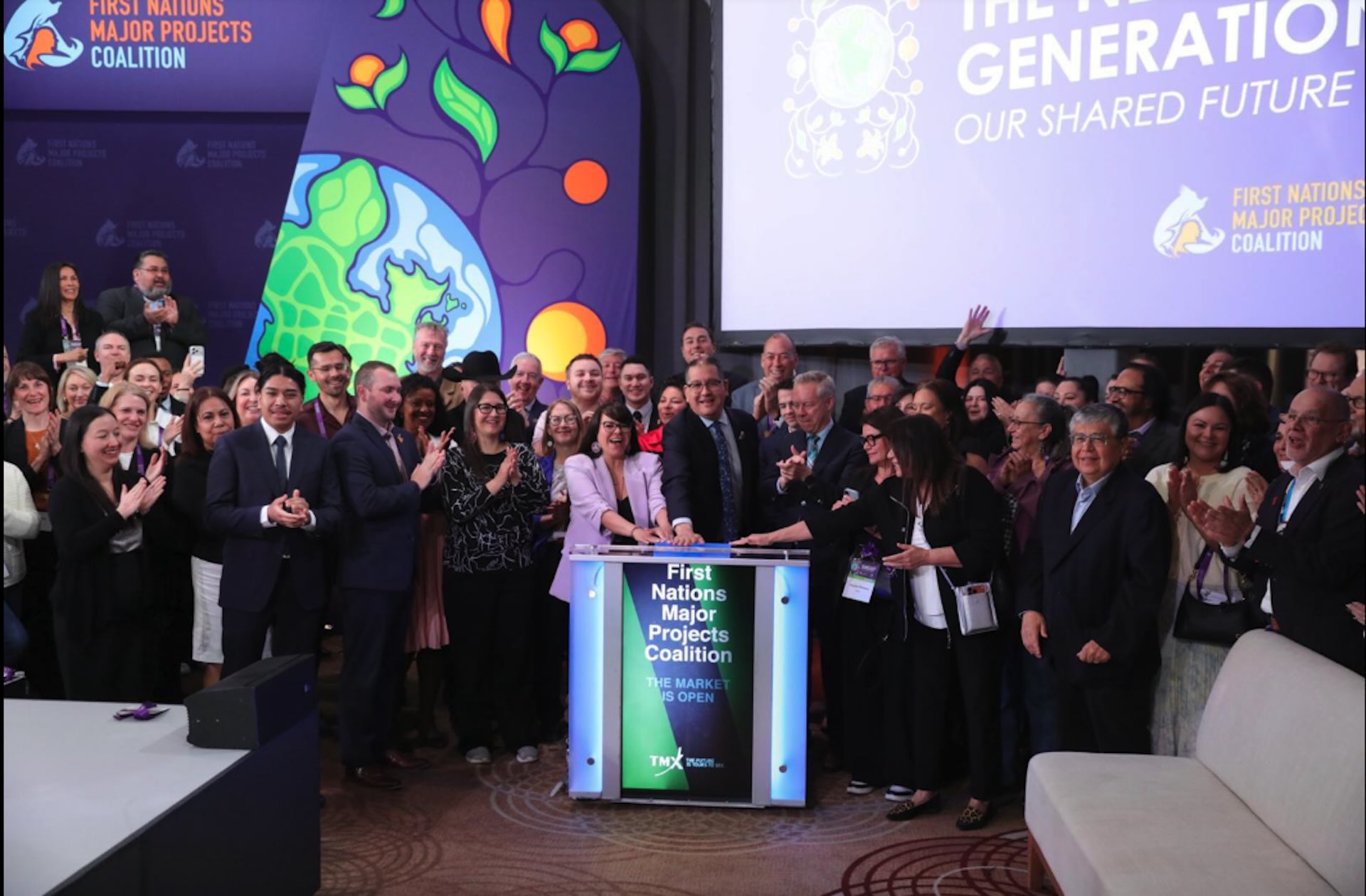
Nations Royalty is partnering with TMX Group to encourage Indigenous investors to go public. Photo: First Nations Major Projects Coalition’s Facebook page
Jun 10, 2026 | 5:45 AM ET
A A
A Small A Medium A Large
Share

Gift

Share

Listen Now
0:00

Canada’s first majority-Indigenous-owned public company is working with TMX Group to encourage peers to follow it into the equities market.

Publicly traded stocks are an underused financial tool that could benefit Indigenous investors looking to capitalize on projects in their territories, said Derrick Pattenden, who was previously a director of investment banking at Canaccord Genuity before becoming CEO of Nations Royalty. He hopes to change that with a forthcoming public markets 101 training program for Indigenous communities in Canada.

Talking Points

  • Nations Royalty is partnering with TMX Group to pivot Indigenous investors toward more public equity offerings
  • The company is testing a strategy to bundle mining benefit payments into a publicly traded portfolio, potentially offering Indigenous investors more liquidity and diversification

Pattenden saw the power of public markets firsthand when Nations Royalty went public in June 2024 on the TSX Venture Exchange. The company debuted with a unique business plan: acquiring Nisga’a Nation’s annual benefit payment entitlements from five mines.

Nearly a year after that landmark public offering, First Nation-owned Selkirk Copper Mines joined Nations Royalty as a majority-Indigenous-owned public company. Still, Pattenden says, they remain too rare. 

“The wealthiest people on the planet… pretty much all are connected with publicly traded companies,” Pattenden said. “First Nations are starting to use debt quite a bit, but I would suggest that if you’re not using public equity, you’re probably using debt too much.”

In addition to managing Nisga’a Nation’s portfolio and launching the new TMX training program, it is recruiting other First Nations to bundle some of their benefit payments into the company’s publicly traded portfolio in exchange for shares. The goal, he said, is to diversify nations’ income if one mine fails. 

Related Articles
This AI tool aims to show the true scale of Canada’s $100B Indigenous economy

By Chaimae Chouiekh
A shot from the side of three members of the Kwantlen First Nation seated at a table in a hearing room. The woman closest to the camera is wearing a traditional twined hat.

First Nations are getting flooded with requests to consult on projects—and it’s about to get worse

By Laura Osman

Mining royalties are popular with some investors, like Ontario Teachers’ Pension Plan Board, because they provide exposure to commodity-linked cash flows without the burdens of financing mining operations. First Nations’ Impact Benefit Agreement payments that track revenue have competitive multiples when presented to investors as a royalty, Pattenden said.

“If metal price doubles, those payments double,” he said. Mining financier Frank Giustra helped back the company’s vision.

That business model has pushed Nations Royalty to help other First Nations negotiate better agreements that tie payments from mining companies to revenue, said Pattenden. Older Impact Benefit Agreements between Indigenous Peoples and companies often have less favourable terms, such as fixed payments that don’t increase if commodity prices rise, he said.

Equity is growing in importance as Indigenous communities negotiate agreements for critical mineral mining projects because mining projects can rarely be financed only with debt, said Pattenden, who previously worked on mining mergers and acquisitions. 

In recent years, nations like Fort William First Nation, Red Rock Indian Band and the Biinjitiwaabik Zaaging Anishinaabek have negotiated directly with companies for warrants that can be traded for equity stakes. Nations Royalty provides another alternative for Indigenous groups that have negotiated cash payments but want the advantages of public market exposure.

“Instead of waiting for future royalty payments from these mines to come in on an annual basis, what we’re proposing is, ‘Let’s bring all those payments forward to today. Let’s put them into a publicly traded royalty company and let’s get the increased valuations that other royalties have gotten through the years,’” said Kody Penner, vice-president of corporate development at Nations Royalty.

Shawn Blankinship, founder of Seven Generations Analytics, said Nations Royalty’s bundling business model is part of a broader push to build long-term wealth for Indigenous investors. Many are wrangling with the financial fallout of the Indian Act, which has limited using reserve lands as loan collateral, making it harder to finance businesses on reserves. Other models include using bond issuances and venture capital to fund big projects, said Blankinship. 

Settlements or benefit agreements that result in one-time payments are “tough to translate” into long-term gains for First Nations communities, Blankinship said, adding that companies like Nations Royalty can help grow the pot. TSX chief commercial officer Robert Peterman told The Logic last year that “the more models that can be tried out, the better” for Indigenous rights holders.

For now, most of Nations Royalty’s $154 million portfolio remains tightly held by Nisga’a Nation and other executives, according to S&P Global Capital Markets data. Still, Pattenden said that being publicly listed is an advantage, even if shares aren’t changing hands at high volume. It’s much easier to liquidate a stake—and get money to invest in new projects—compared with a private mining business that’s specialized and often remote.

About a third of the roughly 200 energy projects with Indigenous ownership in Canada tracked by Fasken were announced in the past two years, the law firm estimates, including a surge of 14 renewable energy projects in Ontario with at least 50 per cent Indigenous equity ownership.

Gift the full article

Saga Williams, a lawyer and consultant who is on Nations Royalty’s board, said these projects have “triggered the conversation” about how Indigenous Peoples can use stock exchanges to their advantage.

Nations Royalty, she said, can be an example of how tried-and-true capital structures like royalty stocks can be “practical and reliable tools” for generating wealth.

With files from Catherine McIntyre

#Business #capital markets #First Nations #Indigenomics #major projects #mining #TMX Group

Loading...

Thanks for sharing!

You have shared 5 articles this month and reached the maximum amount of shares available.

Close
This account has reached its share limit.

If you would like to purchase a sharing license please contact The Logic support at [email protected].

Close
Want to share this article?

Upgrade to all-access now

Close
Gift the full article!

You have gifted 0 article(s) this month and have 5 remaining.

Copy link and gift
Copy Link
Email to a friend
Send Email
Gift on Social Media

Recipients will be able to read the full text of the article after submitting their email address. They will not have access to other articles or subscriber benefits.

Photo: First Nations Major Projects Coalition’s Facebook page

Most Popular This Week

A yellow ambulance is pictured outside of a hospital in Montreal. A red sign in the foreground reads, “Urgence / Emergency.”
Commentary: Quebec Ink

Quebec just found out what not having digital sovereignty really means

By Martin Patriquin
An image of Mark Carney standing in front of a red podium with the words "AI for All / L'IA pour tous." He is wearing a suit and tie. In the background, people wearing scrubs and white coats are visible.
Special Report

Canada’s new AI strategy sets lofty goals for adoption and growth

By Murad Hemmadi and Laura Osman
Exclusive

Canada’s new AI strategy includes $500M fund to back key firms

By Murad Hemmadi and Catherine McIntyre
The Big Read

Canada’s AI boom is about to collide with a major labour shortage

By Catherine McIntyre

In-depth, agenda-setting reporting

Great journalism delivered straight to your inbox.

News

Bay Street backs Canada’s AI strategy, but warns the devil is in the details

By Anita Balakrishnan and Chaimae Chouiekh

Briefing

Mortgage fintech Nesto raises $302M at a $1.47B valuation

By Claire Brownell   |   Jun 10, 2026 | 12:39 PM ET

Kneat.com to leave TSX in $650M Thoma Bravo takeover

By Chaimae Chouiekh   |   Jun 9, 2026

Teachers’-backed Databricks in fundraising talks that could lift its valuation above US$165B

By Catherine McIntyre   |   Jun 9, 2026

Best business newsletter in Canada

Get up to speed in minutes with insights and analysis on the most important stories of the day, every weekday.

Exclusive events

See the bigger picture with reporters and industry experts in subscriber-exclusive events.

Membership in The Logic Council

Membership provides access to our popular Slack channel, participation in subscriber surveys and invitations to exclusive events with our journalists and special guests.

Recent Popular Stories

Commentary: Quebec Ink

Quebec just found out what not having digital sovereignty really means

By Martin Patriquin   |   Jun 8, 2026
A yellow ambulance is pictured outside of a hospital in Montreal. A red sign in the foreground reads, “Urgence / Emergency.”
News

Canada’s surprise plan to buy Saab command jets leaves competitors seeking answers

By David Reevely   |   May 29, 2026
A closeup of a scale model of a jet covered in pixellated camouflage, with sensor equipment attached to the top of its fuselage. There are civilians and uniformed military personnel milling in the background.
Exclusive

Canada’s new AI strategy includes $500M fund to back key firms

By Murad Hemmadi and Catherine McIntyre   |   Jun 3, 2026
The Big Read

We found every data centre in Canada

By Murad Hemmadi, David Reevely, Aleksandra Sagan, Chaimae Chouiekh, Martin Patriquin and Catherine McIntyre   |   Apr 8, 2026
Four vertical slices of aerial view photos. From left, a building in downtown Toronto housing several data centres, a picture of the Albertan wilderness where the proposed Wonder Valley data centre would go, a lit-up QScale data centre in Quebec, and a data centre at a Hydro-Quebec dam.
The Big Read

ApplyBoard faces a reckoning as Canada’s immigration boom turns into a bust

By Claire Brownell and David Reevely   |   May 27, 2026
News

A Canadian leader in nuclear fusion comes home—with big plans to make power

By David Reevely   |   Jun 4, 2026
A selfie taken by Spencer Pitcher inside a nuclear fusion facility. He is wearing a blue hardhat with the ITER logo on it, and is standing in front of a cavernous chamber full of fusion reactor equipment.

Canada's most influential executives and policymakers are reading The Logic

  • CPP Investments
  • Sun Life Financial
  • C100
  • Amazon
  • Telus
  • Mastercard
  • bdc
  • Shopify
  • Rogers
  • RBC
  • General Motors
  • MaRS
  • Government of Canada
  • Uber
  • Loblaw Companies Limited
logic-logo

Canada's Business and Tech Newsroom

100% human-crafted journalism

Newsroom

  • News Tips
  • AI Policy
  • Editorial Disclosures
  • Story Pitches

Company

  • About Us
  • Terms of Service
  • Privacy Statement
  • Corporate Information

Contact

  • Contact Us
  • Advertise
  • FAQs
  • Work at The Logic

© 2026 The Logic Inc. All Rights Reserved.

Trusted by leaders

Error

Account creation failed.

Please email us at [email protected].

Create Account

[wppb-register form_name=”cozmo-registration-form-for-modal”]

I do have an account
Login
or

[wppb-login]

I don’t have an account