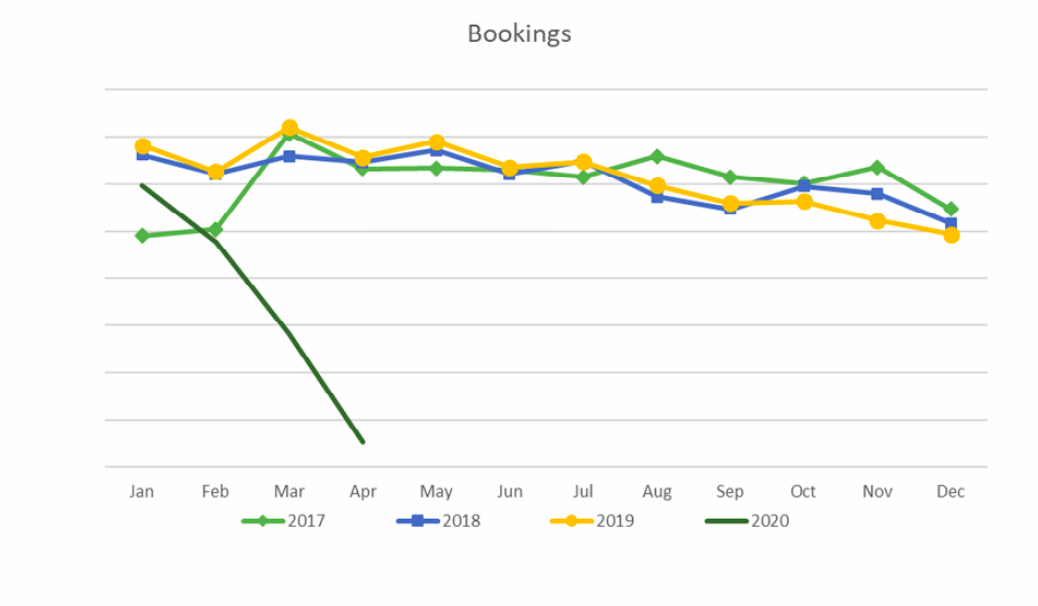
Quebec’s Superior Court has granted travel technology company FlightHub creditor protection after its revenue dropped more than 90 per cent in less than two months.
The Montreal-based company, which sells discount flights, hotel rooms and cruises, is losing money rapidly due to COVID-19 travel restrictions, which have led to trip cancellations and a drop-off in new bookings. The company has already laid off 108 employees, including almost half of its Canadian workforce, but in its application for creditor protection, it said it needs to restructure to continue operating.
Talking Point
FlightHub is the first Canadian tech company to be granted protection under the Companies’ Creditors Arrangement Act since the spread of COVID-19. The Montreal firm was facing some difficulties pre-pandemic, including a drop in revenue and an investigation by the Competition Bureau. A group of its shareholders have formed a company to transfer its debt from TD Bank.
“Despite Management’s best efforts to control and limit operating expenses, the Company recorded a $8M cumulative loss for the 3 month-period ending March 31, 2020,” reads a court filing.
FlightHub is the first Canadian tech company to be granted protection under the Companies’ Creditors Arrangement Act (CCAA)—a federal law allowing firms that owe over $5 million to restructure—since the pandemic began. Twenty firms have been given CCAA protection so far this year, ahead of the 16 firms that had received it by this time in 2019.
Bookings on FlightHub. Photo: Pre-filing report from MNP in FlightHub creditor protection case
“The restructuring process that we have started will ensure that ongoing operations will remain unaffected, and the company will continue to provide great travel options to customers well as service existing customers during the process,” said Melanie Tabet, a spokesperson for FlightHub. “We will work diligently to complete the restructuring in a timely fashion and hope to exit from this process as soon as possible.”
FlightHub sought creditor protection after its relationship soured with TD Bank, which had loaned it $42.2 million, according to court documents.
“In recent weeks, the relationship with TD became strained to a point where several meetings were held between the Obligors and TD’s financial advisors, during which it became clear that urgent action was expected … in order to avoid a potentially devastating liquidation process which could have been engaged by the secured lender,” read the filings. TD declined to comment.
TD agreed to reduce the amount FlightHub owes to $32.2 million and subsequently to transfer that debt to a numbered company, 11656503 Canada Inc., the court documents say. Another Quebec-registered firm, 11656511 Limited Partnership, which was incorporated earlier this month, is loaning $4 million to FlightHub, which will be used as collateral to secure the letters of credit issued by TD as well for ongoing financing of FlightHub’s operations.
“The management of the FlightHub Group is confident that the transaction with TD, together with the resources made available by the LP Lender and the protection afforded by the CCAA and the relief sought herein, will provide the FlightHub Group with an ability to comprehensively restructure its operations and ultimately emerge in an enhanced financial posture,” reads a court filing. Calgary-based chartered accountancy firm MNP is the court-appointed monitor for the restructuring.
11656503 Canada Inc. has four directors, all of whom are FlightHub executives, including CEO Matthew Keezer, co-founder Eric Parent, chief corporate development officer Nick Hart and vice-president of product and technology Henri Chelhot. Hart is 11656511 Canada Inc.’s sole director.
In October 2019, FlightHub announced plans to expand its Montreal headquarters and create “hundreds of new Quebec-based jobs.” The firm has a U.S. subsidiary, JustFly. The parent company has laid off 90 per cent of its U.S. workforce. It’s down to 92 employees at its head office in Montreal and two in Seattle, according to the filing. “We look forward to increasing our operational capacity and potentially bringing back employees to work as demand for travel services resumes in the future,” said Tabet, describing the reductions as a “temporary furlough.”
The company was facing regulatory difficulties prior to the pandemic. The same month, it reached a temporary agreement with Canada’s Competition Bureau to not use false or misleading advertising. The agency “is continuing its investigation and FlightHub Group must continue to comply with the temporary consent agreement,” said spokesperson Jean-Philippe Lepage. If the bureau determines the company has used deceptive marketing practices, it may bring it before the Competition Tribunal, which could impose fines or other sanctions.
The U.S. Department of Transportation and the San Francisco City Attorney are also investigating FlightHub. In its filings, FlightHub lists the Canadian and California proceedings as contingencies that “could have a significant effect on the Company’s position or results of operations.”
The company was facing financial uncertainty prior to the pandemic, the court documents reveal. Between 2017 and 2019, its net earnings decreased from $18.5 million to $10.9 million, despite bringing in as much as $250 million in annual revenue. Things got a bit worse just before the pandemic: FlightHub brought in $84 million in revenue for the five months ended Dec. 31, 2019 with a net loss of $4.2 million. Its losses fell deeper in the first quarter of 2020, with revenues of $32.2 million and a net loss of $8 million.
Other travel-technology companies are also struggling amid the pandemic. In April, Expedia Group raised US$3.2 billion in capital, including an equity investment from two private equity firms; the month prior, it withdrew its earnings guidance to shareholders for the year, citing the “growing impact from the COVID-19 outbreak and the resulting uncertainty on travel trends.” Also in April, The Logic reported that Montreal-based airline-ticket purchasing app Hopper had made “significant” layoffs.
This story has been updated with comment from FlightHub and the Competition Bureau.