Skip to content

Canada's Business and Tech Newsroom

  • Professional Subscription
  • Partnerships & Advertising
  • Licensing & Syndication
Log In Subscribe
Welcome,
  • My Account
  • Log Out
  • Business
  • Tech
  • National
  • The Big Read
  • Briefings
  • Commentary
Search
Log In Subscribe
Welcome,
  • My Account
  • Log Out
News

Why pumping more Canadian crude won’t stop oil prices from soaring

Listen Now
0:00
News

Why pumping more Canadian crude won’t stop oil prices from soaring

The price surge caused by war in the Middle East has other countries clamouring for Canadian oil. The problem is getting it to market.

By Laura Osman
An aerial photo of a petroleum sea terminal, in a landscape of mountains and coastal waterways, with residential homes in the right foreground. There are two tankers docked at the terminal.
The Trans Mountain pipeline terminal in Burnaby, B.C. Photo: The Canadian Press/Darryl Dyck
Mar 4, 2026
A A
A Small A Medium A Large
Share

Gift

Share

Listen Now
0:00

OTTAWA — Oil and gas prices surged as hostilities in the Middle East cut energy supplies to much of Asia, but Canada’s ability to meet the moment by adding crude to global markets is limited by its pipeline capacity.

The United States and Israel’s war with Iran has spilled into other Gulf nations, as Iran answered weekend bombings with strikes on U.S. allies across the Middle East. Oil and gas prices surged over US$77 a barrel on Tuesday, after Iran blockaded the Strait of Hormuz, a critical shipping route for the global oil trade that sees an average of 20 million barrels pass through per day. That’s about 20 per cent of the world’s liquid petroleum consumption, and mainly supplies China, India and other Asian countries. 

Talking Points

  • Energy-hungry Asian markets cut off from oil and gas supplies by hostilities in the Gulf can’t look to Canada for more supply without new infrastructure to get it overseas
  • Alberta’s former energy minister Sonya Savage fears Russian oil and gas could fill the void, since Canada is not in a position to help

Natural Resources Minister Tim Hodgson told CBC on Monday he’s received calls from other countries hoping Canadian energy can fill the gap left by the blockade, adding it will take time for oil and gas producers to respond.

The immediate pressure is acute, though, and for now Canada’s hands are tied, say experts in the sector. Without additional pipeline capacity, “there’s very little Canada can do in the short term to meet the growing global demand as supply is cut off in the Middle East,” said Sonya Savage, a former Alberta energy minister, who now works as an energy lawyer in Calgary. 

Canada is already operating at record production and export levels for both oil and natural gas, said Lisa Baiton, CEO of the Canadian Association of Petroleum Producers. “Achieving any meaningful new production growth will require additional pipeline capacity and new LNG export facilities, which are not available today,” she said in a statement. 

Related Articles
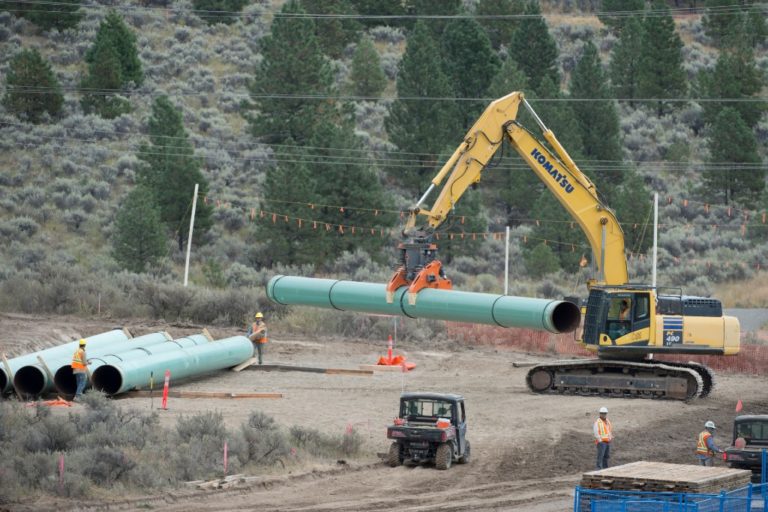
A wide shot of a pipeline construction area, with an excavator using its boom to lift a length of pipe.

Canada got serious about building oil pipelines. Then prices tumbled

By Jesse Snyder
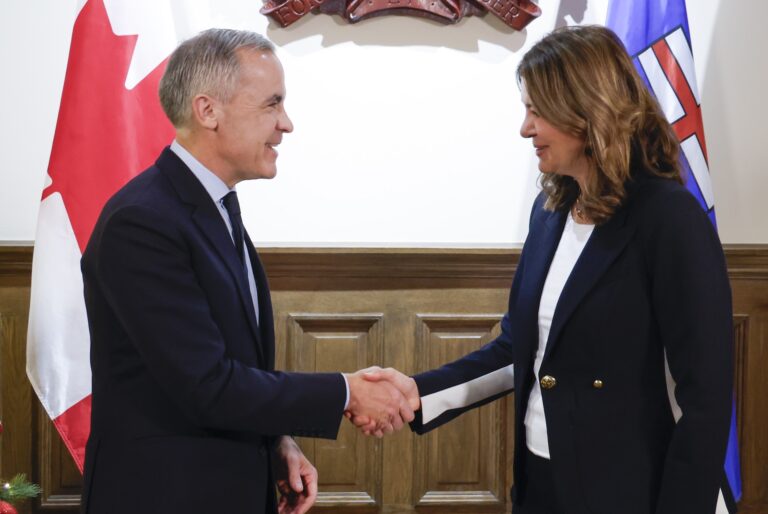
Carney and Smith shaking hands in front a wall with wooden wainscoting and the flags of Alberta and Canada.

Carney and Smith sign wide-ranging deal committing to new pipeline and carbon capture

By Laura Osman

The vast majority of Canada’s oil and gas exports go to the U.S., which is Canada’s main conduit to the rest of the global market, said James Coleman, a professor specializing in energy at the University of Minnesota.

The Trans Mountain pipeline can carry 890,000 barrels of oil per day from Alberta to the West Coast, where it can be shipped directly to Asian markets hit hardest by shortages in the Gulf. But that pipeline was at 87 per cent capacity in the last quarter, the company said. 

It would be an understatement to call the remaining surge capacity modest, said Rory Johnston, the founder of oil market research firm Commodity Context. “It’s a tiny, tiny amount,” he said, especially when compared with the amount that typically passes through the Strait of Hormuz. 

In a moderate scenario, where hostilities in the Gulf don’t cause sustained disruptions to shipping lanes and energy infrastructure, TD economist Marc Ercolao estimates the price of West Texas Intermediate crude would reach US$70 or slightly higher in the next few weeks. If the situation escalates and the strait is closed for a prolonged period, oil prices could exceed US$100 per barrel for several months, he wrote in an analyst’s note. 

That means Canada’s oil industry will benefit in the short term because of the higher prices, said Gabriel Giguère, a senior policy analyst at MEI, a Montreal-based economic think tank.

U.S. President Donald Trump tried to quell energy fears on Tuesday, saying the U.S. navy would start escorting tankers through the strait if necessary. “No matter what, the United States will ensure the FREE FLOW of ENERGY to the WORLD,” Trump said in a Truth Social post. 

For now, many countries have strategic oil reserves to tide them over. But if energy infrastructure is damaged, the impact on global markets could be much greater, said Savage, who fears countries could look to Russia to fill the gap.

In the long term, Canada would like to be a major player in Asia’s energy markets. On Monday, Prime Minister Mark Carney and India’s Prime Minister Narendra Modi issued a joint statement touting the potential for increased energy trade as Canada looks to become a major exporter of LNG and heavy crude.

Those ambitions could take a decade to fulfill, said Coleman. Carney and Alberta Premier Danielle Smith signed a memorandum of understanding in November to fast-track a new pipeline to carry a million barrels a day to the West Coast, but the project still requires Indigenous consent, environmental assessment and a private-sector proponent.

Gift the full article

“It sounds like the Canadian government is trying to do its best to resolve some of those issues, but I don’t think anybody thinks things can be done quickly,” Coleman said. 

In the meantime, the country’s oil industry may benefit from the crisis in other ways, said Johnston, as investors and politicians get a sense of the demand for a stable source of energy. 

“Canada is viewed as the world’s most secure source of energy, broadly,” said Johnston. “I think that brand Canada always benefits, in an outsized way, from acute energy insecurity globally.” 

#Donald Trump #economy #global trade #Iran #markets #National #Oil and gas

Loading...

Thanks for sharing!

You have shared 5 articles this month and reached the maximum amount of shares available.

Close
This account has reached its share limit.

If you would like to purchase a sharing license please contact The Logic support at [email protected].

Close
Want to share this article?

Upgrade to all-access now

Close
Gift the full article!

You have gifted 0 article(s) this month and have 5 remaining.

Copy link and gift
Copy Link
Email to a friend
Send Email
Gift on Social Media

Recipients will be able to read the full text of the article after submitting their email address. They will not have access to other articles or subscriber benefits.

An aerial photo of a petroleum sea terminal, in a landscape of mountains and coastal waterways, with residential homes in the right foreground. There are two tankers docked at the terminal.

Photo: The Canadian Press/Darryl Dyck

Most Popular This Week

A shot of a small rocket sitting on a launch pad attached to its launch equipment. The backdrop is open sea and a light blue sky.
News

Canada’s submarine decision just paid off for Nova Scotia’s spaceport

By David Reevely
An aerial photo of Kearny mine, a mine surrounded by dense forest, with terraced rock walls that surround a deep blue body of water.
News

Canada bets on graphite as allies scramble for critical minerals

By Anita Balakrishnan
News

Feds move to help small firms with new Buy Canadian rules

By Laura Osman and Chaimae Chouiekh
A cityscape featuring two tall buildings; the right one has a large orange "Q" logo and a Quebec flag atop. The sky is clear and blue.
Commentary: Quebec Ink

Quebec’s era of endless, cheap electricity is coming to an end

By Martin Patriquin

In-depth, agenda-setting reporting

Great journalism delivered straight to your inbox.

A view of oil extraction equipment consisting of pipes, catwalks and cylindrical tanks; there are three company representatives in the foreground wearing white hard hats and blue coveralls with yellow reflective striping.
News

Governments, oilsands giants reach deal to push ahead with carbon capture project

By Meghan Potkins

Briefing

CPP Investments backs German defence startup Helsing’s US$1.8B funding round

By Catherine McIntyre   |   Jul 13, 2026 | 3:43 PM ET

Ford and Unifor reach tentative deal

By Anita Balakrishnan   |   Jul 13, 2026 | 3:17 PM ET

General Fusion shares begin trading on Nasdaq after SPAC deal finalized

By David Reevely   |   Jul 13, 2026 | 2:11 PM ET

Best business newsletter in Canada

Get up to speed in minutes with insights and analysis on the most important stories of the day, every weekday.

Exclusive events

See the bigger picture with reporters and industry experts in subscriber-exclusive events.

Membership in The Logic Council

Membership provides access to our popular Slack channel, participation in subscriber surveys and invitations to exclusive events with our journalists and special guests.

Recent Popular Stories

Commentary: Quebec Ink

Quebec’s era of endless, cheap electricity is coming to an end

By Martin Patriquin   |   Jul 6, 2026
A cityscape featuring two tall buildings; the right one has a large orange "Q" logo and a Quebec flag atop. The sky is clear and blue.
Analysis

Canada’s ETF industry is almost a trillion-dollar business

By Chaimae Chouiekh   |   Jul 3, 2026
Despite a down year a sign board displays the TSX's upbeat close on the final day of the year, in Toronto's financial district on Monday, Dec. 31, 2018.
The Big Read

What Alberta’s corporate heavyweights really think about separation

By Meghan Potkins   |   Jul 2, 2026
A shot of a placard on a table reading "Let Alberta Decide." There is a person out of focus in the foreground wearing a cowboy hat.
News

A niche white-collar role is becoming the AI industry’s hot new job

By Anita Balakrishnan   |   Jun 30, 2026
A person in glasses and a blue top is sitting and typing on a laptop in an office. A desktop screen next to the laptop displays some blurred-out coding work.
News

Canada bets on graphite as allies scramble for critical minerals

By Anita Balakrishnan   |   Jul 7, 2026
An aerial photo of Kearny mine, a mine surrounded by dense forest, with terraced rock walls that surround a deep blue body of water.
News

Canada’s submarine decision just paid off for Nova Scotia’s spaceport

By David Reevely   |   Jul 8, 2026
A shot of a small rocket sitting on a launch pad attached to its launch equipment. The backdrop is open sea and a light blue sky.

Canada's most influential executives and policymakers are reading The Logic

  • CPP Investments
  • Sun Life Financial
  • C100
  • Amazon
  • Telus
  • Mastercard
  • bdc
  • Shopify
  • Rogers
  • RBC
  • General Motors
  • MaRS
  • Government of Canada
  • Uber
  • Loblaw Companies Limited
logic-logo

Canada's Business and Tech Newsroom

100% human-crafted journalism

Newsroom

  • News Tips
  • AI Policy
  • Editorial Disclosures
  • Story Pitches

Company

  • About Us
  • Terms of Service
  • Privacy Statement
  • Corporate Information

Contact

  • Contact Us
  • Advertise
  • FAQs
  • Work at The Logic

© 2026 The Logic Inc. All Rights Reserved.

Trusted by leaders

Error

Account creation failed.

Please email us at [email protected].

Create Account

[wppb-register form_name=”cozmo-registration-form-for-modal”]

I do have an account
Login
or

[wppb-login]

I don’t have an account