OTTAWA — The federal Liberals’ election promise to give stronger job protections to gig workers has run into two big problems: Very, very few gig workers are under federal authority, and there aren’t really good options for helping those who are.
Skip to content

 Jennifer Scott, president of Gig Workers United, in downtown Toronto in May 2022. Photo: Nick Iwanyshyn for The Logic

News
Liberals’ promises on gig work run into a problem: They don’t control much of it
Most digital-platform workers are under provincial control, limiting federal options
Labour Minister Seamus O’Regan’s problem with living up to this promise is that he doesn’t have jurisdiction over many of them. Photo from December 2022, in Ottawa. Photo: The Canadian Press/Justin Tang
OTTAWA — The federal Liberals’ election promise to give stronger job protections to gig workers has run into two big problems: Very, very few gig workers are under federal authority, and there aren’t really good options for helping those who are.
The governing party’s 2021 platform was unequivocal. A re-elected Liberal government would “strengthen rights for workers employed by digital platforms so that they are entitled to job protections under the Canada Labour Code,” the document said. The Liberals also promised to amend the Income Tax Act to ensure gig work would count toward EI and CPP, while requiring platforms to contribute to those plans like other employers.
Talking Points
- The federal Liberals were re-elected partly on a promise to make life better for gig workers who rely on digital platforms for their employment
- Labour Minister Seamus O’Regan’s problem with living up to this promise is that he doesn’t have jurisdiction over many of them
Prime Minister Justin Trudeau made this Labour Minister Seamus O’Regan’s problem in his mandate letter that December.
Last summer, O’Regan’s department came to him with some ideas, and warnings, in a memo and presentation that The Logic obtained through access-to-information legislation.
They lay out early on O’Regan’s limited power, pointing out that “very few digital-platform workers fall exclusively under federal jurisdiction.” The federal government oversees industries whose operations inherently cross provincial boundaries, such as airlines, banking, broadcasting, long-haul freight and telecommunications.
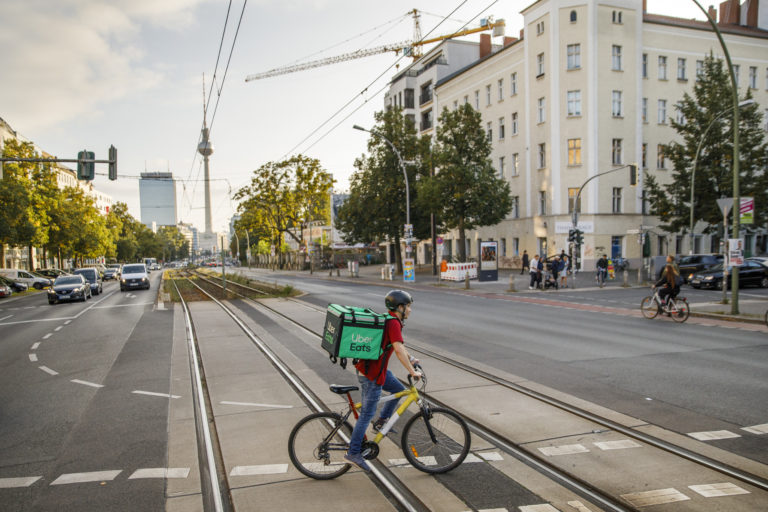
Couriers for services like Uber and SkipTheDishes are primarily regulated by the provinces.
Even using an expansive definition of the work in question, encompassing all gig workers, the federal government has authority over about 41,000 people—and 63 per cent of those are in trucking. Workers in that sector have challenges, but independent trucking has a long history, and attempts to sweep truckers into the same legal category as Lyft drivers have gone badly.
Related Articles

(Another big category of federally regulated gig worker: Freelance television and radio broadcasters, whom the CBC uses extensively.)
So what can O’Regan do for workers in the newer gig economy who work in precarious conditions with low and unpredictable pay? His department offered him two potential models, based on what other jurisdictions have done.
The first is to see that more of the few federally regulated gig workers become formal employees of the platforms on which they depend.
To continue to be treated as independents, workers would need to meet three conditions—the “ABC test,” as it’s called in labour relations—to show they aren’t dependent on one employer, that the work they do isn’t core to any given employer’s business, and that they’re plying their own regular trade or occupation. By this standard, a plumber who goes in to fix a pipe at an Uber office doesn’t become an Uber employee, for instance.
This model would bring challenges, O’Regan’s department told him. Putting the ABC test into law would spawn lawsuits over how to interpret each prong. Truckers in California, for example, oppose a law that treats them this way alongside other gig workers—increasing their rights but also limiting flexibility. The law, known as AB5, is still in the courts.
Lots of employers, and probably workers, would seek exemptions, which also happened in California. And there are “risks of negative impacts on employment and growth,” the minister was told.
Still, in consultations, labour groups liked this approach, the briefing document says.
“It’s clear that ending misclassification and implementation of something like the ABC test is really the only next step forward,” said Jennifer Scott, president of Gig Workers United, in an interview. The Toronto-based group is primarily focused on app-based delivery workers, but its interest extends to federal issues, too. App platforms don’t pay into public programs like employment insurance for independent workers, she said, and that’s not right.
Employers “strongly opposed” the ABC test, the memo to O’Regan says.
The second major option would be to create a new category of worker in the Canada Labour Code, “extending intermediate rights and protections” to digital-platform gig workers under federal jurisdiction.
This is what Ontario did, with legislation setting a minimum wage for gig workers (but only while they’re actively on a job) and requiring that platform operators explain decisions to kick a worker off. Scott’s group was unimpressed.
O’Regan’s officials told him this approach would lock platform workers into second-class status, “enshrining inequities in the labour market,” and it would do nothing for gig workers who don’t work through digital platforms—other temps, casuals and short-term contractors.
While workers and employers were divided on the first option, there was a broad consensus on this one when the government asked stakeholders about it. There was “general opposition to [the] Model 2 approach,” the memo says, warning that the approach “would complicate the system and risk ‘downgrading’ some workers’ status.”
Several pages after that were redacted in the document released to The Logic.
An annex notes that there are some options the government could use outside employment law, such as requiring digital platforms of all kinds to be transparent and fair in the terms they set for users. Governments can issue rules prohibiting Amazon from sticking outrageous clauses that hardly anybody reads into its conditions for ordering goods, for instance; to the extent that the relationships between workers and employers are mediated by apps, that kind of regulation can be useful, the document says.
O’Regan and the government are working on it, his spokesperson Hartley Witten wrote in an email, and thinking about what they heard in those consultations.
“Our priority remains protecting the rights of gig workers,” he wrote. “In the coming months, we look forward to sharing findings of these consultations that will inform our ongoing efforts to build a uniquely Canadian federal solution that meets Canada’s and Canadians’ needs.”
In the meantime, Witten wrote, the government has amended the federal labour code to strengthen protections against misclassification—employers’ treating federally regulated workers as free agents when they really aren’t—and promised $26.3 million over five years to enforce those standards.



Loading...
Thanks for sharing!
You have shared 5 articles this month and reached the maximum amount of shares available.
CloseThis account has reached its share limit.
If you would like to purchase a sharing license please contact The Logic support at [email protected].
CloseGift the full article!
You have gifted 0 article(s) this month and have 5 remaining.
Recipients will be able to read the full text of the article after submitting their email address. They will not have access to other articles or subscriber benefits.
Photo: The Canadian Press/Justin Tang
Jennifer Scott, president of Gig Workers United, in downtown Toronto in May 2022.
Most Popular This Week




In-depth, agenda-setting reporting
Great journalism delivered straight to your inbox.
Commentary
Carmichael: Canadian ignorance about India is a strategic weakness
Briefing
Aritzia shares pop after earnings rise 204%
First Nation in Alberta goes to court over fast-tracked oil pipeline
Chinese EV maker Geely Auto Group to launch in Canadian market in 2027
Best business newsletter in Canada
Get up to speed in minutes with insights and analysis on the most important stories of the day, every weekday.
Exclusive events
See the bigger picture with reporters and industry experts in subscriber-exclusive events.
Membership in The Logic Council
Membership provides access to our popular Slack channel, participation in subscriber surveys and invitations to exclusive events with our journalists and special guests.